Resources
Questions? We'd love to hear from you!
Abigail Garofalo aeg9@illinois.edu, Erin Garrett emedvecz@illinois.edu, Amy Lefringhouse heberlei@illinois.edu
Welcome to another episode of the Everyday Environment podcast where we explore the environment we see every day. I'm your host, Amy Lefringhouse.
Erin Garrett: 00:16And I'm your cohost, Erin Garrett.
Amy Lefringhouse: 00:18And today, we are here with Kelly Estes. She is the state survey coordinator. And she's gonna talk to us about how we protect our ag commodities, our natural resources, our urban environments from invasive pest threats. That's a lot of things. So welcome, Kelly. Thanks for being, on the podcast with us today.
Kelly Estes: 00:43Thanks for having me.
Amy Lefringhouse: 00:44First, Kelly, tell us, you work with the Cooperative Agricultural Pest Survey or the CAPS program? For listeners who might be unfamiliar with that, what is CAPS and how does that program help protect Illinois from these new and emerging pest threats?
Kelly Estes: 01:04It's not well known, but it's been around for so long. It's got actually a federal program through the US Department of Agriculture in their APHIS PPQ program. And I'm based here at the University of Illinois at the Illinois Natural History Survey. And historically, years and years and years years ago, the CAPS program did just what, like, the name sounded like, agricultural pest survey. And so they surveyed pests of corn and soybeans and alfalfa.
Kelly Estes: 01:35But over time, things changed. And with the increase of global trade and the movement of pests around the world and USDA really honing in on the that movement of new pests, it kinda reshaped its its purpose. And so the CAPS program is a program that's found in every single state, as well as Puerto Rico, The Virgin Islands too. And each state has its own program and focuses specifically on invasive species threats to the commodities within that state, that state's natural resources, things that really pertain to what's going on at that local level. So each state operates independently, but we operate together as a whole across the US.
Amy Lefringhouse: 02:26So are you guys looking at lots of different invasive species or are you guys just kind of focusing in on pests?
Kelly Estes: 02:33It focuses on insects, invasive plants, pest pathogens, sometimes mollusks like snails and things like that. It really depends on the state and what they deem is most at risk or things like that that help them determine that. So for example, we within Illinois have a state CAPS committee. And myself, I have federal counterparts from USDA APHIS PPQ, Illinois Department of Ag, Illinois Department of Natural Resources, experts on campus here, we sit down every year and we look at the guidelines that USDA provides us. And within those guidelines each year, they also give us lots and lots of information.
Kelly Estes: 03:18There is scientists within USDA that are looking at what's going on all around the world and they're gathering information and pest profiles and looking at maps of host plants and how things maybe are moving through the world. And so we have this list of different pests that they deem are at high risk to be introduced into the US. And then we can look at each one of those and maybe break it down a little bit further at this is their risk of introduction to Illinois. And here is a map of potential host plants. So if there's some type of caterpillar or pathogen that affects corn or, you know, maybe something that feeds on trees, and we can look is that tree species present in Illinois.
Kelly Estes: 04:09And so we just really start looking at all this information, and then we pull it all together, also take into account, you know, corn and soybeans are a huge part of Illinois commodities, but we also have a lot of specialty crops. We also have lots and lots of natural areas in state parks, not to mention, you know, lots of trees in natural areas within urban communities as well. So we kinda put together all the puzzle pieces and lay everything out in surveys for each year. I personally am an entomologist and a lot of things on our list are insects, and so I tend to to gravitate towards some of that kind of stuff, but this is also why we have this cooperative effort. We have specialists around the state that can assist with different types of surveys.
Kelly Estes: 04:59So even if I don't know much about an invasive plant, or I can do a survey for a pathogen, but then I do the collecting or the survey, and then I send the information off to a diagnostician or a plant pathologist or things like that. So lots of different things are surveyed for, but depends on the location and what's going on that year.
Amy Lefringhouse: 05:20Sure. Now Chris we talked to Chris Evans earlier in the season. He talked about invasive regulations, and he he also may mentioned APHIS. You said APHIS PPQ. Can you just tell us what that is just very briefly?
Kelly Estes: 05:33Yeah. APHIS PPQ is within the USDA structure and they will oversee different pest regulations. I work with several PPQ officers. They have a couple different offices around the state, Des Plaines and Peoria, one here in Champaign, just down the street from me. And so they may be doing inspections of labs for different researchers.
Kelly Estes: 06:02They do inspections when maybe things get shipped. They also do some of their own survey work, federal surveys for things like spongy moth. My counterpart in Chicago also maybe were looking at things within cut flower survey. So they have different funding that they're doing surveys, I'm doing surveys, but they're also doing regulatory work, making sure things are running smoothly or moving smoothly between between states and things like that. Regulations, it gets kind of confusing and tricky because Department of Ag also oversees things. So you have nursery inspectors, and then you think about O'Hare, and you have inspectors that are inspecting cargo and luggage and all sorts of stuff. So a lot of those are our first lines of defense against invasive species, and so the CAPS program ends up maybe being a second line. We are out there surveying for things that hopefully don't get by that first level of defense, but certainly may.
Erin Garrett: 07:05So that leads into our next question. Can you talk a little bit about what a typical CAPS survey season looks like? Kind of walking us through how your team monitors for different pests and what that looks like.
Kelly Estes: 07:18I laughed to myself a little on the inside, a typical survey season because one of my most favorite things about this job is that nothing is ever the same. There's always new pests, new issues that are coming down down to us, and and, yes, they're invasive, but insects are cool and they're just interesting to learn about. Our typical survey season starts probably the planning for the next season actually starts in August where we write up our surveys and send them to USDA and making the tweaks and things like that. And so as we move through winter, we are gearing up that survey. We're ordering supplies.
Kelly Estes: 07:59We're looking at maps. I'm Google earthing things, looking to see, you know, where things are at. So as we roll into probably spring is when things really start getting busy. And we'll use this past year as an example. We had a corn and soybean survey, and then we are also doing what we call a high risk pathway survey.
Kelly Estes: 08:22And that's usually how CAPS surveys work. We they may be commodity focused or pathway focused. And when we say pathway, invasives move lots and lots of different ways, and quite a bit of the time, they move by us. We are the reason invasives are spreading. We group our targets together, maybe based on a certain pathway.
Kelly Estes: 08:43And so the pathways we were looking at this year looked at rail, trucking, movement of industrial type things. We spent a lot of time in the winter looking at places where trains move through, trucks move through, maybe where trains stop. And in accordance to that, we look at, okay, so there's a rail yard here or this is an intermodal area, but right next to this is a natural area or a place where there's trees where there's host plants where they might be. All those things start coming together when we have targeted areas. And so back in August, we decided we're gonna do x number of locations, x number of targets that we're looking at, and then we start putting those out.
Kelly Estes: 09:32Our pathway survey looked at spotted lanternfly, and then it had what was previously known as like an Asian defoliator complex, and that is tied to spongy moth. We have spongy moth that is present here in Illinois up in the northeast, but there's other species within this complex that are similar appearance, similar in host plants, or the amount of destruction, I guess, they may cause should they be brought here. And there are things that can easily be brought from overseas on cargo containers, ships, rail, all that kinda stuff. And then we would also, in that survey, do a visual survey for tree of heaven and spotted lanternfly. Because there really wasn't a trap for spotted lanternflies, so we wanted areas where we could go and visually look every other week.
Kelly Estes: 10:25Which brings up my next point is that our surveys, we go to every location every other week from May through September or October. And we cover the entire state, north to south, east to west. Granted, that's not always feasible. So we do. We maybe we're targeting the northeast down through Champaign.
Kelly Estes: 10:47And so we had thirty thirty five locations in the pathway survey, and then we had 35 locations in corn and soybeans. So we visited, and I'm gonna use the universal we. My team really did work for me this summer. Mhmm. I would see college interns, and they were fantastic.
Kelly Estes: 11:06We log thousands upon thousands of miles. And each week, we go back, we look at the insect traps, we collect everything that's in them, put them back out for the next week or the next two weeks, come back to the lab. And so you do a little bit of lab work, sorting, identifying insects through September, October. October, November, we're still sorting insects and counting because most of the interns leave in August to go back to school. And then wrapping up data reports, and then everything from the CAPS surveys go into what's called the NAPIS Pest Tracker.
Kelly Estes: 11:42There's a a public facing side that lets you look up insects, and there's a map that will let you see where surveys are and where things may or may not have been found for around the US. And intermixed into all that is our our general outreach, doing podcasts, write ups, things like that. So it's busy. And so it used to be, hey, December, January, that's gonna be your downtime. Get it right.
Kelly Estes: 12:10It's not really like that anymore.
Amy Lefringhouse: 12:13I work at the University of Illinois or Ag Research and Demonstration Center, and I know that what's that? In Perry?
Kelly Estes: 12:21We used to go there every other week too. We didn't this year.
Amy Lefringhouse: 12:25I do know that he has traps and things out there that he is checking, you know, on a regular basis, the farm manager out there. So I didn't know if he was related to the CAPS program or if that's something different.
Kelly Estes: 12:37No. So he is doing that for me. Okay. That is not tied to funding through CAPS, but it is tied through funding for another project I do, and I work with Nick Seiter in crop sciences. And we do a lot of the, we'll call it like endemic agricultural pest surveys.
Kelly Estes: 12:54So in the middle of summer, I also do the statewide corn and soybean survey. We do go to every corner of the state. We survey about 40 counties, like, four to five out of each crop reporting district, and then five stops within each of those counties. And then we do sweeps and soybeans, visual surveys in corn, and they collect and bring them back. And we do that over a two week span in July, and that's one of the longer standing pest surveys really in the state of Illinois.
Kelly Estes: 13:22So it's been very cool. You can see pest populations over time, like corn rootworms and Japanese beetles, and there's, like, 10 or 12 insects that we survey for. And also tied to that is trapping. So we trap in the spring for black cutworm and armyworm, and then in the summer we would trap for earworm, corn borer, sometimes fall armyworm. And so the purpose of that was to give farmers and producers an idea of insect pests and timing for the state for management purposes as well. Lots of different things going on in my lab.
Amy Lefringhouse: 14:01That's amazing. I'm always amazed at, you know, what are what things are going on in the background, you know, of our lives that are providing information to, you know, farmers and landowners and just us as general, you know, citizens. There's just all these people doing these, like, background work that is gathering that data and that information to be used, you know, in real everyday lives.
Kelly Estes: 14:26For me, it's one of the reasons I got into this position I'm in now is that I didn't grow up wanting to be an entomologist. I always saw an Extension. My dad was in Extension. Knew lots of Extension people. I loved it. And know, I started out in Extension in crop sciences. And part of my role as an IPM specialist was working with growers, and we did a lot of insect trapping and taking data and information and then putting it out in different ways. And so when this position became available, it was actually pretty perfect because it took a lot of the things that I really like to do and focus just on that.
Erin Garrett: 15:03I have a question. You're talking about insect trapping, and I'm trying to wrap my head around the amount of data that you have to go through. How many insects do you find in a trap at a time? I know there's probably a huge range, but, like, are we talking hundreds or, like, a small little handful?
Kelly Estes: 15:21So both. Okay. So one of the cool things about I'm gonna refer use CAPS as the example is, so I mentioned we get all this information, and we get this information from CPHST, USDA, all the government agencies love to use acronyms. And so CPHST is Center of Plant Health Science and Technology, and that's where the scientists and researchers are coming from. Before we are ever we use insects because we're talking trapping, is put on that list, more than likely, there's an approved survey method.
Kelly Estes: 15:54Because they're not just gonna let us go all willy nilly out there. And so insects can be attracted to color, they can be attracted to shape, and a pheromone. And pheromones can either be like a mating sex type pheromone, it can be a floral scent, it can be some type of scent that's been researched and figured out. So the insects we survey for have a specific trap and a specific pheromone that we have to use. Some of them are amazing, and the insect is either there or it's not.
Kelly Estes: 16:27So we'll go check a trap and you're like, yep, nothing there and you feel awesome. Like, you know, you been there, you've tapped this out, and we're not finding it. Because honestly, the goal of everything I do is to not find it. Yeah. We do not want data.
Kelly Estes: 16:42The only job where negative data is a great thing, but there are others that that's not the case. And one of them is the one we is one we trap for. It's called old world bollworm. And old world bollworm, and to put it in very lame in terms, is kinda like a cousin to corn earworm. So corn earworm is present in the US.
Kelly Estes: 17:04It's widely found across Illinois, and its scientific name is Helicoverpa zea. Helicoverpa armigera is old world bollworm. It looks like corn earworm. It's identical, has a lot of the same host plants, but more. So we do survey for old world bollworm.
Kelly Estes: 17:23It had been intercepted in Florida. It's widespread in South America where it's a huge pest. It is resistance to different pesticides down there. Well, we've also found it intercepted at O'Hare. And so it it's a huge pest in our list, you know, we've had different vines around O'Hare, but we've not found it within our corn cropping systems, which is what we want.
Kelly Estes: 17:51Up until recently, and I've been surveying for this past seven, eight years now, I'd have to look to be sure, but the only way you could differentiate between it corn earworm is you'd have to take the abdomens off the moths, and you would have to boil it in potassium hydroxide, then you'd put it in ethanol, then you'd have to dissect it and look at the genitalia. And the pheromone for old world bollworm is not specific. We would literally get hundreds of what has turned out to be corn earworm in this trap. Mhmm. Luckily, technology is awesome, and I now can send the all those specimens off to USDA lab, and they use genetic analysis.
Kelly Estes: 18:30They can process all thousand of my samples that I sent for the month within a day, whereas I would spend all winter with microscopes. So it's amazing how we can detect these things now. It's it just it blows my mind.
Erin Garrett: 18:45Mhmm. That's crazy.
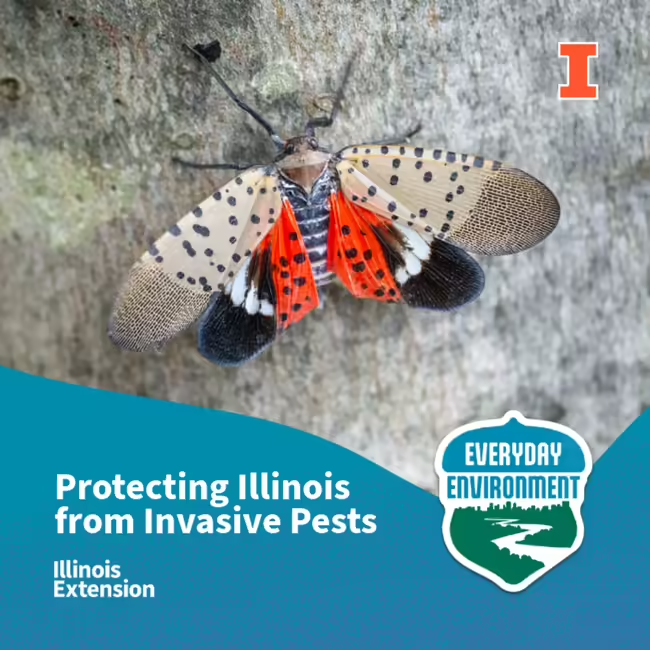
Amy Lefringhouse: 18:47Well, you mentioned spotted lanternfly. So Illinois has been hearing a lot about spotted lanternfly recently. How does spotted lanternfly illustrate the kinds of invasive pest threats that can impact ag, natural resources, and our urban environments?
Kelly Estes: 19:07I used to say emerald ash borer was our our poster child. It was very easy, very recognizable. People understood what I was working on. People still think I worked on that. But now I can I can move that forward to spotted lanternfly because it it does act kinda like a poster child for invasive species?
Kelly Estes: 19:24It's readily recognizable once you see it, but it has all the characteristics of a great invasive, and that that is not the way to word it. But we say great invasive, but it feeds on over 70 different types of plants. I've read a 100 in in a couple publications. It has the ability to spread on its own, very small distances, but it's very easily moved by people. And when I say it's easily moved by people, all life stages are actually moved very easily by people.
Kelly Estes: 19:59It lays its egg masses on anything and everything, so that's the first way it can move. You can move nymphs, though not as easily if plants are moved, but adults have such an amazing way of sneaking into things and moving in cars, on trains, in trucks. Then we we get lots of different reports now. A FedEx driver reported he had spotted lanternfly in the back of his truck. We had a report from an employee at an Ace Hardware store where they had stock tanks that had come, and they had wedged themselves in between stacks of stock tanks that were sitting on the lot.
Kelly Estes: 20:40Now they were dead, which is great, but it goes to illustrate that they really can inadvertently move very, very easily. It does feed on lots of different types of plants, and I think that has potential to be an issue for, say, like our grape growers, as it feeds on grape or specialty crops. But it also feeds on ornamentals and hardwoods. But with that, it's also a leaf hopper, so it also has a characteristic that makes it just a nuisance pest to everyday people, much like aphids, which a lot of people are familiar with. As it feeds, it also excretes a sugary substance, and, you know, that honeydew just covers things.
Kelly Estes: 21:21And this has been a pest out east for many, many years, and the populations are so high that, you know, you have this honeydew that just coats benches, play structures, sidewalks, under stories of wooded areas. So it has the potential to affect people in many different ways.
Erin Garrett: 21:41So beyond spotted lanternfly, what other invasive insects or diseases are top concerns for Illinois right now?
Kelly Estes: 21:49You know, I get asked this question a lot and it's actually kinda hard to explain because a lot of the stuff we survey for are not easily recognizable by people. So spotted lanternfly and old world bollworm continue to top our pest list of most unwanted. Asian longhorned beetle is still on our list. We may not have an active survey for it for me, personally, with the the surveys I'm doing, but it's an invasive that was present in Illinois. We were able to eradicate it, but there are still Asian longhorned beetle populations around the US, and it's another pest that can easily be moved.
Kelly Estes: 22:26And it also can be so devastating if found here. So it still it stays in the back of our mind and still keeping an eye on things like that. But, you know, the things that are on our list for next year, again, that spongy moth complex remains on there. I'm also trying to think, we haven't completed our twenty twenty six most unwanted list of upcoming year yet, but laurel wilt stays on it. So and that's also kinda hard, to explain because a lot of the stuff that I survey for has some federal implications, but there's still a lot of invasives that are out that may be found in other states that we as a state are concerned about, but I maybe there's not federal funding to survey for it or it's not necessarily on my or my list of focus, but there are other groups that are.
Kelly Estes: 23:19And through our cooperative efforts, we still wanna get information out about things like that. And so think about things like, like I mentioned, laurel wilt, salt cedar. I'm trying to think of some pathogens. Boxwood blight kinda isn't in the background somewhat that, you know, we we try to play pay attention to. Elm zigzag sawfly is something that that was recently found in Illinois and we're just trying to learn a little bit more about that and figure out what is the impact of that particular insect year to year. So those are just a couple that come to the top of my mind right now.
Amy Lefringhouse: 23:57So we talked about pathways. You already really talked a little bit about this, but those pathways are those like, are those the ways that invasive pests typically arrive in our state?
Kelly Estes: 24:09They're one of many ways, and probably most do arrive that way. And you think about, especially, like, worldwide and you think, well, how do these insects from Asia get here? Well, we are a very very global society and there's movement of goods so frequently and the volume is just mind blowing actually. And you think I think the what was it? 95% of our wood boring invasives are connected to things like pallets or crates and things like that.
Kelly Estes: 24:45And a lot of that is moving through shipping containers or or truck or rail or things like that. You think about nursery trade, while it is is regulated and there's inspections and and things like that. Some of these insect eggs are tiny. They're microscopic, and you you don't always see them. Or maybe, you know, something has been inspected and cleared, and that's because the pathogen is still maybe the symptoms aren't visible when they ship it, and then it arrives at the net you know, the the big box store, and then, you know, symptoms start to appear. So there's so many different ways invasives can move undetected.
Erin Garrett: 25:26So unfortunately, there's a lot of different ways invasives can get here, can spread around. But on the positive side of things, public help is really important for detecting pests, spotted lanternfly. Right? I know when that first started coming there was a huge movement of people. We were ready. Right? That early detection rapid response. We had the materials ready to go. It had been found in Cook County and we were like, let's do it everyone. Pay attention. Look for it. Send us your sightings if you see it. So what role can Illinois residents play in spotting, reporting these pests, and what types of information is most important to send if someone makes a report?
Kelly Estes: 26:12Those are all really good observations. And it is one of my also one of my favorite things about my role here. And is that the number of people that I get to work with and interact with, boy, doing a little math on the spot is hard, but I've been in this job since 2006. Okay. So almost twenty years of surveys. And we discussed, you know, 30 or you know, 70 locations a year, multiple visits a year. I want you to guess how many invasives that I have found on my traps.
Amy Lefringhouse: 26:4720? A 120?
Kelly Estes: 26:49Wow. One. I've had one positive find and it was What? Emerald ash borer in Bloomington, Illinois on my traps, but we have still had so many reports of invasives. So your illustration is that public interaction, public response is so, so huge.
Amy Lefringhouse: 27:10Mhmm.
Kelly Estes: 27:10And getting to spend the time to to educate, interact, and just share with people about invasives. I and it can be a huge bummer listening to this because of, wow. They're they're impactful. Yes. But the great thing is a lot of times we can if we find them early, they there's hope for eradication, or the more we know about them, the better we can manage them and things like that.
Kelly Estes: 27:38So interacting in your your listeners, sharing information, recording things that just look off. And I think that is a lot of what we deal with. And yes, we're gonna share information about this is what the insect looks like, and if you see one, please take a picture and report it to us. Always gonna be our number one message, you know. And then you share as much information about what you saw as you can, where you were at, how many were there, the date, things like that.
Kelly Estes: 28:12And a picture is always helpful because we need to be able to positively identify it. But ultimately, sometimes it comes down to somebody's like, you know what? I've had these trees that I've been doing poorly and I've I've talked to an arborist, they don't know what's going on or I've sent a sample, you know, to, the plant clinic or things like that And maybe that's the first thing that really gets the ball rolling on something that we may not necessarily see. And so seeing something out of the norm and sharing that with someone and you know, Extension has become such a huge part of that because there's there's one of me and so many Extension professionals out there that are local to an area that are more than happy to to work with somebody and and go over, you know, what's going on in their area.
Erin Garrett: 29:11Yeah. It's always interesting to me when we have a new pest arrive and we're able to put together, like, the map of which counties it's been found in. Right? And I'm thinking of, like, jumping worms as when that happened more recently, and all the reports that people sent in, and then we were able to say it's found in all of these counties. And so now that we know it's found, you don't really need to tell us anymore because we're aware, it's great, thank you, but like we've got it marked off the list.
Erin Garrett: 29:38But if you're in these other counties where we haven't found it, like pay attention, and if you find it, report it. And it's always really cool to me to see how many people are able to respond to that and, like, participate and help provide that data. Right? Like, you think, what can I really do to contribute to science? And sometimes it's just like, I know I was digging in my garden and I found what I thought was a jumping worm and I took a video and sent it to to Chris. And I was like, does this look like a jumping worm? Because I think it is. And he's like, yep, you got it.
Erin Garrett: 30:10But we already know that it's there, but thanks for sending it. And I'm like, okay. Well, but still, right, you see that thing out of the ordinary. So definitely does show the importance of that that impact for at least figuring out where these pests are and then helping formulate, like, what the response is gonna be to to managing them.
Kelly Estes: 30:29It is. Citizen science is so huge right now, and we're sharing information in so many different ways that our network has just increased exponentially, honestly. And then it's just a matter of filtering that those reports back and so that they all come together, and so we can make those maps or be able to get the information out and say, you know, these counties in northwest Illinois or these counties in southern Illinois should be on the lookout or or things like that. It's so impressive, honestly, on what people know and are willing to share, and what we can learn from it.
Erin Garrett: 31:10For sure.
Amy Lefringhouse: 31:11Yeah. Continuing down this same path, how can people stay informed, or maybe even engaged with CAPS, or, you know, find out more information, or what where the, you know, most wanted species list is, or, you know, things like that. How can residents stay up to date on on this information, Kelly?
Kelly Estes: 31:34So we try to provide this information in lots of different ways because everybody prefers their information in a different way right now. So we do have a website, the Illinois Pest Survey website, which I'm sure we can can share here with the podcast and that will give you a direct link. We try to, share via social media because a lot of people like to go that route either through X or Twitter, whatever you wanna call it, and Facebook, and that's at IL Pest Survey, and we try to push stuff out through that. And then, of course, through different Extension outreach type materials, whether it be newsletters or podcasts or things like that as well. So those are the main ones.
Erin Garrett: 32:15I love it. I just went to your Facebook page and I'm like, oh, I am following them. Okay. Just making sure I'm in the know.
Amy Lefringhouse: 32:21The state water survey has their, like, weather monitoring network, and they have a, you know, a social media outlet part. But they kind of, you know, insect pests and weather kind of go together, so sometimes they post, like, the degree days and when people can see, you know, certain pests emerging and things like that. And I don't know if I'm assuming that you two work together with that.
Kelly Estes: 32:49I'm tied to that too.
Amy Lefringhouse: 32:50Yeah. I'm sure you two work together or your agencies work together, but I always find that interesting, that kind of connection between, know, pests and weather and. Well, I think on that note, we'll we'll wrap things up, Kelly. We really appreciate you being here with us today and helping us learn about the CAPS program specifically and just like what, you know, you guys in that organization and around the state are looking for as far and how you're looking for the pests that are in our state. We really appreciate again, we appreciate you being here and sharing that with us.
Kelly Estes: 33:27Oh, it was my pleasure. It's always fun for me to talk about what I do.
Amy Lefringhouse: 33:31Thanks so much again, Kelly. We are gonna finish today's episode with an everyday observation. So this is where we highlight just something normal, maybe even mundane in our environment that is actually really interesting when you look into it. So we're gonna round table it here like we do every episode. So Erin, if you would kick us off and let us know what your everyday observation is.
Erin Garrett: 34:00Sure. So I'm gonna do a reflection on the last year. I have been growing that that was a really big intro, a reflection on the past year when it comes to my pollinator garden. So I have been growing swamp milkweed in my garden for, I don't know what, four or five years at this point at two different houses and I had never seen a monarch caterpillar on it. And this year, I found one and then I found another and another and another and it was like an explosion.
Erin Garrett: 34:32Like, they found me, they found the milkweed, finally. I was really excited about it. There were so many of them, and I found multiple chrysalises, if that's how you say the plural. And it was really interesting because I had some that were failed, which was really sad. They just never turned or emerged, and then I found some that did emerge.
Erin Garrett: 34:53And so it was just really exciting to kind of follow the whole life cycle because then, of course, I had the adult monarchs come back, and it was really interesting. But an observation that I made is in previous years I had so many seed pods. It was insane. And this year with all the caterpillars, I don't think I got a single seed pod on my swamp milkweed. So I don't know if there was the feeding was just so heavy, it didn't have the energy to put into the seed pods.
Erin Garrett: 35:24I was trying to research it before I got on and I couldn't find anything reputable that talked about that. But it was just really interesting, whereas, like, last year I collected so many seeds, but didn't have any of the caterpillars. This year, it's the opposite of that. So I'm kind of interested to see moving into the future what I observe going forward, but it was just kinda cool to, one, finally get the caterpillars in my yard, and then, two, just kinda see the changes in in the pollinator gardens over the years. So that was my that was my season wrap up of my monarchs and milkweed in my garden.
Amy Lefringhouse: 36:00That's awesome that just kind of like being year to year, season to season, how those changes can can be and just you have that same spot in your garden that you can go back and kind of just make those notes every year. So that's that's pretty neat. Kelly, what do you have for your everyday observation?
Kelly Estes: 36:19I was like, what should I share? I don't know. And when you said mundane, I'm like, oh, man. Because mine was like, wow. Like, mine's the Northern Lights. Like
Amy Lefringhouse: 36:30Oh, yeah.
Kelly Estes: 36:31I've been around a long time and I've never seen them in, you know, I live south of Champaign and I've been able to view them from my yard three separate times this year and it was amazing to me. Like my mind is completely blown. Science is so cool. The last time here, it was so vibrant.
Kelly Estes: 37:00So everything to me and for me, like for, you know, just the everyday observation is being able to view with my kids Mhmm. Who had never seen it before and my mind thinks, well, they're almost 13 and 15, and they're getting to see this now. And how many more times are they gonna be able to see this kind of cool stuff throughout the years? And I just, I'm just always amazed at at the things that we see.
Amy Lefringhouse: 37:28You're right. That that is amazing. And I just, I remember talking about it when I was a little kid. We went fishing really early in the morning, and somebody was telling us, oh, if we get up early, we might be able to see it. And I don't even remember if we saw it because it was like, oh, let's look. And I'm like, well, am I seeing it? I don't know. So this these times around lately, yeah, it has been amazing.
Kelly Estes: 37:54Yeah. I'm just blown away. I can also add to the swamp milkweed. Like, I have we've had, like, this one corner of our yard, some volunteer swamp milkweed. Also, had a monarch on there. Mhmm. And we had two this summer. Yay. And I'm gonna be honest, my first thought was, oh my god, I am gonna keep them because I love to rear them and some of our greatest memories are rearing some monarchs in our house with my kids when they were younger. Because if you have the chance to see them actually go through the process, also mind blowing.
Kelly Estes: 38:29And so I thought to myself, I should snag these and we can, you know, do that. And I didn't. I'm like, nope. I'm gonna be an adult about this, and I'm gonna let them be in. They were gone. They got snatched right up by a bird. So so sad. But I'm so glad that that you were able to get some.
Erin Garrett: 38:47This was the year for them. I tell you, I found one on my mom's swamp milkweed at home, and I found we have some at one of our a little pollinator garden. We have at the food donation garden, and that was really cool because we found the chrysalis on the swamp milkweed and you usually don't find them but I think it was kind of they didn't really have any other place to go it was like in a raised bed but we found like the emerged chrysalis ones where they were still developing and the caterpillars, like all together. It was it was the year for it on the swamp milkweed. I don't know, but it was crazy. I could talk about it forever, but I'm gonna stop so that Amy can share her everyday observations.
Amy Lefringhouse: 39:29That's so funny. Well, I'm gonna go a different route. I too found a caterpillar on my swamp milkweed, so yes, I will agree. But I had this is just a very basic observation, but I was out in a wooded area and there were really old ash trees there and you don't see that very often anymore because, like, we had talked about the emerald ash borer earlier, but you just don't see, you know, mature, older ash. And we were just really looking at the bark of an older ash gets really kind of like squares, little bitty squares, just like checker, you know, like a checkerboard kind of pattern. And at first, we were all like, what? Is this a persimmon? That's a big persimmon. You know, we were kind of going through all of our check mental check boxes of like what trees have kind of this like checkerboard. And finally, were like, this is an ash, an older ash that gets that checkerboard bark. So it was just kind of a neat, I guess, observation to see well, one to see an older ash tree, but then also to kind of see how the bark had changed, you know, as it aged. So so yeah, that's my kind of, you know, just regular old everyday observation.
Erin Garrett: 40:51I love it, Amy. You reminded me of another tree bark observation that I'm gonna save for future podcast episode so. Thank you.
Amy Lefringhouse: 41:02So stay tuned.
Erin Garrett: 41:03Stay tuned.
Amy Lefringhouse: 41:04Breaking observation. This has been another episode on the Everyday Environment podcast. Check us out next week where we talk with Theresa Culley. She will be talking to us about invasive plant genetics.
Kelly Estes: 41:23This podcast is University of Illinois Extension production, hosted and edited by Abigail Garofalo, Erin Garrett, and Amy Lefringhouse. Marketing and communications are by Emily Steele.
Matt Wiley: 41:35University of Illinois Extension.