Learn More
- Invasive insects
- Spotted Lanternfly reporting via email: lanterfly@illinois.edu
- Elm zigzag sawfly
Questions? We'd love to hear from you!
Abigail Garofalo aeg9@illinois.edu, Erin Garrett emedvecz@illinois.edu, Amy Lefringhouse heberlei@illinois.edu
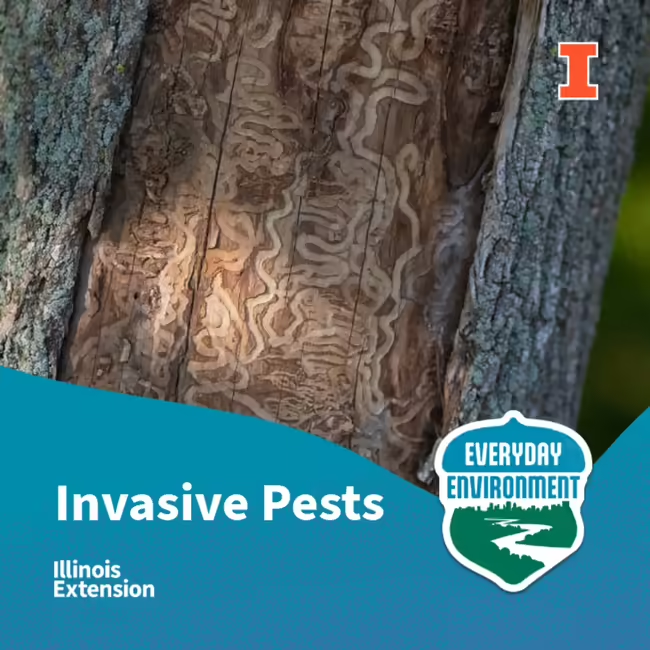
Welcome to another episode of the Everyday Environment Podcast where we explore the environment we see every day. I'm your host Erin Garrett.
Amy Lefringhouse: 00:14And I'm your co host Amy Lefringhouse.
Erin Garrett: 00:17So we're really happy to be joined today by Tricia Bethke. Tricia is the forest pest outreach coordinator at the Morton Arboretum. Welcome Tricia.
Tricia Bethke: 00:27Thank you very much, Amy and Erin. I'm delighted to be with you, both of you, and welcome back after maternity leave. It's exciting news.
Erin Garrett: 00:34Yeah. Thank you so much. Tricia, it's great to have you on the podcast. You have been on Everyday Environment before and our webinar series a time or two, I believe. And it's just great to have you on in a different format.
Erin Garrett: 00:48But for those who maybe haven't heard your webinar before or don't know who you are, can you share a little bit about the work that you do?
Tricia Bethke: 00:57Sure, Erin. I'm happy to. My position is funded through the US Department of Agriculture through their Plant Protection Act, so the PPA funding that comes through every year. And in Illinois, we've been really lucky. We've had ten years of solid forest health funding, and that is incredible.
Tricia Bethke: 01:17We're grateful for our partners. The Morton Arboretum is my cooperator. I've been at the Morton Arboretum for seventeen and a half years, and time has just blown by. Yeah. It is home to me, honestly.
Tricia Bethke: 01:29I'm grateful for all the training and the experience and the support that they've provided me for this position. And this position is is not only something that I do, but I also feel that it is a collaborative project or a collaborative position. Right? It's not a project, but it's a position we have so many wonderful partners like Extension, Partners Agriculture, the City of Chicago, the Shawnee, you name it, Illinois Forestry development Council, Department of Natural Resources. We have many, many, many collaborative partners, and we have a great crew of, like, volunteers all throughout NGOs, nongovernment offices throughout the state.
Tricia Bethke: 02:09So it's it's a it's a really cool program, and I'm honored to to be that person that gets to travel around and meet people and talk about how to how to plant and care for trees specifically. I love plants too. I'm a master gardener. Thank you very much. Love it.
Tricia Bethke: 02:25Yay. Yay master gardeners. If I had more time, I'd be a master naturalist too. But maybe maybe that's coming up now in the next year or two. So we'll see.
Amy Lefringhouse: 02:35I bet you are a master naturalist in your own right. Right?
Tricia Bethke: 02:40Yes. I've always loved trees. I I I grew up climbing trees, and although I can no longer climb a tree, I still am in an awe of them and want really desperately to to empower people and to give people hope and tools in order to protect our trees.
Amy Lefringhouse: 02:57Quick question, Tricia. Are you specifically focused on Illinois, or do you cover outside the boundary of Illinois?
Tricia Bethke: 03:05Yes. Specifically, the the funding is for Illinois. So anything that is federally regulated, so I would provide education and outreach on emerald ash borer, Asian longhorn beetles, spotted lanternfly, although it's not regulated in Illinois. We have spongy moth as well. You know, I cover jumping worms, but jumping worms is not regulated.
Tricia Bethke: 03:26So for the most part, I cover all of the regulated species, and then I really cover species of concern within Illinois, but my partnerships actually are in the Midwest and and, you know, a little bit little bit larger, maybe the East Coast, not so much the West Coast.
Amy Lefringhouse: 03:44Well, we're really happy again. I know Erin's already said this, but we're really happy that you took time out of your schedule to be with us and to share this information that you have with our audience. To start off, can you tell us what exactly is an invasive species and how is it different from an insect that's simply non native?
Tricia Bethke: 04:07That's a really good question, and I've been thinking about that a lot certainly as we have conversations about, you know, how do we classify something as invasive. So invasive from a federal level means something that can cause harm, whether it's human health, whether it's economic, agricultural impact, something that really causes harm. Oftentimes when we refer to invasive, we have this like invasive species. And and you may not like it, so you call it invasive, but to be honest with you, the technical term really is those plants, those trees, those pathogens that cause harm. I think sometimes there are situations where we might have a native bug like our picnic bug, right?
Tricia Bethke: 04:49Who doesn't love a picnic bug except when you're having one that has a pathogen on it, and that that bug can go to an oak tree and it can carry that pathogen. Or, you know, with walnut twig beetle, thousand cankers disease, that's another one that we're always on the on the lookout for. We have the pest. We don't have the pathogen and the pest. So it's hard to sometimes tease things out.
Tricia Bethke: 05:13But for this conversation and for today, I think that we need to think about those pests that potentially could cause economic or human health or social harm.
Erin Garrett: 05:24I know sometimes it's hard to separate out that harm like you said and you know there are so many different non native plants that we have just say focused in Illinois or non native pests or pathogens but that doesn't mean that they cause that large scale harm like you said. Right? And so making that distinction is important so that we like focus our efforts, right, in the invasive world onto those that are causing the most harm or have the biggest impacts, right, versus just like managing every nuisance plant, animal, insect, right, that that comes about. So kind of on that train of thought, why do you think some introduced species become invasive while others remain harmless or kind of barely noticeable?
Tricia Bethke: 06:13Sure. I think one of the most interesting backgrounds, if you will, on spotted lanternfly is spotted lanternfly is a nuisance. Right? It is invasive, and its invasive tendencies mean that she the females have an inordinate amount ability to lay egg masses within thirty minutes, and that clutch could have 200 eggs. So if you have a pair and you've got one egg mass, that's 200.
Tricia Bethke: 06:39But next year, you have four egg masses. You have eight egg masses. So the overwhelming ability for that pest in order to to to have that large scale, almost dramatically increasing number of viable eggs makes it what we would consider to be to be invasive. And also there there there may not be a predator. Right?
Tricia Bethke: 07:01So that pest comes over, and then we don't have that right predator that came, say, from East Asia. In Asia, the the cool part about it is they've got spotted lanternfly, and they look at us and they're like, that's a big deal. Well, big deal and the difference as to why it is invasive here is that our composition within our urban, within our rural, our woodlands is vastly different. So where we have millions of tree of heaven, they may only have two or three, Right? And so their urban area their urban area is highly diversified, so a spotted lanternfly may or may not feed on all of their trees that are present.
Tricia Bethke: 07:44Where sometimes, and we've learned that lesson with emerald ash borer, If we have too many of one species in a concentrated area, that is a situation that sets up a perfect storm for that pest to come in and just start, you know, really creating multiple generations. And I think we've seen that, and we'll talk a little bit as we go along about the newest pests that we're concerned about. And I think it's the ability to fly. Right? I think it's the ability to be have a general host, and I think it's the the inability to or not having a predator to keep it in check.
Erin Garrett: 08:19Yeah. And that's interesting too because if you put all of those factors together, some of it is just like physiologically, like, how that pest is. Right? Like, its characteristics. Some of it is the environment that we've created.
Erin Garrett: 08:35Right? And so it's like a combination of those different factors put together that makes, like, the perfect storm. Right? Right. Of where they're able to be successful.
Tricia Bethke: 08:44So if you're talking about physiological differences, everybody was spotted lanternfly came, spotted they're like, why does spotted lanternfly like tree of heaven, and why does it like rusty metal, and why is it like flat surfaces?
Tricia Bethke: 08:58Well, if you think about it, tree of heaven, if anybody knows tree of heaven so this pest has a piercing mouth part, and pests want to spend and and insects. The least amount of energy and and wildlife too, the least amount of energy and and take the least amount of effort in order to get fed. Right? So it takes that piercing mouth part, and it's got this tiny lenticel, and it opens that lenticel up, and it just creates this fountain of fluid and nutrients that is absolutely amazing. Think about a bur oak.
Tricia Bethke: 09:29Think about the piercing mouth part you'd have to have on, you know, to get through
Amy Lefringhouse: 09:32Not gonna happen.
Tricia Bethke: 09:34Right. So as spotted lanternfly, it came in Berks County, Pennsylvania, and that that landscape yard was ringed in tree of heaven. So it was a it was a perfect setup, unfortunately.
Amy Lefringhouse: 09:47We know that it likes tree of heaven. Other thin bark trees, do they will they congregate to those as well?
Tricia Bethke: 09:55Yeah. With maple? Red maple, super Yeah, I mean they're looking for and if you think about like maple, why would you like a maple? Well, like maple because we like maple syrup, right? It's that wonderful, sugary, high carbohydrate.
Tricia Bethke: 10:10Spotted lanternfly I mean, tree of heaven and walnut both have this allelopathic compound that increases the viability, so the survivability of egg masses. And that's just like Erin said, physiologically. I mean, how I hate to say how cool is this, but I'll be honest with you. It is interesting to me. I love it.
Tricia Bethke: 10:33Love finding out more about it.
Amy Lefringhouse: 10:35Well, had a you know, we were talking a little you talked a little bit about, you know, international invasives invasive is different in different areas. Right? So I just was when you were talking about, you know, folks in Asia that are like, what's the big deal about spotted lanternfly? I assume that like other nations might say the same things about some of our native species here and they're, you know, maybe becoming invasive other places. I guess I have never even thought about that or considered that.
Amy Lefringhouse: 11:06But yeah, that's pretty wild to think about.
Tricia Bethke: 11:10I think on the agricultural side, we we have a tendency to to probably spread some some pathogens, but I don't know that many of them. If you go back to kind of when trade actually started in the in the mid nineteen, you know, third thirties, forties, you can see the increase in the amount of invasive species. Right? The globalization, global trade is what is making these invasive species so easy to just just fly around the world. I mean, the the amount of cargo, the amount of airline, the amount of shipments that we're doing are just growing exponentially.
Tricia Bethke: 11:47I think our partners in Canada and Mexico do less importing, and so they have less invasive species, which I find to be very interesting. I think that there's also some really good safeguarding systems that are in place that are are making importers really make sure that they are checking their cargo, not having, infested wood, that heat treated wood. Wood is the number one way that people move pests around, And I think that that was also extremely interesting and never thought about firewood or wood being the vector for pathogens and pests. So knowing that little thing, that's my glimmer of hope. You know, if you don't move firewood, if you buy local, you burn local, you're really gonna stop the spread of these major invasive pests and pathogens.
Tricia Bethke: 12:37That's how Emerald Ash borer got to Colorado. It was sixteen hour car ride, you know, instead of one hundred and thirty years of natural, you know, cycles, life cycles throughout decades. Yeah.
Amy Lefringhouse: 12:49Well Trisha, you were talking, you know, we were talking about the definition of invasive, and you talked about harm. So what are those kinds of impacts, the ecological impacts, economic impacts, social impacts that invasive species have on our everyday environment? Like our backyards, our parks, our city trees? What what what comes from these invasive species?
Tricia Bethke: 13:16I think what comes to mind is the change in the landscape or the potential change in the landscape. Emerald ash borer I think, was the perfect example of of how one teeny tiny little pest can find its overabundant host all throughout the state. And, you know, in Northern Illinois, there were many different management strategies, whether you treated, whether you removed, or whether you let the pest just kind of come through and work its way out depending on the amount of ash that you have in your canopy. But it's in Central Illinois and Southern Illinois that I I really started to see the impacts locally. So I saw garden centers.
Tricia Bethke: 14:00I saw native gardens that are ringed in ash tree parks, schools. You name it. Those trees were dead, and they die quickly because ashes if emerald ash borer really takes all of the nutrients out, once that tree starts to dry, it dries out and becomes very brittle. And so knowing that those trees were planted in areas where families and communities gathered and recreated and to know that they've died and they've kind of just shifted the landscape. And what happens when you don't have these trees that you have increased energy costs.
Tricia Bethke: 14:35Right? So your house is gonna be higher hotter. The playground's gonna be hotter. Your campsite's gonna be really hot if you don't have any of that shade. And then you're talking about air quality.
Tricia Bethke: 14:47We're talking about water quality too. Many times in in Central Illinois, you've got ashy riparian systems, and that ash is gone, and that water all a sudden heats up. And so you've got more aquatic, you know, potential nuisances that that could impact that area. You know, I think that there's also I think that there's also things that sometimes we need to just kind of think about, and I always go back to that that that silver lining. One of the interesting things that happened with our old ash borer in our natural systems, and many people have said this, you know, you got a woodland in your backyard, right, and you're walking or you're on the trail.
Tricia Bethke: 15:25So with that ash dying, it created a mosaic, and so you've now got ash, you know, that's dying in the center areas, is dying on an edge, and so you've got these big beautiful hawks that are coming back, you've got the owls that are coming back, they're They're nesting because that that that woodland area, that forest is is now more open. It's more accessible. And I think that, you know, I always think about that when I talk about I would never want emerald ash borer, obviously, to come back, but it is here. Can we handle can these trees handle a little pressure? You know?
Tricia Bethke: 16:01No. I think sometimes when you look at impacts to if we had box tree moth, and I don't really wanna go down the the road on box tree moth. Box tree moth in Europe, in Azerbaijan and in Eastern Europe, is a huge issue. I mean they've got boxwood, hills of boxwoods, and they're all gone, and this pest is just ferocious. We don't have buxus buxus in our natural systems.
Tricia Bethke: 16:31We do have it in our landscape. Mhmm. And so I would encourage our listeners to really think about alternatives for boxwood. So hedges, different types of hedging material. I know the University of Illinois Extension's got some really really good resources for plant alternate alternatives.
Tricia Bethke: 16:53I would lay low off of boxwood. I would just just hold off on boxwood for a couple years. We've got a great program, great safeguarding system in the Department of Agriculture, so I don't worry about that, and the nursery and the green industry is super tight in Illinois, so that's fantastic. But that's a pest that, you know, if it got here and it did arrive and there was a a response that came from Canada, there was a very swift and very effective response. And I think that that's also what we think about when we talk about invasive species.
Tricia Bethke: 17:25We need an early detection and a rapid response, but the early detection is what drives the quick management of it and keeps it in check.
Erin Garrett: 17:33Yeah. And I think the examples that you shared just illustrate too the importance of having a diversity of species in our landscapes. Right? And especially in our built environments, right, where we can choose what trees, for example, we plant and we don't wanna have just like streets full of all maples or streets full of all oaks. Right?
Erin Garrett: 17:57We want to have lots of different trees so that if there was, you know, a pest that came and that was specific to one species, it doesn't take out the whole canopy. Right? We've learned that that's not great. Hopefully, we've learned that we're not replacing all the ash with just one other tree, but
Tricia Bethke: 18:12like I think we have learned. I think, you know, I I think we have. There's been so much good conversation and good production coming out of nurseries that really will help. And you're doing bringing a tree out, bringing a a resistant tree, or changing production, it doesn't happen overnight. It doesn't happen in one year.
Tricia Bethke: 18:33It takes five to ten years to get that liner stock grown out, have it tested, and then bring it to market. So it's it's very interesting to me. One thing that you're talking about plants and and, you know, our our local landscape, our gardens, and our backyards, and everything in our parks. Yeah. I think about Japanese beetle, and you talk about plants, and you talk about, like, what to plant, what not to plant.
Tricia Bethke: 18:56Boy, oh, boy, oh, boy. Japanese beetle, I think there's cyclicality with that pest. So some years are better or worse than others, but knowing that, I took my roses out. You know, I'm sorry. I mean, doesn't everybody love rose garden?
Tricia Bethke: 19:10But no. You know what? They just ate them. And I was like, well, uncle, alright. I can find some other flowering, you know, beautifully flowering plant during the summer to to put in there in in its place.
Tricia Bethke: 19:22And I think it that that flexibility and that realization that sometimes you're not just gonna win. You're not gonna win kind of like the the challenge of how do you manage it all the time instead of being able to put something in that may have the same color, right, or may have, you know, it's like you want burning bush. Alright. Well, put in, you know, Tupelo or put in, you know, some other beautifully red, you know, I I love a red maple. My my red maples are are very pretty.
Tricia Bethke: 19:53So, you know, I was thinking about that, though. I think that Japanese beetle isn't technically invasive, but it is pervasive. So I think that there's a difference between invasive and pervasive. It just depends on your individual response and what you're you're capable or interested in managing.
Amy Lefringhouse: 20:13Back to that you guys were talking about the built environments and landscaping, also our natural woodlands and our natural ecosystems too. Really important to maintain the diversity there as well because we could see, you know, especially from a pest perspective, maintaining the tree diversity and the plant diversity in your within ecosystem, but the invasive plants that are coming in, you know, our bush honeysuckles and our autumn olives and our privets and whatnot, you know, are trying their best to, you know, shift our or decrease the diversity in those ecosystems so they can't be as resilient to you know the single species pests or single family pests or whatever. Again we try we're going down into the sadness of invasive species but but really just keep keeping in mind that biodiversity and diversity in all of our ecosystems whether they're in your landscape in your yard you know or those those bigger natural areas is highly important to to help those ecosystems thrive.
Tricia Bethke: 21:16And you bring up a really good point because we're talking about the hopeful side of of having this conversation. Small patches make a big deal. You know, I've got a little backyard, but I've got diverse suite of trees. I've got a diverse suite of plants, not because I've been trained, not because I'm a botanist. It's just because I thought, all right, what are my goals?
Tricia Bethke: 21:41What is my plan for this area? And it's fun to think about our neighborhood, and we've got all of these really cool patches, and if you walked our little subdivision, you would see this corridor of connectivity, whether they're pollinators, whether it's wildlife. And we know our neighbor had a buckthorn hedge, we were like, hey, hey. I'm tired of getting rid of that buckthorn every year. Yeah.
Tricia Bethke: 22:13You know, so we we shifted to Lilacs. He was really cool. He was just like, I need a hedge. I'm like, alright. What do you want?
Tricia Bethke: 22:19Want something that smells good, looks pretty? Sure. You know? So let's let's work together and figure out, you know, what what makes most sense for for everybody. But I think having people think about, you know, how important their their area is and how it really is related to a much bigger picture.
Erin Garrett: 22:38Mhmm. Our listeners are really familiar with hearing Amy, Abigail, and I chat about our very diverse native gardens in our yards, and so that seems to be a theme that runs through a lot of the episodes. So, yeah, just those small changes in your own landscape, removing invasives if you have them. Right? And what are you putting in place?
Erin Garrett: 23:01And then, yeah, it is interesting, like, going around I know I go around my neighborhood and in the fall when my aromatic asters started blooming and I was so excited, I noticed a few other yards that had a few pops of aromatic aster and I was like, they're like me. They have them too. Like, they know. They have them instead of mums. Like, I love it. It's great to see.
Erin Garrett: 23:21You can, like, find your people that are out there. Right? And and know it's not just you that that's doing that too. So it's kind of fun.
Tricia Bethke: 23:30It's very cool. I'm not familiar with the aromatic aster, but I'm gonna circle back to you after this .
Erin Garrett: 23:36It's good. It's it's very aggressive. So it's a beautiful native, but it is a heavy cedar and it explodes. So if you have a good spot for it, it's awesome, but I would be cautious on that one. So, Tricia, you've shared a lot of examples of different pests so far, but which recent invasive pests do you think best illustrate how quickly a small problem can turn into a major forest disruption?
Tricia Bethke: 24:06I would say that Asian longhorned beetle is a very good example. So during COVID, right, we were all home, and, you know, those pests had no idea what COVID is. They're out. They're moving around. They don't care.
Tricia Bethke: 24:21They don't have a boundary. You know, they're not they're not paying attention. Mhmm. Well, Asian longhorned beetle was found in South Carolina, It was shocking that we've been talking about this pest for since the late nineteen nineties. We had it here in Illinois.
Tricia Bethke: 24:42It was eradicated, but you can never say eradicated because it's not like Asian longhorned beetles gonna be like, hey. We've been hanging out in Ohio for a while. Let's try Illinois. And the other one goes, no. We've been there.
Tricia Bethke: 24:54We wanna go to Iowa now. No. No. They don't do that. They'll come in.
Tricia Bethke: 24:59They'll come in off of anything, and they'll hang out. They can hang out without us knowing it. They're a lazy pest. They're in maple. They can hang out in a really healthy viable tree.
Tricia Bethke: 25:12And so if you get a dead and dying branch, you're like, I'll cut that later. But then you have another one, you're like, what's going on with that? Well, three or four years later, right, and now you've got a major infestation, an Asian longhorned beetle has the ability to alter the the the true makeup of not only our natural areas, but our urban areas. So if you get rid of maple, take that maple component out. Oaks are struggling.
Tricia Bethke: 25:39Right? So you've got oaks and they're struggling. You've got elms, and we'll talk about a recent one that that that I wanna chat about because it's a fascinating story. But Asian long horned beetle can come in, and it's removal. Right?
Tricia Bethke: 25:52No. It doesn't matter all the technology that we have. It is removal because the only way to get rid of it is to get rid of its host, and they have over 250 different host types. That's not much. I mean I mean, like, what what else is left?
Tricia Bethke: 26:07There's an I shouldn't say that's not much. There's not much left, right, when you're talking about 250 different species. So I think that that it has dramatically impacted Ohio, New York, Massachusetts, where there's no other alternative other than to bring it down. And I think that that's a challenge because, you know, if you're if you're in Ohio, it's not 1,700 like we had in Illinois. It's 38 or 42,000, and they're on private properties.
Tricia Bethke: 26:37So if you got a you got a host tree and you got Asian longhorn beetle within a half mile or a mile of original infestation, you're talking about removing it, and that's a hard thing to think about. Emerald ash borer was the same thing. Now with emerald ash borer, I think it's really fascinating. If I were I would love to inspire a researcher, graduate student, undergraduate student, anybody, anybody to pick this up. Can our ash trees withstand a little bit of beetle pressure?
Tricia Bethke: 27:12We've got a lot of ash seedlings in our natural systems. You know what? Could they grow into like, you know, their teenage years and kind of hang out, and so they got a little pest? Oh, well, you know, it's like your kids. You know?
Tricia Bethke: 27:27They got acne. You're like, okay. You're fine. You'll you'll be you'll get through it. Whatever.
Tricia Bethke: 27:32But I'm wondering, you know, can our ash trees, especially in in, you know, Southern Illinois Central And Southern Illinois, think about pumpkin ash. Right? Think about blue ash. Think about some of these more native species that are not as heavily impacted as our white ash and our green ash. So I think that that's a question that we all have our fingers crossed, and please let's hear one for the ash trees.
Tricia Bethke: 27:56Yeah. Can they regain, you know, not a foothold, but can they can they really withstand a little bit of this this beetle pressure, especially because they won't the emerald ash borer won't be as abundant as it as it was when it was here. So I think that that I think those two pests really are deeply concerning. Asian longhorned beetle is the number one pest threat in Illinois. It is not here.
Tricia Bethke: 28:23We have August. It is tree check month, so I think every month should be tree check month. Get out and check your trees. I know. It's just and, you know, it's a shameless plug for a really phenomenal program that USDA APHIS does.
Tricia Bethke: 28:39It's as simple as taking a very a number two pencil and everybody's got one, and if you can put that pencil about an inch deep into an exit hole, you definitely have to have that tree evaluated. I love going out in the winter. It is my go time because I can get really close to that tree. I don't worry about what's buzzing around me, and I can get my binoculars out. I can look for exit holes.
Tricia Bethke: 29:05I can look for egg masses, and I can kinda figure out and the other thing is I listen to woodpeckers because they do the job for me. Literally. And I'm like, okay. Spot on. Well, let's look at that.
Tricia Bethke: 29:18So I think that that is those are the two biggest concerns. And I don't know if you want me to go on to our our most recent pest of concern, but
Amy Lefringhouse: 29:28I was just gonna ask you before we go into maybe, like, some action items that folks can do. Are there a few pests that are kind of emerging that people maybe not have heard of that you want to highlight?
Tricia Bethke: 29:39Yes Amy, and that's it's a fascinating question. Two years ago, Nagine in the forest preserves at Cook County and her crew saw some elms, and it was at a, like a picnic grove in the forest preserves. So there's a, you know, a shelter where they've got, elm trees that are kind of, lined on this asphalt path, and they they saw some heavy defoliation. Well, first of all, it looked like herbicide damage, right? Did that tree just get smoked, right?
Tricia Bethke: 30:11Just completely defoliated or almost nearly defoliated? And no, that wasn't it, and they were so good at following up about documenting what they saw. They took pictures. They took leaf samples. They reached out.
Tricia Bethke: 30:27They reached out to Doctor Miller. They reached out to me. They reached out to Jo Hansen and Will Met, who's phenomenal, the Illinois Arborist Association. He kind of like emailed me and said, hey, what do you think?
Tricia Bethke: 30:38And I was like, I don't know. And so Doctor Miller and I talked. He is our acting forest health director for the DNR, And I went out there a couple times, and this is 2024. Trees defoliated.
Tricia Bethke: 30:53I mean, chewed on, nothing left, you name it. And we took samples, I took samples, I brought them back, Doctor Miller looked at them, maybe Japanese beetle, we thought maybe spongy moth, right? Spongy moth is a big defoliator. So we thought, okay, this is this is a thing, we should we should look at this.
Tricia Bethke: 31:13They came back again. They said, hey, we've got a sample. We we actually caught one. And we're like, alright, fine. So this is how this process worked, and I didn't know about it.
Tricia Bethke: 31:22It's like so cool. I took the sample, processed it, and then aphis put it into the system, and then we shipped it out to our national lab, and it was confirmed. It was elm zigzag sawfly. And so, you know, there's a sawfly for everyone, you know, every plant. There seems to be some sawfly that bothers them, but this is really, really, really problematic and very new for Illinois, not for Wisconsin.
Tricia Bethke: 31:48Wisconsin's got, I don't know, ten, fifteen counties that are positive for elm zigzag sawfly. So elm zigzag sawfly doesn't have a predator. It's parthenogenic, meaning it doesn't need anybody. They come fully loaded. They lay their eggs.
Tricia Bethke: 32:02They can have five generations, and they fly 50 miles. Hello.
Erin Garrett: 32:06Woah.
Tricia Bethke: 32:09Five zero? Five zero. Wow. Five zero. So the pest alert came out, and it never it had been developed.
Tricia Bethke: 32:18So we were all kind of like you know, I felt like it felt like you know when you go to a school for the first time and you're just talking to people and you feel kind of weird because you don't know if you're going to fit in or whatever, like, I don't know, whatever. And I kind of felt that way. I was like, I don't know, we have it, but I'm not sure what it is. And people are like, Well, you're going to really know if you have it. We're like, Okay.
Tricia Bethke: 32:39So we did the due diligence, right? We went around and networked, we got the pest alert out. I mean, was so much solid communication, and that is the great thing about Illinois. We are so tight with each other about communicating, you know, things that are really important. So the story does have it doesn't have an ending yet.
Tricia Bethke: 33:01This year, we decide, great. You know what we're gonna do? Cook County volunteered. We gave Frederick Miller gave him the traps, and so they hung up traps, and we did survey. Right?
Tricia Bethke: 33:11So it was great. We surveyed, you know, one grove where it was the original infestation, and then another grove had a positive confirmation too. Not too far away, so it wasn't, like, scary, wasn't like in DeKalb or anything like that. But we collected the samples, they went through everything, and I went out to take pictures. Photo documentation is so unbelievably important.
Tricia Bethke: 33:31Those elm trees could not have looked better. No defoliation. Nothing. Nothing. Of course.
Tricia Bethke: 33:38Actually, I think they looked better. It's kinda like yeah. Yeah. Yeah. It's like when you get a haircut, you're like, oh, didn't know you needed a haircut.
Tricia Bethke: 33:44But these guy we don't know what and then I I don't mean to make light of it other than, you know, we don't know what the answer is. Why what happened this year? So we didn't have five generations. We probably had two, maybe three. So we're gonna look at that data, be able to share that in upcoming training sessions once we really get a chance.
Tricia Bethke: 34:09The thing I wanna do is really look at what was going on weather wise. What was different than '24 versus '25 in that same twelve week period? You know, kinda let's let's try to answer that question. And that's a cool part about me. And I mean, there's not a lot of cool things, but I like to answer questions.
Tricia Bethke: 34:25I love to answer questions, and so that's what drives me to do the things that I do. And I'm waiting for the next chapter on this.
Amy Lefringhouse: 34:36So wait, hang on. So you went back and you trapped at the place where you initially found the specimen, Elm Zig Zag Sawfly, which is a fun name to say, but Elm Zig Zag Sawfly, and when you went back, the trees looked like they were the same trees looked like they defoliated, looked like they were rejuvenated.
Tricia Bethke: 35:01Yeah. And I don't mean, this is, like, kind of everyday environment. I don't want to get into, like, rejuvenation pruning. I'm like, no. No.
Tricia Bethke: 35:07No. It's not
Amy Lefringhouse: 35:08that But still okay. Just not that you would expect. Right? Right.
Tricia Bethke: 35:13No. And and and I went back at the exact same time, took pictures and walked around. I mean, you know an elm tree. I mean, a Siberian elm looks bad all the time, so, you know, just take that one off off off the list. But our other elms are frontier accolade, you name it.
Tricia Bethke: 35:31I think by the end of the season somebody's chewing on them, you know, they've got holes in them, somebody's doing that. So but this was defoliation, and defoliation in a pattern where you just keep like the top part of the crown of the tree on. Can a tree re leaf during a defoliation event or a defoliation after an event or during the summer? Yes, it can. But what happens is that it starts to really rob what's going on under underneath, so that root is just really stressed out.
Tricia Bethke: 36:01It may leaf out, but it may be smaller. That photosynthetic process is completely annihilated, if you will, if they don't have any material. So it's it's a big stress for that tree, add on to a lot of other weather days that we have had in the last couple years. So that one, stay tuned. And if you see your tree and one day it's leafed out, the next day it's not, you have to figure out what is wrong other than just going to the conclusion, I'm gonna go to the store, get something, and spray it. Because spraying it oftentimes, you know, I mean, you have to follow the label. The label is the law, and we don't have anything in Illinois that is rated for zigzag sawfly because it is that new. It will fly.
Tricia Bethke: 36:50It will move around on firewood. It'll move around on campers or, you know, vehicles, you name it. So that's that's something that that was out there that was like, wow. I mean, it was amazing. I just it was amazing.
Tricia Bethke: 37:04But more to come. We're gonna trap again, so stay tuned.
Erin Garrett: 37:09Interesting. I remember hearing about this pest when it came out, and it was one too that I was like, never heard of that before. That's really interesting. Okay. Add that to the list of things to, you know, keep an eye out for.
Erin Garrett: 37:24But we've mentioned quite a few times today the importance of early detection, and that was just a great example of why it's really important. And, you know, we emphasize, of course, being ready and, like, go time. Right? Like, when spotted lanternfly came, it was like, we're ready. Early detection.
Erin Garrett: 37:42We found it. We're ready. Let's alert everyone. Like, let let's do it. So why is catching these pests early so critical, and can it make a difference in management or eradication, and and what difference are we looking at here?
Tricia Bethke: 37:55Yeah. Absolutely. Absolutely. If I were, you know, in front of you with a screen, I would be able to show you that invasion curve, but I'll I'll I'll walk you through it. I think what happened, especially with spotted lanternfly, and spotted lanternflies was such a cool example.
Tricia Bethke: 38:12We trained volunteers, people like you and me, citizen scientists, people. Right? Or just people or people out looking around. Well, the the the first positive confirmation of spotted lanternfly came through an open lands tree keeper, and that volunteer just knew what to do. So lanternfly@illinois.edu.
Tricia Bethke: 38:31Yay. We were able to see it. We were able to document it. We were able to get the right agency partners. And instead of letting it spread out like spotted lanternfly does, we were able to keep it contained.
Tricia Bethke: 38:44We removed egg masses. So that early detection and if you think about early detection allows you to have the least amount of time and the least amount of costs associated with it. If it were to be here for five years, remember earlier, we talked about kind of that the exponentiality of invasiveness. Right? And how if it's here for four or five years, we're not talking about 200, we're now talking about 1,200.
Tricia Bethke: 39:12And so that difference of managing 200 eggs versus 1,200 is significant. And I think that that's what we hope will happen when we have, you know, great opportunities like this to empower our public to really respond in a way that makes significant, not only ecologically, but economically and socially as well. So that's a great question. And I think it's really important to know that people like you and me, like all three of us, like, we could get out there. We could really do something.
Tricia Bethke: 39:43So that's that's the good news.
Amy Lefringhouse: 39:45Well, let's end on good news. So tell us, Tricia, what are the simplest, most impactful steps that we can do? You talked about a few of them maybe, tree checks. But the simplest, most impactful steps that we could do to prevent the spread of invasive pests in our communities.
Tricia Bethke: 40:07Yeah. There's two. Don't move firewood. Just don't do it. So whatever you do, don't move firewood.
Tricia Bethke: 40:14And you need to support local businesses. So buy local, burn local, and, you know, really encourage not only scouts, campgrounds, you name it. You know? Or events when people get together and they kind of come in and they bring their wood, and they think that they're doing people aren't malicious. They think that they're doing a favor by leaving the wood.
Tricia Bethke: 40:32Somebody else is gonna come. They're gonna burn it. So don't move firewood, that is number one.
Amy Lefringhouse: 40:37So when you go to the gas station in the grocery store and they have those little bundles out in the front, like, is that thumbs up or thumbs down?
Tricia Bethke: 40:45The the bundles that you see should be they're commercially available for sale, and they should have the heat regulated, the stamp. So they have to be heat treated in order to be commercially sold or for sale. And so if you don't see that stamp or the heat treated logo on packaging, you need to make don't buy it. You know?
Tricia Bethke: 41:08No no need to. What worries me the most, and I'll be honest with you on it, it it it it it I it don't I don't think the volume is such that it needs to be a concern. You know, you're driving around, you got somebody who's got a bunch of wood at the end of their driveway, and it's $5, you know, to buy some wood. You know, that's a that that's a good thing. Right?
Tricia Bethke: 41:27If you live right next door and you wanna go down and get your wood, get your wood, and that's great. But don't take your wood and move and, you know, drive to Kentucky. That's that's that's the big difference I get asked all the time. And then I would say one a would be if you see it if you see something, report it. Extension, hello.
Tricia Bethke: 41:46You guys are like, you know, the tell me. Tell me what's going on. I will be here. I will help you. The Morton Arboretum, the plant clinic, the Department of Agriculture.
Tricia Bethke: 41:57The Department of Agriculture actually is the first line of defense, so they they are a good partner. Department of Natural Resources, USDA APHIS, our PPQ office is great. If you see something, don't be afraid to tell somebody. Right? I just love it.
Tricia Bethke: 42:13You know? I I at the state fair, nine days, and I table ten to twelve hours a day, and I love every minute of it because everybody has a story to tell, and they have a picture, and they wanna talk about what they saw. And I take notes, and we follow-up, and it's it's really it's really heartening to listen to people who wanna share, and I wanna encourage people to share.
Erin Garrett: 42:36Yeah. Definitely. So if you see something interesting that seems out of the ordinary, right, definitely, you know, your local extension office, take it in. It might just be something normal you've never noticed before, or it could be, you know, an emerging pest. I know when I've been out working in the gardens before, there I can't remember what it is, but there's a little insect that I'll see that is like a larva form of another insect, and to me it always looked a little bit like spotted lanternfly, so I'd always take a picture and go back and use iNaturalist or whatever and identify it like, oh yeah, I can't remember what it is right now, but I'm like, it's just it's this other thing, but it looked a little bit off, And so I'm like, let's take a picture, and then I'll check it and see.
Erin Garrett: 43:23And hopefully, it's it's not anything invasive, but, you know, it's always a good just double check. So alright. Well, thank you, Tricia, for sharing all of your knowledge about invasive pests today. We're gonna finish our episode with our everyday observations where we highlight the mundane and normal of our environment that is actually really interesting. So Amy, what is your everyday observation?
Amy Lefringhouse: 43:47Well, mine is very mundane in that normally you look over these things when you're at the creek or somewhere where you're in the woods and you're looking at rocks and things like that. But again, Southern Illinois was like a trip for me with all kinds of everyday observations. But we were looking on the rocks and we found tons of liverworts. And I've really never paid attention to them. Honestly, I probably wouldn't have even like paid attention that day, but we had a master naturalist who was leading us and she was pointing them out.
Amy Lefringhouse: 44:24And we saw snakeskin liverwort which was really cool and very common, but for me I got some like up close pictures of it. And then I was looking up some different information about snakeskin liverwort and like their male reproductive structures are not encased in pollen like a plant, have to be moved by water which is just kind of like little bitty tiny drips of water and that's how it's moved from one to the next and just kind of neat to pay attention, guess, look a little bit more closely to some of that stuff and that there's a lot more going on when you look really right up close to those rocks, know, you've got moss, but then I was kind of tuned into the liverworts this time. So that was fun.
Erin Garrett: 45:13I love it. Adding snakeskin liver wort to my Google search terms that I need to do later to look up pictures because I wanna see what it looks like.
Amy Lefringhouse: 45:23Yes. You will you will see why it's called snakeskin liver wort. Okay.
Tricia Bethke: 45:27Okay. Very cool.
Erin Garrett: 45:29Alright, Tricia. How about you? What's your everyday observation?
Tricia Bethke: 45:32I can follow-up on the coolness of that snakeskin liverwort. You know, my everyday observation right now has been limited to kinda like what's going on outside of the front front of the house, the porch. And so every single year, I have pumpkins, and I talk to the squirrels, and I'm like, you know, I got you. Don't worry. You can eat them.
Tricia Bethke: 45:56I put them in a certain spot and everything, but I do keep, like, one or two. I don't treat my pumpkins or anything. So anyway, I had one, and I was keeping it for Thanksgiving, and the the squirrel got into it. I thought, okay. Good.
Tricia Bethke: 46:12You know what? It's been bad weather. You know, it's good. So I had another one, and I put it up on the table, and it is right by the window, and it is right by the door. And I literally finished cleaning off hundreds of thousands of seeds.
Tricia Bethke: 46:29I turn around, I go into the house, grab a cup of water, I look outside, and what do I see? Nothing but just a hurry of activity. The tails going back and forth, that squirrel's just diving in, and he's just, like, digging out these seeds and everything. And I was like, I don't have a problem with squirrels. I just wish they would clean up after themselves.
Tricia Bethke: 46:52So this is like this is like my fall activity here at the house, and I moved pumpkins back to the garden, but they're like, no. We like the view. They're like they like to dine outside, you know, in front of the house so everybody can see them. So that was it. That was my that was that was my fun recently.
Amy Lefringhouse: 47:12I can see it's kind of like a cartoon character with their, you know, their big bushy tail, like, flying out the top of there, and, like, seeds are just flying up on the sides.
Tricia Bethke: 47:22Thing the funny thing is, like, I'm looking out the window, and all I can see is the tail flapping back apart. And I was like, what is tail? I don't know. Anyway, so that is it. But but, yeah, no.
Tricia Bethke: 47:36This has been so fun. Thank you for this opportunity. It was great to to be with you guys. And what about you? Erin?
Tricia Bethke: 47:44Erin, what's your everyday observation?
Erin Garrett: 47:47So I'll share today. I was out cleaning up a food donation garden and we're recording in December. And as I was, you know, cutting back a bunch of dead foliage, I found a ladybug larva on a leaf, which was really exciting for me to see, but then I paused for a minute and went, wait a second, it's December. I feel like somebody's a little behind here. So I just did a little research because I didn't quite know, like, how do ladybugs or lady beetles, like, how do they overwinter or hibernate or how does that work?
Erin Garrett: 48:20And they will overwinter as adults. So I was given this little little one that I found today, little pep talk that a little behind. We've already had snow here once, so I don't I don't know what's going on, but it was really fun to see them today because they look really cool. If you're not familiar with ladybug larvae, look them up. They look like they don't look like the adult at all.
Erin Garrett: 48:46They look like little, I don't know, alligators I've heard them referred to because they've like elongated bodies, they're kind of bumpy on the top. I don't know. They're just really cute. So
Amy Lefringhouse: 48:56Oh my gosh. Another thing that we all need to Google and look up.
Tricia Bethke: 49:00I'm starting get down now.
Erin Garrett: 49:03Thank you again, Tricia. It's been wonderful having you on as a guest, and we really appreciate you sharing all of your knowledge with us today.
Tricia Bethke: 49:10You're more than welcome. It was my pleasure. Thank you for asking. It was really fun.
Erin Garrett: 49:13Well, this has been another episode on the Everyday Environment Podcast.
Amy Lefringhouse: 49:17Check out our other podcast this week where we talk to Kelly Estes about how we track pests in the state of Illinois.