Watch this on YouTube https://youtu.be/jKHrH_eeGFo
The full conversation with Dr. Ward https://youtu.be/HxZ3HiI69hs
Skip to what you want to know:
01:30 How do we discourage barn swallows from building nests underneath overhangs?
03:52 Should we feed birds bread, crackers, and other human food?
05:10 Is there anything we can do to stop birds from hitting our windows?
07:33 What can we do about a territorial cardinal?
08:47 Should we feed birds all year? When is the best time to feed birds?
10:33 I only get sparrows at my feeders. How do I attract more types of birds?
12:22 Do we need to provide birds with water in the winter, or do they use snow?
13:18 How often and with what should we clean birdfeeders?
Contact us!
Chris Enroth: cenroth@illinois.edu
Ken Johnson: kjohnso@illinois.edu
Check out the Good Growing Blog: https://go.illinois.edu/goodgrowing
Subscribe to the weekly Good Growing email: https://go.illinois.edu/goodgrowingsubscribe
Any products or companies mentioned during the podcast are in no way a promotion or endorsement of these products or companies.
Barnyard Bash: freesfx.co.uk
--
You can find us on most podcast platforms.
iTunes - https://podcasts.apple.com/us/podcast/good-growing/id1446630377
Tunein - https://tunein.com/podcasts/Gardening/Good-Growing-p1187964/
Spotify - https://open.spotify.com/show/202u3siWExE1tTqrVgtmCR
Vurbl - https://vurbl.com/station/good-growing-4pljnNlUtyG/
Listen notes - https://www.listennotes.com/podcasts/good-growing-chris-enroth-cHLPMWpvEOG/
Ivy - https://ivy.fm/podcast/good-growing-167902
Castbox - https://castbox.fm/channel/Good-Growing-id4302614?country=us
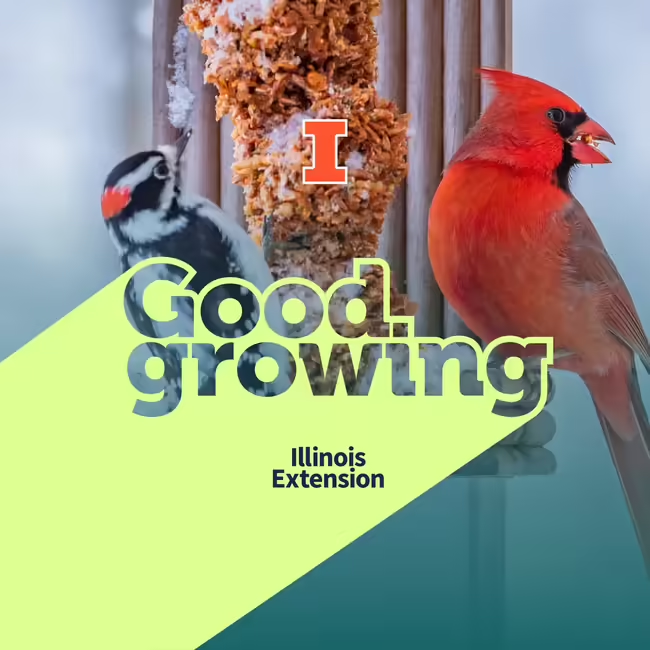
Welcome to the Good Grind Podcast. I am Chris Zenroth, horticulture educator with University of Illinois Extension coming at you from Mac Omb, Illinois, and we have got a garden bite for you this week. Today, we are going back in time to 2021 when we sat down and had a talk with, professor Michael Ward at University of Illinois, who studies ornithology, and we asked him a slew of questions, listener submitted questions about birds. And it's very timely. We talked to him in the 2021, and so, we are kinda brushing this off now in the 2026.
Chris: 00:44So enjoy this list of questions. We go into everything from, you know, what how often should we be feeding our birds, how to clean our bird feeders, how to deal with those onry cardinals that like to peck at our windows, and a lot more. And if you're interested in seeing the entire conversation that we have with doctor Ward, please feel free to check out our description down below, and we'll have a link to the full episode. And with that, enjoy.
Chris: 01:10I feel like I still have so many questions for you, Michael, but we are also a question and answer show. So we have to get to our our homeowner questions today. So, if you wouldn't mind helping us to answer these questions that are coming from, extension offices and social medias.
Michael: 01:23Sure.
Chris: 01:24Alright. So let's see. Katie, I think we have you kicking off the questions for this week, please.
Katie: 01:30Yeah. So our first question comes from McDonough County, and it comes from a local golf course that just built a new pro shop, but now this structure is very suitable for barn swallow habitat. Do you have any advice to discourage nesting where the golfers sit and eat?
Michael: 01:48Yeah. First off, I think golf courses are a great opportunity for bird conservation. Right? So I worked on a golf course in Jacksonville, and the superintendent there was very interested in birds. And so we were able to, you know, at the same time provide good golfing experiences, use herbicides and pesticides and and get birds.
Michael: 02:07I mean, the question about barn swallows and trying to keep them from nesting on the wedges or underneath eaves is tricky. So you can't the best way is to physically make it so they can't be there. So they sell sticky spikes. So just all plastic spikes that you roll out and stick on the very you can't see them very easily, but they make it so if the bird tried to actually build their mud nest, it would be difficult for them. So when you wanna manage bird like, problematic birds like geese, we have we do a lot of research with geese.
Michael: 02:40It's all about energy. So you wanna make it more energetic costly for them to do something that you don't want than it is for them to go somewhere else. And the thing you know, putting up spikes or making like, from geese, there's ways to make it so they don't like to fly because it costs a lot of energy. And so that's the way I think about it. So for the barn swallows, I would just go online, buy those spikes, put them up, they stick on their old plastic things.
Michael: 03:04I definitely wouldn't. They sell things where they're like ultrasonic sounds or they make sounds like owls. Birds are a lot smarter than people realize, and they're not gonna fall for that. We work with crows. Crows are the smartest bird in Illinois by far.
Michael: 03:19And so we couldn't hardly catch them. They're just too smart. You have to wear disguises. You can't drive the same car twice because they know the car is coming in. You know, you can teach them to talk.
Michael: 03:28I mean, and when they did catch crows, it's all like baby crows. They catch crows that are one year old. You can't catch adults, so they're just too smart. And so, yeah, people, a lot of times, even even geese, think geese are dumb. And, yeah, that's till you start doing research on them and realize they're a lot more savvy than you expect.
Michael: 03:47So putting out physical things to keep them from nesting is the way to go. I wouldn't waste money on some of those other approaches.
Ken: 03:53Alright. Our next question comes from Facebook. Is people food like scale bread and crackers bad for birds? Sometimes people will will throw those in the backyard and let the birds feed them.
Michael: 04:05Yeah. I mean, there's some some evidence that, like, if you catch candied geese that are in parks and are being fed bread all the time, they have pretty kinda messed up. Right? So it's essentially like us, yeah, eating junk food, you know, breakfast breakfast, lunch, and dinner. And well, it's like my kids.
Michael: 04:25Right? So I got kids in high school, and they were just out there eating. And if they had their choice, they would eat junk breakfast, lunch, and dinner. Right? And so I make them not.
Michael: 04:34So birds are kind of thing. They're gonna think that they're gonna it's gonna the calories, they're gonna wipe the calories out of some of the the bread, but it's not providing the nutrients they want. So it's okay if you have I mean, I do the same thing. If I have some stale crackers and I've got throw them up in the feeder, but you don't wanna make it a staple of birds because it's just they need the nutrients. I mean, I'm a big I use nitro seed and sunflower seeds in my backyard, and you know, those seeds don't provide everything they need because sometimes you know, they need insects as well.
Michael: 05:04But definitely, especially in winter, provides a lot of what they what they need to survive.
Katie: 05:08We have another question from Facebook. They're asking, we set our feeders far away from the windows, but we still get bird strikes. Is there anything they can do to prevent the birds from hitting our windows?
Michael: 05:20Yeah. So, you know, millions of birds die every year from hitting windows. And so definitely have things you can do. We have an issue on campus right now where we're dealing with this. So there's a couple things to keep in mind.
Michael: 05:31So birds hit windows either because they see the reflection of vegetation or in some cases, you have a lot of house plants on their side of the window and they're flying toward that. Or they see through your house. Right? So they see through a window to another window and there's light on their side, and they think it's a passage through a forest essentially. And so the way to keep birds from hitting windows is to make sure they can see the window.
Michael: 05:53And so there's a couple things you can do. Birds see in the UV, so they see the world differently than we do. So you can buy UV stickers that we kinda see, but not really see, but birds really see them. Those work a little bit. I'm a I'm a I like to actually on campus, what we're trying to do is put some strips, just some cloth strips from the window and the movement of those and the you don't have to put that many.
Michael: 06:19Just enough so they know there's something there that'll stop the the collisions. When I had a problem in my house when we moved in years ago, and it I determined that this because they could see through kind of breezeway area. So I moved the couch over so they couldn't see through there. And I'd still get some now that I'm home, I've determined what caused it too. I still get some collisions.
Michael: 06:40Most of the time is because the Cooper sock sneaks up on them on the feeder and the Cooper sock has learned to scare them toward my patio and they bounce off the the window stunned and then the Cooper sock has easy food for them. So but but there's definitely things you can do. There's lot of online resources, you know, like in Chicago where there's a huge problem where there was where, like, McCormick Place would leave their lights on all night and birds migrating at night would find a McCormick Place and they go around the wheelbarrow and pick up all the dead birds every morning. Luckily, mayor Daley, the time was the mayor of Chicago, and he he was interested in birds, and his wife was interested in birds. And so they asked him to stop, and now they get maybe one or two a night.
Michael: 07:20And so there's definitely things we can do to make a difference. And for people in their backyards, just putting something on the windows so birds learn there's a window there can go a long ways.
Katie: 07:30What would you do about a territorial cardinal that keeps attacking? Yeah.
Michael: 07:35They're funny. You know? I just said birds are so smart, and then someone will send me a picture of a cardinal smacking its head against a rearview mirror all day long. So I usually we had a we've I've had a problem in my yard about this. I put a just a paper sack over the the side windows, and then usually well, that'll stop them in the short term.
Michael: 07:56But usually, it's when their testosterone's building up, some males so in about in Illinois, in about a month, cardinals will be getting all pissy. Right? So they're the males are trying to be who the subtliest male is and try to get the females. And so once that passes, you just gotta get to that point. Right?
Michael: 08:14And so it's usually only a couple week period and if you can kind of take majors to stop it, then they'll kind of figure it out on their own and it'll be okay. But it can be annoying. I mean, woodpeckers do the same thing when they pick on your house if you have wood siding. And so they're usually not trying to get insects. They're just trying to sound like a big, studly woodpecker that's making all this noise, and you it's hard.
Michael: 08:36Right? So you gotta put out something to stop them from, you know, some metal flashing in certain areas. But but usually, it's a short term thing and that'll it'll go away.
Ken: 08:44Alright. Our next question is from Facebook again. Should we feed birds all year? My feeders are not very busy in the summer. When would be a good time to start and stop if we don't do all year?
Michael: 08:55Right. So as I mentioned earlier, I mean, think that from a population level, it's probably except for maybe hummingbirds, not making a difference. So you could feed all year if you want to. It probably wouldn't make much difference. If you look at your activity at your feeder, this time of year, you're gonna be a lot more active because there's lot more stress for food.
Michael: 09:17And so if you're doing bird feeding to try to help the individuals in your neighborhood, the individual birds, and to see them, I personally, what I do is I start feeding kind of the end of migration, which in Illinois is November, then I'll go through like March. If you wanna go longer, you'll get some other interesting birds showing up like rose russet grosbeaks or indigo bunnings, those kind of things. But but you can feed all year round. You're not you know, people talk about, well, you're causing them to not migrate, which that might be true in some cases, but if they weren't gonna migrate, were gonna die anyway. And so, you know, one thing that's hard for people to especially if I go to Audubon Society is the concept that birds die.
Michael: 09:59That's the way it is. Right? So birds produce a lot of offspring. If the offspring all live, then we would be, you know, swimming in birds. And so birds die, it's kinda the way it is, but we've got to think big picture on to how we can maintain a population that is either stable or increasing.
Michael: 10:16And bird feeding is maybe a small part of that, but it's not the it's more habitat driven than anything else. And so I I mean, I I think that it's up to you. You can feed whatever you want, but you get your most bang for your buck in terms of seeing birds in the colder months.
Katie: 10:33Our next question comes from McDonough County, and their backyard backs up to a cornfield. They've set out black oil, sunflower seed, and nitrous seed, but all they ever get are little sparrows. What can they do to attract birds like cardinals?
Michael: 10:49Yep. I get people saying that sometimes. There there are like, with Dodd County, I guarantee you, there's lots of cardinals. One thing is cardinals like to have some bushes around. So if you're down in the open area and you don't have any, especially if you're out in a big ag field and you don't have any trees or bushes, cardinals don't move around that much.
Michael: 11:11They're non migratory, so they might not be there in the summer. And so it might be good to plant some some trees that'll or some bushes that'll bring in the cardinals. The especially in agricultural areas, you get a lot of house sparrows, which, you know, we don't like. But if you set up multiple feeders and kinda try to just you you you're only gonna have so many house burrows in the area. And so multiple feeders, can kinda space them out.
Michael: 11:38And they can be aggressive, but I mean, I would suggest adding a couple feeders and planting some trees. And that way by doing that, you'll get not only cardinals, but, like, McDonough County, should get blue jays, maybe tufteimis, maybe black capped chickadees, maybe goldfinches. It's just that a lot of these birds get nervous. They're not they're not programmed to be in big open areas, and so there's some interesting research on you're just like us. Right?
Michael: 12:06So if you grew up out in the country and you drop you on the Lakeshore Drive, you get a little antsy, you get a little nervous. Well, the same thing, drop a bird that's in the forest into a middle of a cornfield, it gets a little nervous. Right? And so you gotta provide some more structure for it to start taking advantage of your bird feeder.
Ken: 12:22Our next question is from Cass County. Do we need to provide water in the winter or do birds use snow?
Michael: 12:29So some birds use snow. Birds have a very high metabolic rate, which the byproduct is that is they use a lot of water. So if you do put a heating element out for a bird bath in your backyard, you will get a lot of birds taking advantage of that. That's also why this time of year, especially like today when it's so cold, if you go by a stream that actually has open water, you'll see lots of birds there because they they need a certain amount of water to maintain their metabolic activity. I don't know that you providing water is saving any of them per se because they've all kind of evolved to deal with cold temperatures.
Michael: 13:08But if you do wanna enjoy birds, putting out a bird bath with one of those water heaters, I've seen those where it's amazing how many birds take advantage of that over the course of the day.
Katie: 13:18Then our last question for the day comes from Hancock County, and they this person saw an online instructional video for cleaning bird feeders with apple cider vinegar. Does this work to kill diseases?
Michael: 13:34Probably. The there's a disease that I see actually, I saw a bird this morning in my feeder with it. It's kinda like a pink eye that house finches and goldfinches get, your eyes swell shut. And they do likely transmit that at thistle feeders, and so cleaning them is a good idea. I probably don't clean mine as much as I should, but, you know, for me, if I fill up the feeder, it takes about a month for them to get through the feeder most times.
Michael: 14:03And so maybe every every other month, I'll try to clean out a little bit. I I typically just use Dawn and water and just clean it out. Vinegar probably work better. It's really just a problem for birds that are called finches, house finches and goldfinches, and it's just disease they get in their eyes. For most other birds, we don't really see diseases at feeders causing big problems.
Michael: 14:30But I don't see why apple cider vinegar would would be a problem, and especially if you have lots of goldfinches or house finches, which I know some people do, especially in Southern Illinois and kinda Southeastern Illinois. They can get you can have a feeder with lots of those birds. It's probably not a bad idea to do that every couple weeks or yeah. Probably every time you fill up the feeder, it wouldn't be a bad idea.
Chris: 14:51Well, that was a lot of great information all about birds and their care and feeding them, especially this time of year when they are a mainstay in our landscape. So one of the the key ornamental features for a lot of us as we look out, of our windows to a very brown and gray landscape. And so it's nice to have a little bit of movement and color out there with our feathered friends. Well, the Good Growing podcast is a production of University of Illinois Extension, edited this week by me, Chris Enroth. Hey, listeners.
Chris: 15:20A big thank you for hanging out with us today, enjoying these throwback gardening questions with doctor Ward. So we'll have more coming at you next week. So listeners, thank you for doing what you do best, that is listening or if you watched us on YouTube watching. And as always, keep on growing.