Episode Number
104
Episode Show Notes / Description
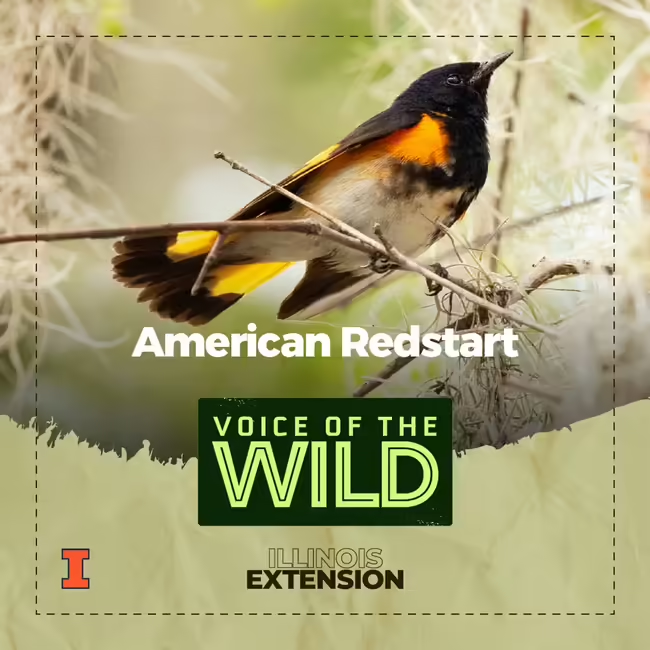
American Redstart (Setophaga ruticilla).
A common warbler with a frequently-fanned colorful tail.
Voice of the Wild is a podcast about wildlife and the wild sounds they make.
The following Cornell Lab | Macaulay Library recordings were used in this episode:
- American Redstart song 1 by Wil Hershberger (ML509130)
- American Redstart song 2 by Matthew D. Medler (ML509134)
- American Redstart song 3 by Arthur A. Allen and Peter Paul Kellogg (ML509128)
- American Redstart call by Hope Batcheller (ML509136)
Sources and more:
- Cornell’s All About Birds
- Audubon
- Field guide to hotspots and birds in Illinois by Colin Dobson
- Audubon videoguide to 505 birds of North America
- Peterson field guide to the birds (Fourth edition)
- Sibley birds East
- Stokes Field Guide to Warblers
Transcript
This is Brodie with Illinois Extension and I’m here with a new “voice of the wild”
This bird dances through spring foliage flashing black and orange or grey and yellow as they go. They pivot and turn through shrubs, park trees, and skirt the forested edges of waterways while drooping their wings and fanning out their colorful tail. This is the American redstart.
As simple as the redstart’s visual identification is (nothing else in the east is even close) they’re easily one of the most challenging warblers to ID by sound. Their song is extremely variable and often alternates between different strings of syllables that rise or fall at the end. If you’re confused about a warbler’s call for long, a good rule of thumb is to ask yourself whether it might belong to an American redstart. And here’s the redstart again.
Thank you to the Macaulay library at the Cornell lab for today’s sound. Learn more about voice of the wild at go.illinois.edu/VOW
This bird dances through spring foliage flashing black and orange or grey and yellow as they go. They pivot and turn through shrubs, park trees, and skirt the forested edges of waterways while drooping their wings and fanning out their colorful tail. This is the American redstart.
As simple as the redstart’s visual identification is (nothing else in the east is even close) they’re easily one of the most challenging warblers to ID by sound. Their song is extremely variable and often alternates between different strings of syllables that rise or fall at the end. If you’re confused about a warbler’s call for long, a good rule of thumb is to ask yourself whether it might belong to an American redstart. And here’s the redstart again.
Thank you to the Macaulay library at the Cornell lab for today’s sound. Learn more about voice of the wild at go.illinois.edu/VOW