Episode Number
85
Episode Show Notes / Description
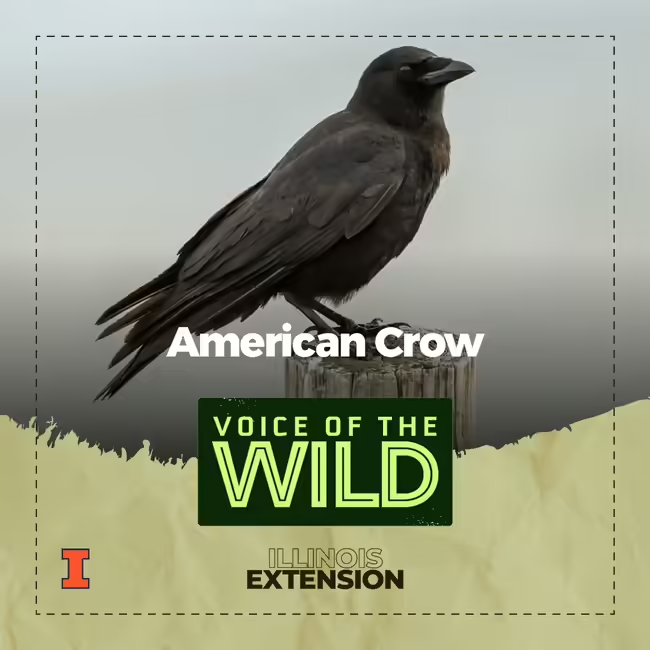
American crow (Corvus brachyrhynchos).
The clever Corvid.
Voice of the Wild will be taking a holiday break! We'll be back with a new episode on the 9th of January.
Voice of the Wild will be taking a holiday break! We'll be back with a new episode on the 9th of January.
Do you want to learn more bird songs, frog calls, and insect noises? Join Voice of the Wild every Friday to explore a new wild voice. We’re available on most podcast platforms, including Apple Podcasts, Spotify, and YouTube.
- Subscription links Here
- Subscribe to the Newsletter
- Listen online on our Homepage
The following Cornell Lab | Macaulay Library recordings were used in this episode:
- American crow song by Mike Andersen (ML508005)
- American crow croak call by Geoffrey A. Keller (ML508007)
- American crow nasal call by Robert C. Stein and William W. H. Gunn (ML508012)
- American crow flock call by Arnoud van den Berg (ML508014)
- Fish crow call by Geoffrey A. Keller (ML508032)
Sources and more:
- https://www.allaboutbirds.org/guide/American_Crow
- https://www.audubon.org/field-guide/bird/american-crow
- Dobson, C., Kassenbaum, D., Oehmke, D., & Misewicz, M. (2023). Field guide to hotspots and birds in Illinois. Scissortail LLC.
- Godfrey, M. A., & Kaufman, Kenn. (Directors). (2004). National Audubon Society videoguide to the birds of North America [Video recording]. In Audubon videoguide to 505 birds of North America DVD I & DVD II (Fullscreen.). Godfrey-Stadin Productions.
- Peterson, R. T., & Peterson, V. M. (1980). A field guide to the birds: A completely new guide to all the birds of eastern and central North America (Fourth edition, completely revised and enlarged.). Houghton Mifflin Company.
- Sibley, D. (2016). Sibley birds East: Field guide to birds of eastern North America (2nd ed.). Alfred A. Knopf.
Transcript
This is Brodie with Illinois Extension and I’m here with a new “voice of the wild”
This adaptable and social omnivore will of course enjoy the natural scavengings found in the wild, but has also learned that A busy city can suit them just fine; it affords them special access to high-calorie urban gleanings like scraps of fast food and trash. I once found one eating hot Cheetos right out of a discarded bag. This is the American crow.
The “caaw” of a crow is distinctive, but be alert for raven-like croaks or a young crow’s nasal "caaw"; it can sometimes tricks new birders into thinking they’ve found a fish crow. These are typically only found along the coast or on the Mississippi river while the American crow can be found all throughout us and Canada. In winter, crows form large and highly social roosts, often in urban areas. One such roost in Danville Illinois was, in the late 90’s, the world’s largest. It topped out around 300,000 birds before tapering off to just a few thousand in the mid 2010’s. It’s unknown what brought all those birds together, but for a time in east-central Illinois, the skies were blackened by the wingbeats of thousands of crows.
Thank you to the Macaulay library at the Cornell lab for today’s sound. Learn more about voice of the wild at go.illinois.edu/VOW
This adaptable and social omnivore will of course enjoy the natural scavengings found in the wild, but has also learned that A busy city can suit them just fine; it affords them special access to high-calorie urban gleanings like scraps of fast food and trash. I once found one eating hot Cheetos right out of a discarded bag. This is the American crow.
The “caaw” of a crow is distinctive, but be alert for raven-like croaks or a young crow’s nasal "caaw"; it can sometimes tricks new birders into thinking they’ve found a fish crow. These are typically only found along the coast or on the Mississippi river while the American crow can be found all throughout us and Canada. In winter, crows form large and highly social roosts, often in urban areas. One such roost in Danville Illinois was, in the late 90’s, the world’s largest. It topped out around 300,000 birds before tapering off to just a few thousand in the mid 2010’s. It’s unknown what brought all those birds together, but for a time in east-central Illinois, the skies were blackened by the wingbeats of thousands of crows.
Thank you to the Macaulay library at the Cornell lab for today’s sound. Learn more about voice of the wild at go.illinois.edu/VOW