Episode Number
86
Episode Show Notes / Description
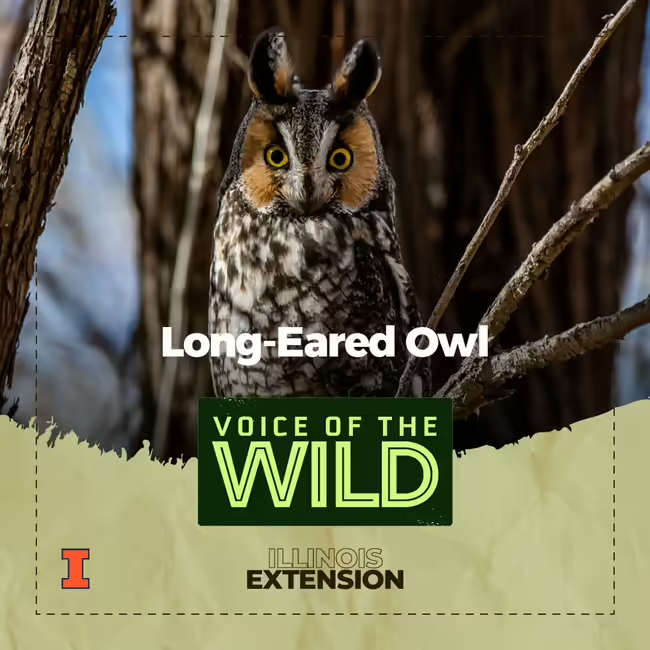
Long-eared owl (Asio otus).
The crow-sized owl that sometimes roosts communally.
Do you want to learn more bird songs, frog calls, and insect noises? Join Voice of the Wild every Friday to explore a new wild voice. We’re available on most podcast platforms, including Apple Podcasts, Spotify, and YouTube.
- Subscription links Here
- Subscribe to the Newsletter
- Listen online on our Homepage
The following Cornell Lab | Macaulay Library recordings were used in this episode:
- Long-eared owl song by Dave Herr (ML507093)
- Long-eared owl coyote-like call by George B. Reynard (ML507096)
- Long-eared owl barks by George B. Reynard (ML507100)
- Long-eared owl snaps by George B. Reynard (ML507101)
Sources and more:
- https://www.allaboutbirds.org/guide/Long-eared_Owl
- https://www.audubon.org/field-guide/bird/long-eared-owl
- Dobson, C., Kassenbaum, D., Oehmke, D., & Misewicz, M. (2023). Field guide to hotspots and birds in Illinois. Scissortail LLC.
- Godfrey, M. A., & Kaufman, Kenn. (Directors). (2004). National Audubon Society videoguide to the birds of North America [Video recording]. In Audubon videoguide to 505 birds of North America DVD I & DVD II (Fullscreen.). Godfrey-Stadin Productions.
- Peterson, R. T., & Peterson, V. M. (1980). A field guide to the birds: A completely new guide to all the birds of eastern and central North America (Fourth edition, completely revised and enlarged.). Houghton Mifflin Company.
- Sibley, D. (2016). Sibley birds East: Field guide to birds of eastern North America (2nd ed.). Alfred A. Knopf.
Transcript
This is Brodie with Illinois Extension and I’m here with a new “voice of the wild”
A slender and secretive owl that’s cosmopolitan in distribution but can be found in the lower Midwest only in the depths of winter. They tend to roost in mid-sized evergreens stands near open fields. I often check beneath spruce windbreaks and stands of abandoned cedars for their oblong pellets and look near the trunk for the bird’s namesake long ear tufts. This is the long-eared owl.
Those long ear tufts can, at first glance, give the appearance of a great horned owl, but the long eared owl is substantially smaller, about the size of a crow. They’re also slimmer than the great horned and have streaks that run down the body instead of across. If you do manage to find a long eared owl, be sure to look carefully in the trees nearby, as they are one of the few owls that sometimes roost communally. In our second playthrough, note that, alongside the more traditional owl hoots, the long eared has some strange barking calls that are almost coyote-like. Here’s the long-eared owl again.
Thank you to the Macaulay library at the Cornell lab for today’s sound. Learn more about voice of the wild at go.illinois.edu/VOW
A slender and secretive owl that’s cosmopolitan in distribution but can be found in the lower Midwest only in the depths of winter. They tend to roost in mid-sized evergreens stands near open fields. I often check beneath spruce windbreaks and stands of abandoned cedars for their oblong pellets and look near the trunk for the bird’s namesake long ear tufts. This is the long-eared owl.
Those long ear tufts can, at first glance, give the appearance of a great horned owl, but the long eared owl is substantially smaller, about the size of a crow. They’re also slimmer than the great horned and have streaks that run down the body instead of across. If you do manage to find a long eared owl, be sure to look carefully in the trees nearby, as they are one of the few owls that sometimes roost communally. In our second playthrough, note that, alongside the more traditional owl hoots, the long eared has some strange barking calls that are almost coyote-like. Here’s the long-eared owl again.
Thank you to the Macaulay library at the Cornell lab for today’s sound. Learn more about voice of the wild at go.illinois.edu/VOW