Episode Number
87
Episode Show Notes / Description
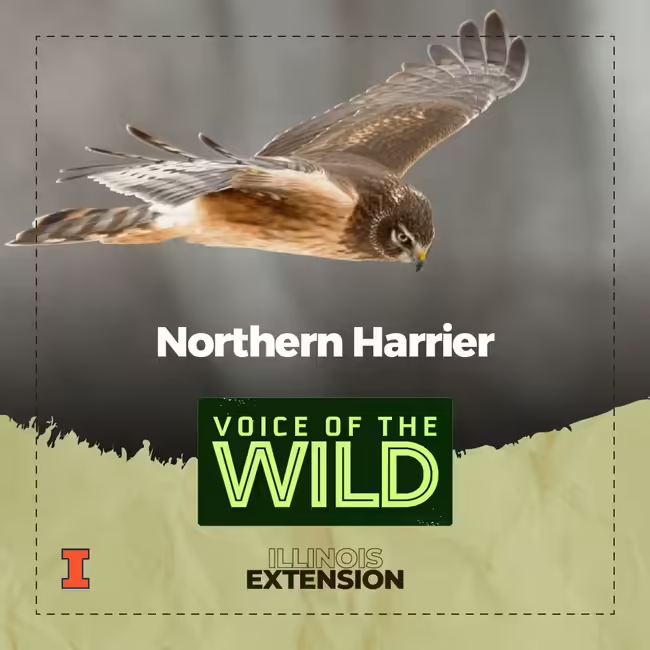
Northern harrier (Circus hudsonius).
The owl-faced hawk.
Do you want to learn more bird songs, frog calls, and insect noises? Join Voice of the Wild every Friday to explore a new wild voice. We’re available on most podcast platforms, including Apple Podcasts, Spotify, and YouTube.
- Subscription links Here
- Subscribe to the Newsletter
- Listen online on our Homepage
The following Cornell Lab | Macaulay Library recordings were used in this episode:
- Northern harrier call by Cleveland P. Grant and William W. H. Gunn (ML505954)
- Northern harrier screech call by Charles Duncan (ML505956)
Sources and more:
- https://www.allaboutbirds.org/guide/Northern_Harrier
- https://www.audubon.org/field-guide/bird/northern-harrier
- Dobson, C., Kassenbaum, D., Oehmke, D., & Misewicz, M. (2023). Field guide to hotspots and birds in Illinois. Scissortail LLC.
- Peterson, R. T., & Peterson, V. M. (1980). A field guide to the birds: A completely new guide to all the birds of eastern and central North America (Fourth edition, completely revised and enlarged.). Houghton Mifflin Company.
- Sibley, D. (2016). Sibley birds East: Field guide to birds of eastern North America (2nd ed.). Alfred A. Knopf.
Transcript
This is Brodie with Illinois Extension and I’m here with a new “voice of the wild”
Rather than soaring high circles through sunlit skies, or surveying the highway from a tall roadside perch, this long-tailed hawk flies low meandering paths over grasslands and marshes; and rarely perch higher than a fencepost. Unique for a hawk they have an owl-like circular face; the shape of which gives them a hearing advantage; the disk of feathers acting like a cupped hand behind the ear. This is the northern harrier.
You’d be forgiven if you didn’t recognize this call; the northern harrier is not a particularly vocal bird; they’re more likely to be identified by their conspicuous white rump, or by the way they sweep across an open field with their long and agile wings held in gentle V. While the harrier is diurnal, which means they’re active during daylight hours, the most reliable time to see them seems to be at dawn and dusk. They share the same habitat with short-eared owls and with a little luck you find both hunting the same field at sundown. Here’s the northern harrier again.
Thank you to the Macaulay library at the Cornell lab for today’s sound. Learn more about voice of the wild at go.illinois.edu/VOW
Rather than soaring high circles through sunlit skies, or surveying the highway from a tall roadside perch, this long-tailed hawk flies low meandering paths over grasslands and marshes; and rarely perch higher than a fencepost. Unique for a hawk they have an owl-like circular face; the shape of which gives them a hearing advantage; the disk of feathers acting like a cupped hand behind the ear. This is the northern harrier.
You’d be forgiven if you didn’t recognize this call; the northern harrier is not a particularly vocal bird; they’re more likely to be identified by their conspicuous white rump, or by the way they sweep across an open field with their long and agile wings held in gentle V. While the harrier is diurnal, which means they’re active during daylight hours, the most reliable time to see them seems to be at dawn and dusk. They share the same habitat with short-eared owls and with a little luck you find both hunting the same field at sundown. Here’s the northern harrier again.
Thank you to the Macaulay library at the Cornell lab for today’s sound. Learn more about voice of the wild at go.illinois.edu/VOW