Episode Number
88
Episode Show Notes / Description
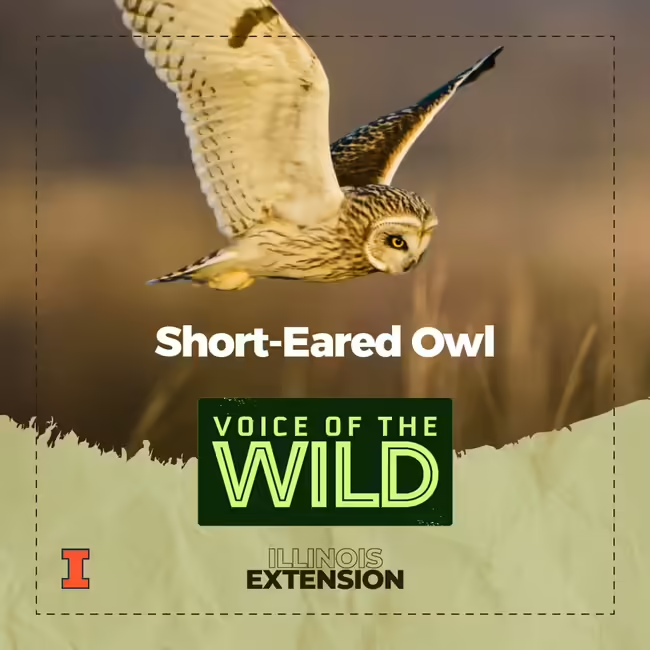
Short-eared owl (Asio flammeus).
The prairie owl.
Do you want to learn more bird songs, frog calls, and insect noises? Join Voice of the Wild every Friday to explore a new wild voice. We’re available on most podcast platforms, including Apple Podcasts, Spotify, and YouTube.
- Subscription links Here
- Subscribe to the Newsletter
- Listen online on our Homepage
The following Cornell Lab | Macaulay Library recordings were used in this episode:
- Short-eared owl wing sonation by Brian McCaffery (ML507105)
- Short-eared owl bark call by Gerrit Vyn (ML507110)
- Short-eared owl call by Gerrit Vyn (ML507111)
Sources and more:
- https://www.allaboutbirds.org/guide/Short-eared_Owl
- https://www.audubon.org/field-guide/bird/short-eared-owl
- Dobson, C., Kassenbaum, D., Oehmke, D., & Misewicz, M. (2023). Field guide to hotspots and birds in Illinois. Scissortail LLC.
- Godfrey, M. A., & Kaufman, Kenn. (Directors). (2004). National Audubon Society videoguide to the birds of North America [Video recording]. In Audubon videoguide to 505 birds of North America DVD I & DVD II (Fullscreen.). Godfrey-Stadin Productions.
- Peterson, R. T., & Peterson, V. M. (1980). A field guide to the birds: A completely new guide to all the birds of eastern and central North America (Fourth edition, completely revised and enlarged.). Houghton Mifflin Company.
- Sibley, D. (2016). Sibley birds East: Field guide to birds of eastern North America (2nd ed.). Alfred A. Knopf.
Transcript
This is Brodie with Illinois Extension and I’m here with a new “voice of the wild”
An unusual owl who’s flopping and buoyant flight might be seen above a winter prairie just as the sun sets. They’re crepuscular rather than nocturnal, so they’re most active in the dim light between night and day; though may be seen during the day if voles are particularly active or if they’re startled from their roost, often a tall patch of grass or a weedy ditch. This is the short-eared owl.
While their name is not a misnomer, it is perhaps a little misleading; their ear tufts are so short you’re unlikely to even see them. A better name may have been moth-owl, as their buoyant flight that bobbs with every wingbeat is often said to look like that of large moth. They share both habits and habitat with Northern Harriers and can be differentiated from them by that mothlike flight, their big head, and a comparatively short tail. Aside from a few short barks they might give while hunting, most of the short-eared owl’s sounds are reserved for their breeding displays in the far north, including their unusual wing-clicking. Here’s the short-eared owl again.
Thank you to the Macaulay library at the Cornell lab for today’s sound. Learn more about voice of the wild at go.illinois.edu/VOW
An unusual owl who’s flopping and buoyant flight might be seen above a winter prairie just as the sun sets. They’re crepuscular rather than nocturnal, so they’re most active in the dim light between night and day; though may be seen during the day if voles are particularly active or if they’re startled from their roost, often a tall patch of grass or a weedy ditch. This is the short-eared owl.
While their name is not a misnomer, it is perhaps a little misleading; their ear tufts are so short you’re unlikely to even see them. A better name may have been moth-owl, as their buoyant flight that bobbs with every wingbeat is often said to look like that of large moth. They share both habits and habitat with Northern Harriers and can be differentiated from them by that mothlike flight, their big head, and a comparatively short tail. Aside from a few short barks they might give while hunting, most of the short-eared owl’s sounds are reserved for their breeding displays in the far north, including their unusual wing-clicking. Here’s the short-eared owl again.
Thank you to the Macaulay library at the Cornell lab for today’s sound. Learn more about voice of the wild at go.illinois.edu/VOW