Episode Number
89
Episode Show Notes / Description
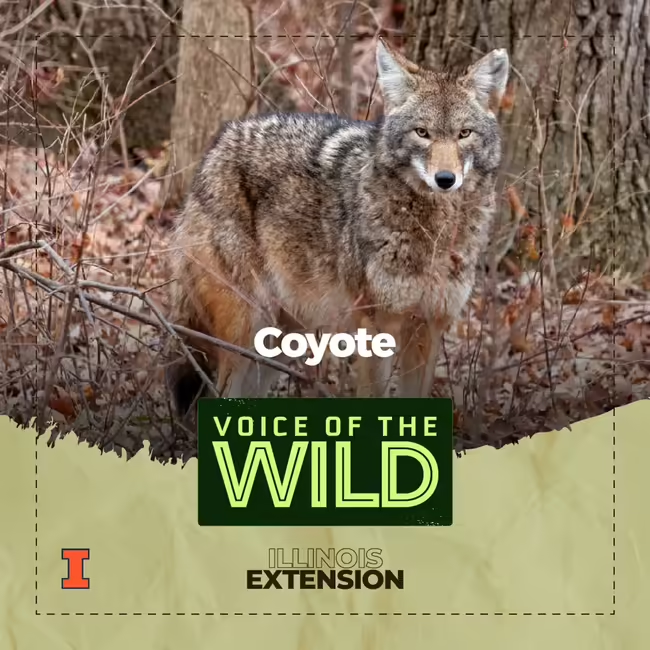
Coyote (Canis latrans).
The song dog.
Do you want to learn more bird songs, frog calls, and insect noises? Join Voice of the Wild every Friday to explore a new wild voice. We’re available on most podcast platforms, including Apple Podcasts, Spotify, and YouTube.
- Subscription links Here
- Subscribe to the Newsletter
- Listen online on our Homepage
The following Cornell Lab | Macaulay Library recordings were used in this episode:
- Coyote pack howling by Brad Walker (ML307053)
- Coyote individual bark by Jay McGowan (ML204867)
Sources and more:
- https://macaulaylibrary.org/asset/307053
- https://macaulaylibrary.org/asset/204867
- Jensen AJ, Marneweck CJ, Kilgo JC, et al. 2022. Coyote diet in North America: geographic and ecological patterns during range expansion. Mammal Review. 52(4):480–496. https://doi.org/10.1111/mam.12299
- Kilgo JC, Shaw CE, Vukovich M, et al. 2017. Reproductive characteristics of a coyote population before and during exploitation. J Wildl Manag. 81(8):1386–1393. https://doi.org/10.1002/jwmg.21329
Transcript
This is Brodie with Illinois Extension and I’m here with a new “voice of the wild”
In some native american myths and stories, this call belongs to a trickster, whose deceptions, benevolent or not, nearly always carry a lesson for the listener. For many the call belongs to a powerful symbol of nature’s persistence and adaptability but for others…it is merely the sound of a foe; a predator with an appetite. but to all..it is the song of the coyote.
Coyotes are misunderstood animals; often blamed for reducing game populations and predating on everything from livestock to pets. But studies show that the average coyote’s diet consists almost entirely of rodents and rabbits with a scattering of wild fruits and berries…and in any case: scientists have shown that coyotes rebound quickly if local populations are removed. It's as if those old trickster stories had more than a grain of truth to them; take coyote from his territory and two take his place.
Here’s coyote’s song again.
Thank you to the Macaulay library at the Cornell lab for today’s sound. Learn more about voice of the wild at go.illinois.edu/VOW
In some native american myths and stories, this call belongs to a trickster, whose deceptions, benevolent or not, nearly always carry a lesson for the listener. For many the call belongs to a powerful symbol of nature’s persistence and adaptability but for others…it is merely the sound of a foe; a predator with an appetite. but to all..it is the song of the coyote.
Coyotes are misunderstood animals; often blamed for reducing game populations and predating on everything from livestock to pets. But studies show that the average coyote’s diet consists almost entirely of rodents and rabbits with a scattering of wild fruits and berries…and in any case: scientists have shown that coyotes rebound quickly if local populations are removed. It's as if those old trickster stories had more than a grain of truth to them; take coyote from his territory and two take his place.
Here’s coyote’s song again.
Thank you to the Macaulay library at the Cornell lab for today’s sound. Learn more about voice of the wild at go.illinois.edu/VOW