Episode Number
92
Episode Show Notes / Description
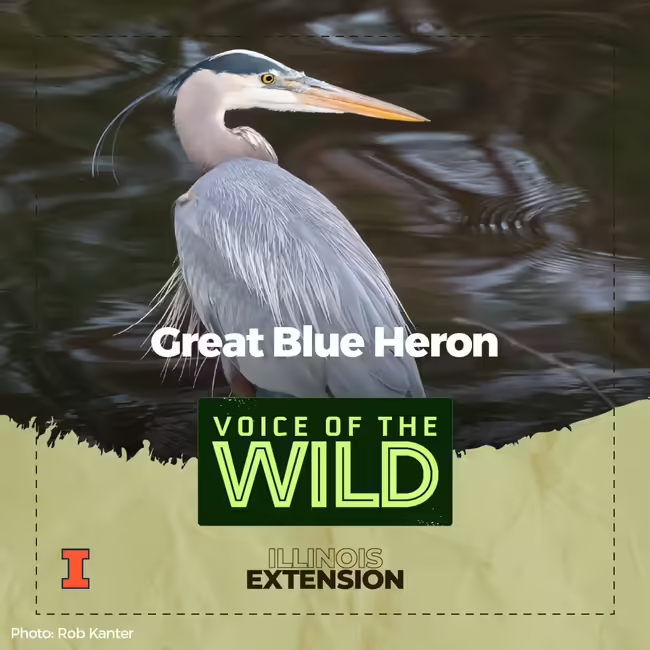
Great blue heron (Ardea herodias).
The big heron with an awkward squawk.
Do you want to learn more bird songs, frog calls, and insect noises? Join Voice of the Wild every Friday to explore a new wild voice. We’re available on most podcast platforms, including Apple Podcasts, Spotify, and YouTube.
- Subscription links Here
- Subscribe to the Newsletter
- Listen online on our Homepage
The following Cornell Lab | Macaulay Library recordings were used in this episode:
- Great Blue Heron call 1 by William Evans (ML505860)
- Great Blue Heron call 2 by William Evans (ML505863)
Sources and more:
- https://www.allaboutbirds.org/guide/Great_Blue_Heron
- https://www.audubon.org/field-guide/bird/great-blue-heron
- Peterson, R. T., & Peterson, V. M. (1980). A field guide to the birds: A completely new guide to all the birds of eastern and central North America (Fourth edition, completely revised and enlarged.). Houghton Mifflin Company.
- Sibley, D. (2016). Sibley birds East: Field guide to birds of eastern North America (2nd ed.). Alfred A. Knopf.
Transcript
This is Brodie with Illinois Extension and I’m here with a new “voice of the wild”
A shy bird who’s just bold enough to live alongside us, but usually not so bold that they’ll tolerate you getting close on your morning run past their favorite neighborhood pond. Sometimes they’ll take off gracefully and fly on slow, measured wingbeats to the other side, Other times you startle them and they’ll leave with a hurried and awkward squawk. This is the great blue heron
Great blues can be recognized in flight by their slow wingbeats and by the position of their head; they keep it hunched back and resting on their shoulders as they fly, as opposed to held out in front like in geese and cranes. They are a very large bird, but despite this great size they still nests in trees, often with many other pairs. These nesting areas are sometimes called heronries or heron rookeries. Herons like to forage in and around just about any slow moving body of water, and though their diet is mostly fish, they will sometimes get a hankering for mice or voles, so they’ll sometimes forage in open fields.
Here’s the great blue heron again
Thank you to the Macaulay library at the Cornell lab for today’s sound. Learn more about voice of the wild at go.illinois.edu/VOW
A shy bird who’s just bold enough to live alongside us, but usually not so bold that they’ll tolerate you getting close on your morning run past their favorite neighborhood pond. Sometimes they’ll take off gracefully and fly on slow, measured wingbeats to the other side, Other times you startle them and they’ll leave with a hurried and awkward squawk. This is the great blue heron
Great blues can be recognized in flight by their slow wingbeats and by the position of their head; they keep it hunched back and resting on their shoulders as they fly, as opposed to held out in front like in geese and cranes. They are a very large bird, but despite this great size they still nests in trees, often with many other pairs. These nesting areas are sometimes called heronries or heron rookeries. Herons like to forage in and around just about any slow moving body of water, and though their diet is mostly fish, they will sometimes get a hankering for mice or voles, so they’ll sometimes forage in open fields.
Here’s the great blue heron again
Thank you to the Macaulay library at the Cornell lab for today’s sound. Learn more about voice of the wild at go.illinois.edu/VOW