Episode Number
94
Episode Show Notes / Description
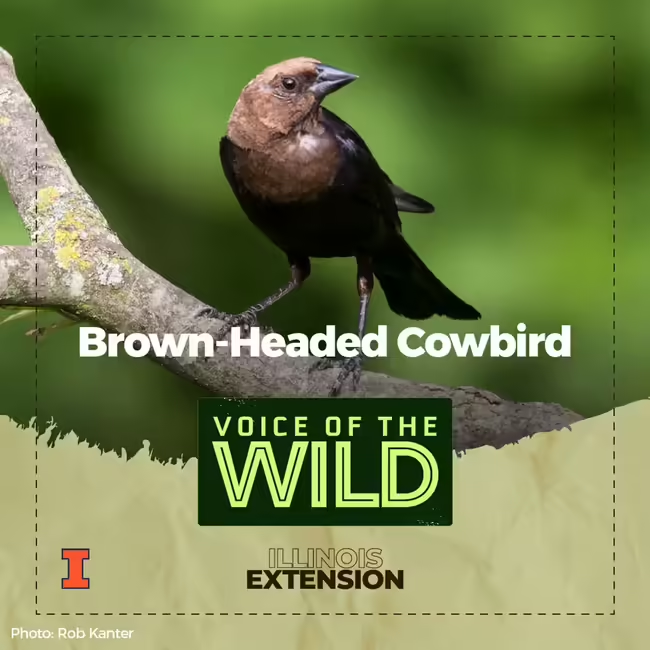
Brown-headed cowbird (Molothrus ater).
North America’s best-known brood parasite.
Do you want to learn more bird songs, frog calls, and insect noises? Join Voice of the Wild every Friday to explore a new wild voice. We’re available on most podcast platforms, including Apple Podcasts, Spotify, and YouTube.
- Subscription links Here
- Subscribe to the Newsletter
- Listen online on our Homepage
The following Cornell Lab | Macaulay Library recordings were used in this episode:
- Brown-headed Cowbird song by Robert C. Stein and Eugene Morton (ML510050)
- Brown-headed Cowbird call by Wil Hershberger (ML510043)
- Brown-headed Cowbird flock by Arthur A. Allen and Elsa G. Allen (ML510051)
Sources and more:
- https://www.allaboutbirds.org/guide/Brown-headed_Cowbird
- https://www.audubon.org/field-guide/bird/brown-headed-cowbird
- Dobson, C., Kassenbaum, D., Oehmke, D., & Misewicz, M. (2023). Field guide to hotspots and birds in Illinois. Scissortail LLC.
- Peterson, R. T., & Peterson, V. M. (1980). A field guide to the birds: A completely new guide to all the birds of eastern and central North America (Fourth edition, completely revised and enlarged.). Houghton Mifflin Company.
- Sibley, D. (2016). Sibley birds East: Field guide to birds of eastern North America (2nd ed.). Alfred A. Knopf.
Transcript
This is Brodie with Illinois Extension and I’m here with a new “voice of the wild”
In winter you’ll find these birds mixed in with flocks of blackbirds around feedlots and cattle pastures. You can pick them out from their blackbird companions by looking for their relatively small size, shorter tail, and finchlike beak. In greener months they’re much more widespread and can be found around the edge of forests where you might hear the male’s gurgling and complex call or catch a female searching for another bird’s nest where she might lay her eggs. This is the brown-headed cowbird.
Most know the cowbird as North America’s brood parasite, just like Europe’s well-known common cuckoo. but they are not the only bird in North America that’ll lay their eggs in another bird’s nest; many waterfowl will do the same, usually but not always in the nest of a member of the same species. Its thought that waterfowl are less negatively affected by brood parasitism because waterfowl chicks can forage on their own. The victims of the cowbird are not so fortunate, cowbird chicks are as voracious and helpless as the chicks they replace. Here’s the brown-headed cowbird again.
Thank you to the Macaulay library at the Cornell lab for today’s sound. Learn more about voice of the wild at go.illinois.edu/VOW
In winter you’ll find these birds mixed in with flocks of blackbirds around feedlots and cattle pastures. You can pick them out from their blackbird companions by looking for their relatively small size, shorter tail, and finchlike beak. In greener months they’re much more widespread and can be found around the edge of forests where you might hear the male’s gurgling and complex call or catch a female searching for another bird’s nest where she might lay her eggs. This is the brown-headed cowbird.
Most know the cowbird as North America’s brood parasite, just like Europe’s well-known common cuckoo. but they are not the only bird in North America that’ll lay their eggs in another bird’s nest; many waterfowl will do the same, usually but not always in the nest of a member of the same species. Its thought that waterfowl are less negatively affected by brood parasitism because waterfowl chicks can forage on their own. The victims of the cowbird are not so fortunate, cowbird chicks are as voracious and helpless as the chicks they replace. Here’s the brown-headed cowbird again.
Thank you to the Macaulay library at the Cornell lab for today’s sound. Learn more about voice of the wild at go.illinois.edu/VOW