Episode Number
95
Episode Show Notes / Description
Wood Frog (Lithobates sylvaticus).
North America’s northernmost amphibian.
Do you want to learn more bird songs, frog calls, and insect noises? Join Voice of the Wild every Friday to explore a new wild voice. We’re available on most podcast platforms, including Apple Podcasts, Spotify, and YouTube.
- Subscription links Here
- Subscribe to the Newsletter
- Listen online on our Homepage
The following Cornell Lab | Macaulay Library recordings were used in this episode:
- Wood frog call by Jeff Gerbracht (ML224894)
- Wood frog chorus by Gregory Budney (ML138501)
Sources and more:
- https://dnr.illinois.gov/education/wildaboutpages/wildaboutfrogs/waftwoodfrog.html
- https://dnr.illinois.gov/education/edu-pages-main/a-f/edufrogtoad.html
- Wisconsin Citizen-Based Monitoring Network https://www.youtube.com/watch?v=pRPoeNcat94
- Purdue Extension Forestry and Natural Resources https://www.youtube.com/watch?v=zb_32jjcabo
- Nature Museum Calling Frog Survey Resources https://naturemuseum.org/cas/community-science/calling-frog-survey-2
Transcript
This is Brodie with Illinois Extension and I’m here with a new “voice of the wild”
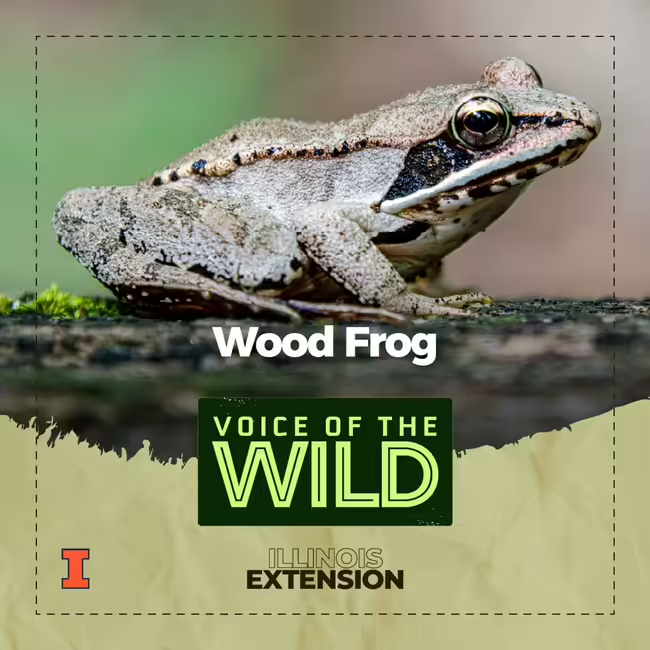
At most, three inches long and only calling for a few nights a year, typically in March, is an uncommon frog of wet woodlands. Their body can be pink or tan, but they always have a chocolate brown or black mask on either side of the head. Their range extends across much of the northeast US and all the way up to Alaska; they’re the northernmost amphibian in North America. This is the wood frog.
Their ability to thrive across such a northerly range is made possible by the wood frog’s most famous trait; their ability to tolerate extreme cold. They sequester biological cryoprotectants into their cells; these control and prevent ice crystal formation which would be deadly. The wood frog is found, generally speaking, around the borders of Illinois and is absent in the central and central west parts of the state. On our second playthrough, note that a chorus of wood frogs can sound a bit like a raft of chatty foraging ducks.
Thank you to the Macaulay library at the Cornell lab for today’s sound. Learn more about voice of the wild at go.illinois.edu/VOW
At most, three inches long and only calling for a few nights a year, typically in March, is an uncommon frog of wet woodlands. Their body can be pink or tan, but they always have a chocolate brown or black mask on either side of the head. Their range extends across much of the northeast US and all the way up to Alaska; they’re the northernmost amphibian in North America. This is the wood frog.
Their ability to thrive across such a northerly range is made possible by the wood frog’s most famous trait; their ability to tolerate extreme cold. They sequester biological cryoprotectants into their cells; these control and prevent ice crystal formation which would be deadly. The wood frog is found, generally speaking, around the borders of Illinois and is absent in the central and central west parts of the state. On our second playthrough, note that a chorus of wood frogs can sound a bit like a raft of chatty foraging ducks.
Thank you to the Macaulay library at the Cornell lab for today’s sound. Learn more about voice of the wild at go.illinois.edu/VOW