Episode Number
96
Episode Show Notes / Description
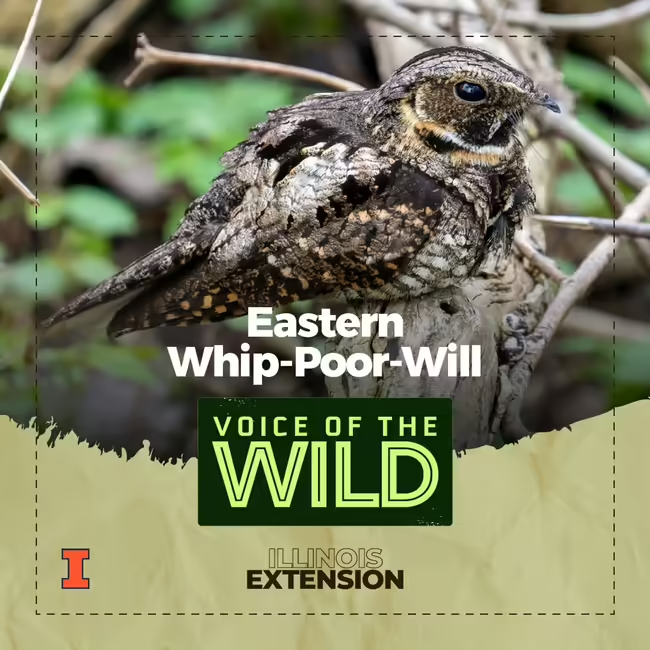
Eastern whip-poor-will (Antrostomus vociferus).
The sound of a summer night in the Northeast.
Do you want to learn more bird songs, frog calls, and insect noises? Join Voice of the Wild every Friday to explore a new wild voice. We’re available on most podcast platforms, including Apple Podcasts, Spotify, and YouTube.
- Subscription links Here
- Subscribe to the Newsletter
- Listen online on our Homepage
The following Cornell Lab | Macaulay Library recordings were used in this episode:
- Eastern whip-poor-will song and growl-cluck by Geoffrey A. Keller (ML507176)
- Eastern whip-poor-will call by George B. Reynard (ML507177)
Sources and more:
- MOON program: https://moon.inhs.illinois.edu/
- Great article in Audubon Magazine about a University of Illinois biologist studying Eastern whip-poor-wills: https://www.audubon.org/magazine/revealing-mysteries-whip-poor-wills-and-what-it-might-take-save-them
- Whip-poor-will in a video game: https://youtu.be/mcu0uzDracc?t=61
- https://www.allaboutbirds.org/guide/Eastern_Whip-poor-will
- https://www.audubon.org/field-guide/bird/eastern-whip-poor-will
- Godfrey, M. A., & Kaufman, Kenn. (Directors). (2004). National Audubon Society videoguide to the birds of North America [Video recording]. In Audubon videoguide to 505 birds of North America DVD I & DVD II (Fullscreen.). Godfrey-Stadin Productions.
- Peterson, R. T., & Peterson, V. M. (1980). A field guide to the birds: A completely new guide to all the birds of eastern and central North America (Fourth edition, completely revised and enlarged.). Houghton Mifflin Company.
- Sibley, D. (2016). Sibley birds East: Field guide to birds of eastern North America (2nd ed.). Alfred A. Knopf.
- Walton, R. K., & Lawson, R. W. (1989). Birding by Ear: Eastern/Central [Compact Disc]. On Eastern/Central birding by ear. Houghton Mifflin Co.
Transcript
This is Brodie with Illinois Extension and I’m here with a new “voice of the wild”
This bird is the subject of famous poems and folks songs, and some listeners may recognize them from video games, which sometimes use the call as nighttime ambience or to alert the player that day has turned to night. That’s a reflection of this bird’s real-life habit of calling out their name on warm summer nights after they’ve returned from foraging moths on the wing at sunset. This is the whip poor will.
The whip-poor-will was once a common sound throughout much of the eastern US, Illinois included…but their numbers have declined substantially. The reason is not well understood but is probably related to insect declines and destruction of habitat by agriculture. If you’d like to help scientists better understand this species, you can join the Monitoring of owls and nightjars…or MOON program. Learn more at the voice of the wild website. Here’s the eastern whip-poor-will again.
Thank you to the Macaulay library at the Cornell lab for today’s sound. Learn more about voice of the wild at go.illinois.edu/VOW
This bird is the subject of famous poems and folks songs, and some listeners may recognize them from video games, which sometimes use the call as nighttime ambience or to alert the player that day has turned to night. That’s a reflection of this bird’s real-life habit of calling out their name on warm summer nights after they’ve returned from foraging moths on the wing at sunset. This is the whip poor will.
The whip-poor-will was once a common sound throughout much of the eastern US, Illinois included…but their numbers have declined substantially. The reason is not well understood but is probably related to insect declines and destruction of habitat by agriculture. If you’d like to help scientists better understand this species, you can join the Monitoring of owls and nightjars…or MOON program. Learn more at the voice of the wild website. Here’s the eastern whip-poor-will again.
Thank you to the Macaulay library at the Cornell lab for today’s sound. Learn more about voice of the wild at go.illinois.edu/VOW