Episode Number
97
Episode Show Notes / Description
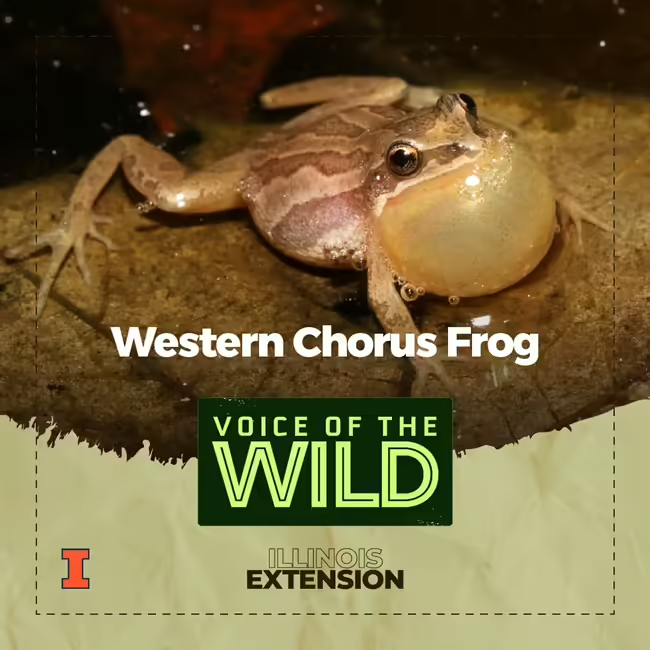
Western chorus frog (Pseudacris triseriata).
One of three chorus frogs found in Illinois.
Do you want to learn more bird songs, frog calls, and insect noises? Join Voice of the Wild every Friday to explore a new wild voice. We’re available on most podcast platforms, including Apple Podcasts, Spotify, and YouTube.
- Subscription links Here
- Subscribe to the Newsletter
- Listen online on our Homepage
The following Cornell Lab | Macaulay Library recordings were used in this episode:
- Western chorus frog call by Jay McGowan (ML555275541)
- Western chorus frog chorus by Geoffrey A. Keller (ML176290)
Sources and more:
- Wisconsin Citizen-Based Monitoring Network https://www.youtube.com/watch?v=pRPoeNcat94
- Nature Museum Calling Frog Survey Resources https://frogsurvey.org/?page_id=9
- IDNR species page: https://dnr.illinois.gov/education/wildaboutpages/wildaboutfrogs/waftwesternchorusfrog.html
- IDNR video series: https://dnr.illinois.gov/education/edu-pages-main/a-f/edufrogtoad.html
- IDNR species video: https://multimedia.illinois.gov/dnr/HDIWestChor.mp4
Transcript
This is Brodie with Illinois Extension and I’m here with a new “voice of the wild”
Said to sound like a fingernail running down the teeth of a plastic comb is the call of a frog only an inch and half long. They’re one of the first frogs to emerge in spring and might be heard in great numbers in ephemeral woodland ponds after the first rains of march. Thought their calls will peak in march, their breeding season runs all the way through May. They’re very secretive, but if you chance upon one up close look for the three dark parallel lines along the back. This is the Western chorus frog
Those three lines on the western chorus frog's back are shared with three other frogs in the Pseudacris genus, each of which are residents of Illinois and give a very similar plastic comb sound. Luckily these three frogs have ranges that only barely overlap; so, In Illinois, If you live north of interstate 70, you’ll hear boreal chorus frogs. Between I-70 and Carbondale, you’re likely to find western chorus frogs, and in the southern tip of the state, beyond Carbondale, you’ll encounter the Upland chorus frog.
Of these three frogs, the western chorus frog has the smallest range, extending only across a few midwestern states. Here’s the western chorus frog again
Thank you to the Macaulay library at the Cornell lab for today’s sound. Learn more about voice of the wild at go.illinois.edu/VOW
Said to sound like a fingernail running down the teeth of a plastic comb is the call of a frog only an inch and half long. They’re one of the first frogs to emerge in spring and might be heard in great numbers in ephemeral woodland ponds after the first rains of march. Thought their calls will peak in march, their breeding season runs all the way through May. They’re very secretive, but if you chance upon one up close look for the three dark parallel lines along the back. This is the Western chorus frog
Those three lines on the western chorus frog's back are shared with three other frogs in the Pseudacris genus, each of which are residents of Illinois and give a very similar plastic comb sound. Luckily these three frogs have ranges that only barely overlap; so, In Illinois, If you live north of interstate 70, you’ll hear boreal chorus frogs. Between I-70 and Carbondale, you’re likely to find western chorus frogs, and in the southern tip of the state, beyond Carbondale, you’ll encounter the Upland chorus frog.
Of these three frogs, the western chorus frog has the smallest range, extending only across a few midwestern states. Here’s the western chorus frog again
Thank you to the Macaulay library at the Cornell lab for today’s sound. Learn more about voice of the wild at go.illinois.edu/VOW