Episode Number
99
Episode Show Notes / Description
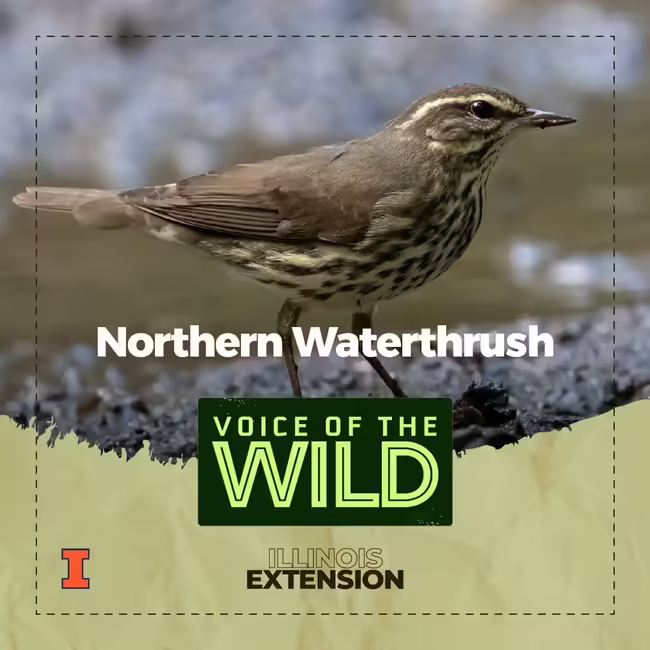
Northern Waterthrush (Parkesia noveboracensis).
The waterthrush with a wash of yellow.
Do you want to learn more bird songs, frog calls, and insect noises? Join Voice of the Wild every Friday to explore a new wild voice. We’re available on most podcast platforms, including Apple Podcasts, Spotify, and YouTube.
- Subscription links Here
- Subscribe to the Newsletter
- Listen online on our Homepage
The following Cornell Lab | Macaulay Library recordings were used in this episode:
- Northern waterthrush song by Robert C. Stein and Eugene Morton (ML508945)
- Northern waterthrush call by William W. H. Gunn (ML508949)
- Louisiana waterthrush song by Randolph Little (ML508941)
Sources and more:
- https://www.allaboutbirds.org/guide/Northern_Waterthrush
- https://www.audubon.org/field-guide/bird/northern-waterthrush
- https://www.sibleyguides.com/2012/08/identification-of-waterthrushes/
- Dobson, C., Kassenbaum, D., Oehmke, D., & Misewicz, M. (2023). Field guide to hotspots and birds in Illinois. Scissortail LLC.
- Godfrey, M. A., & Kaufman, Kenn. (Directors). (2004). National Audubon Society videoguide to the birds of North America [Video recording]. In Audubon videoguide to 505 birds of North America DVD I & DVD II (Fullscreen.). Godfrey-Stadin Productions.
- More Birding by Ear : Eastern/Central. 1994. Boston, Mass: Houghton Mifflin Co. (Peterson field guides).
- Peterson, R. T., & Peterson, V. M. (1980). A field guide to the birds: A completely new guide to all the birds of eastern and central North America (Fourth edition, completely revised and enlarged.). Houghton Mifflin Company.
- Sibley, D. (2016). Sibley birds East: Field guide to birds of eastern North America (2nd ed.). Alfred A. Knopf.
Transcript
This is Brodie with Illinois Extension and I’m here with a new “voice of the wild”
This song belongs to one of the two waterthrushes that can be found in Illinois during spring migration. These are the brown-backed, water-loving warblers that teeter their rear up and down as they forage in flooded woodlands and along the muddy banks of streams. This waterthrush has a wash of yellow in their narrow eyebrow and behind the brown streaks on their chest and neck. This is the northern waterthrush.
Of the two waterthrushes, the northern arrives later in the spring, so a bird found in march or early April is probably a Louisiana, while one found in late April or May is probably a Northern. While the two birds are very similar in appearance, their calls are quite different…the Louisiana’s song starts with a slurred whistle and ends in a jumble, while the Northern’s is staccato and ends as if saying “chew” “chew” “chew”. Here’s the northern waterthrush again.
Thank you to the Macaulay library at the Cornell lab for today’s sound. Learn more about voice of the wild at go.illinois.edu/VOW
This song belongs to one of the two waterthrushes that can be found in Illinois during spring migration. These are the brown-backed, water-loving warblers that teeter their rear up and down as they forage in flooded woodlands and along the muddy banks of streams. This waterthrush has a wash of yellow in their narrow eyebrow and behind the brown streaks on their chest and neck. This is the northern waterthrush.
Of the two waterthrushes, the northern arrives later in the spring, so a bird found in march or early April is probably a Louisiana, while one found in late April or May is probably a Northern. While the two birds are very similar in appearance, their calls are quite different…the Louisiana’s song starts with a slurred whistle and ends in a jumble, while the Northern’s is staccato and ends as if saying “chew” “chew” “chew”. Here’s the northern waterthrush again.
Thank you to the Macaulay library at the Cornell lab for today’s sound. Learn more about voice of the wild at go.illinois.edu/VOW