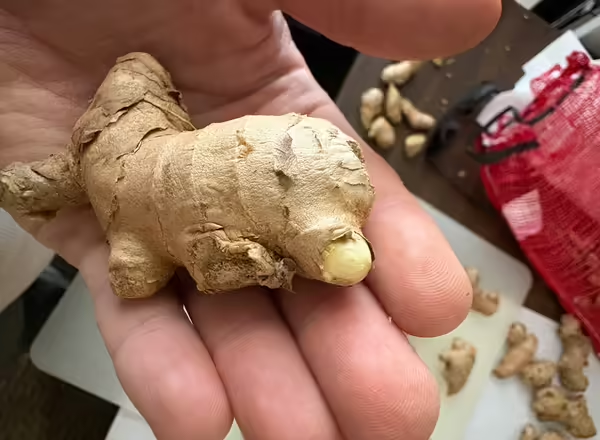
Heading into year two of the Illinois Ginger Growers Collaborative project, fourteen small farmers and six Extension field staff have just received their ginger rhizome seed pieces. Four varieties of ginger rhizome seed from two different vendors are being evaluated for vigor, disease incidence or lack thereof, and yield performance for specialty growers.
The first step in ginger production is the elongated ginger rhizome germination process known as pre-sprout. Unfortunately, there have been issues right out of the gate in 2026 prior to pre-sprout – but it has already provided a learning opportunity.
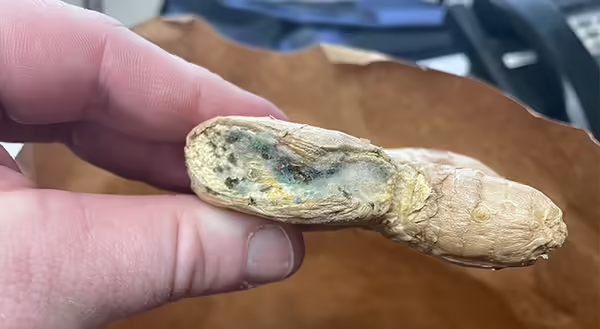
Upon receiving ginger seed stock from the first of two vendors, several collaborators reported incidence of a blue-green mold on the cut ends of most of their orders, shown in this first photo. Samples were immediately expedited to the University of Illinois Plant Clinic in Urbana to identify the causal organism.
U of I Plant Clinic staff diagnosed the issue on seed ginger as “corm and bulb rot – Penicillium sp./spp. – a common storage rot fungus”. The pathogen is external only, on the cut ends of the rhizome seed pieces, which had been cut by the vendor and cured for scab-over before being mailed out. A big thank-you is due to the U of I Plant Clinic staff for expediting and identifying samples.
The good news is that Penicillium-infected portions of seed ginger can be removed, using a sharp knife and isopropyl alcohol for sanitation between cuts, then cut surfaces can be re-cured and planted with generally good crop success, in our limited experience so far.
However, a non-zero amount of Penicillium is almost guaranteed to persist after this process, even with sanitary removal of infected seed rhizome portions. Generally, this is only a storage pathogen that does not persist in the soil during crop development. It is still generally concerning to have sub-standard seed quality prior to the growing season.
Extension field staff are investigating whether a seed treatment for rhizome seed pieces should be recommended for commercial growers that are intent on dispelling risk of Penicillium regrowth, and if so, what those treatment options are.
A seed treatment process that would take place after removal of affected portions, but prior to re-curing (scabbing over) and prior to pre-sprouting would be ideal. Efforts to identify a product or compound that could be used as a pre-plant rhizome dip have been unsuccessful – largely because ginger is such a niche crop that it hasn’t made it onto any major compound’s label.
However, there is one compound that allows for soil or soilless media drench treatment which should reliably control any further Penicillium as well as many other problematic pathogens. Oxidate 5.0 is effective for the control of soilborne plant diseases caused by pathogens such as Pythium, Phytophthora, Rhizoctonia, Ralstonia, Thielaviopsis or Fusarium.
Ginger is not listed on the OxiDate 5.0 label explicitly, simply because it’s a very small specialty crop in the US, and manufacturers generally don’t invest in the EPA registration costs required to add low‑acreage crops to a label. Importantly, the Oxidate 5.0 label instead uses broad “including but not limited to” language for soil and soilless media drenches, which makes those drench applications fully legal for ginger even though the crop isn’t named. Because the label limits pre‑plant dips to specific plant groups (seedlings, cuttings, bulbs, ornamentals) and does not include edible rhizomes, a ginger rhizome dip is not allowed. However, a labeled media drench—before and/or after planting—can still contact the rhizome directly at rates like 1:256, effectively providing antimicrobial activity in place of a dip while staying within label rules.
Here are directions from the Oxidate 5.0 label for Applications Prior to Seeding or Transplanting
- Mix OxiDate 5.0 at a dilution rate of 1:256-1:100 (25-64 fl. oz. per 50 gallons of water)
- Drench soil or growing mediums to the point of saturation
- Wait at least fifteen minutes before planting or watering
Here are directions from the Oxidate 5.0 label for Existing Plantings
- Mix OxiDate 5.0 at a dilution rate of 1:800-1:256 (8-25 fl. oz. per 50 gallons of water).
- Drench soil or growing mediums to the point of saturation.
NOTE: this recommendation has been researched but not yet field tested (will take place in 2026)
NOTE: if at any point the application of Oxidate for pre- or post-plant of ginger rhizome is to be made through irrigation or chemigation systems, refer to the CHEMIGATION section of the Oxidate 5.0 label for further requirements and instructions.
Side by side comparisons of Oxidate 5.0-treated media and untreated media will be used for ginger pre-sprout in the future and results made available through the IFVN, among other information outlets.
Additional research efforts at ginger rhizome seed treatment are underway, as well as understanding potential post-harvest seed treatment options that would allow higher success at holding rhizome seed pieces back for future plantings. Stay tuned for future ginger IPM and crop development updates!