Did you know that many of the invasive plants that landowners, foresters, and conservation workers fight today were first introduced as pretty landscaping plants? It seems hard to believe that one little plant you install in your yard has the potential to rule the world, or at least the nearby wetland.
And yet the truth is apparent as I scan a nearby drainage area, which is overgrown with purple loosestrife, and the nearby timber that is filling with ornamental pear trees. When we plant something in our yards, we are plugging it into a global network of life. And what we do in our yard affects our neighbors and the much larger communities where we live, from the context of a subdivision or an ecosystem.
I am not innocent in the introduction of invasive species. Over my career, I have installed an unknown, but significant, number of landscape plants that are now escaping into natural areas.
What is an invasive species?
When discussing invasive species, it is helpful to answer, “What does 'invasive' mean?” After all, I commonly hear statements such as, “I don’t care if the red flowers attract hummingbirds; that columbine plant is invasive!” While true, the native flower known commonly as columbine and scientifically as Aquilegia canadensis can become a bit of a headache in a manicured landscape; however, it is not an invasive species.
What makes a plant an invasive species is defined in the Illinois Exotic Weed Act, which makes the sale of these plants illegal in Illinois. To be classified on this list as an invasive species, a plant must:
- Not be native to North America
- Spread causing degradation of natural communities
- Reduce the value of fish and wildlife habitat
- Be a threat to Illinois endangered or threatened species
If you would like to dive into the weeds of Illinois rules on invasive species, check out our webpage Illinois Regulations Regarding Invasive Plant Species.
Based on that criterion, columbine’s only flaw in the conventional landscape is that it reseeds unchecked. While you may consider it aggressive, columbine being a native plant, is not invasive. And this is true with many other native plants in Illinois landscapes.
Unregulated Species of Concern
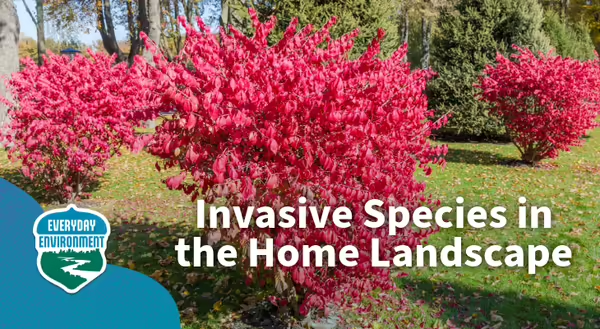
It is a well-known truth that the government works slowly. And getting plants listed as an invasive species is not an exception to this truth. Many non-native plant species, which we are constantly battling in natural areas, are still readily sold and planted in Illinois. Some species of concern are so ubiquitous in landscaping that it would be worth putting money on finding at least one burning bush (Euonymus alatus) or Japanese barberry (Berberis thunbergii) in any given Illinois yard and garden.
Why does it matter what’s in my yard?
The “So what?” commonly comes up when discussing invasive landscape plants.
- “Does it really matter if my burning bush is overrunning a forest a mile away?”
- “At least birds eat the berries of bush honeysuckle.”
- “Purple loosestrife is pretty, and I don’t think it hurts anything!”
- “I like my purple Norway maple! And I’ve never seen it escape.”
- “Just let nature do its thing.”
These are statements I’ve heard when describing the negative impacts of invasive species and recommending ways to remove them from our yards. My rebuttal to this list of statements is that we need to consider food chains.
Plants are the foundation of our local food chain. They are producers that harness the sun’s energy, and that energy is then passed to us, the consumers. Yes, birds will eat invasive bush honeysuckle berries, but most songbird nestlings must eat meat to grow. One thing that makes invasive species so successful is that nothing eats them where they are introduced. When an invasive species displaces the native species, insects lose their food source, and in turn, so do the birds, and the effect is felt up the food chain.
Another important reason to care about how your landscape plants interact with the world is that once natural areas are invaded by non-native species, they lose a significant amount of diversity. As species diversity declines, so does the resilience of that landscape to other stresses such as drought or erosion.
As much as humans can try to distance themselves from nature, the fact remains that we rely on it for our very existence. Healthy soil, clean water and air, functioning ecosystems are what make the transfer of calories from plants to animals possible to meet our human needs.
Should I remove invasive landscape plants?
It is important to note that I may recommend a homeowner to remove an invasive landscape plant, but it is merely that, a recommendation. Even the Illinois Exotic Weed Act does not mandate a property owner to remove the listed invasive plants.
The notion to remove an invasive species is an individual decision. For me, I do not want to contribute to the degradation of natural areas, so the choice is clear. Individually, we are a small player in a big game, but for my part, I want to be a contributor of good or, at the very least, avoid being harmful.
Control options for invasive landscape plants
Scale, budget, and time determine what methods you select to eliminate invasive plants. Practices such as controlled burns, forestry mulching with a skid steer, or expensive sprayers are utilized in large-scale conservation efforts, but are unlikely to be needed in a typical residential landscape. Most tools you’ll need are commonly found in the everyday garage or can be borrowed from a friend or neighbor.
Mechanical Methods
Cut down the plant, again and again...
Repeatedly cutting down the plant removes all its leaves, forcing it to draw energy from its root system to regrow. As the plant regrows, keep cutting it back so it cannot develop leaves, and over time, the roots will starve. This is an effective method when you have one or maybe a handful of plants to kill, but it gets more difficult as the numbers increase.
Some plants, such as an established tree of heaven (Ailanthus altissima), will respond to being cut down by resprouting from the root system, and instead of one problem plant, now you have hundreds. When you cut a plant down and make it angry, we have to go to some additional lengths for control.
Mowing is another option for woody plant seedlings and herbaceous invasive species. Many plants, aside from lawns and common lawn weeds, won’t tolerate constant mowing. However, invasive plants such as teasel (Dipsacus sp.) can adapt to low mowing and still produce flowers and seed beneath the set mowing height.
Pulling
While you can cut down a bush honeysuckle and spend years exhausting the root system, my favorite control for this particular species is to pull the whole plant out of the ground. A small to medium-sized bush honeysuckle is shallow-rooted and pulls up easily when the soil is moist. There are even lever tools to help with the job. Honeysuckle is one of the few woody plants for which hand-pulling can be employed. However, large honeysuckle or shrubs that have previously been cut are very difficult to pull.
Garlic mustard is another fun one to pull. It also makes a great pesto!
Cultural Methods
Competition
By properly siting and caring for desirable plants, you make them more competitive. Temporarily covering soil with mulch or a cover crop can limit seed germination and help to build soil biology in a future planting space. Overseeding wildflower plantings with more native species helps to rebuild the native seed bank. And sometimes you may have to fight an invasive species with an aggressive native plant.
Chemical Methods
Herbicide can be a low-cost, low-labor option for large infestations and large trees and shrubs. Herbicides are a valuable tool, but please use a cautious and conservative approach. Apply the minimum amount of the most appropriate chemical to achieve management goals. Always read and follow product labels before use.
Cut stump treatment
Similar to repeated cutting, except here you cut once and treat the stump with a systemic herbicide to kill the root system. No need to return for future cutting. It is important to apply the herbicide to the stump within 10 minutes of making the cut so the chemical can be absorbed.
Active ingredients and concentrations for cut stump treatment vary by species, but generally, for woody plants, apply glyphosate at a 25% to 50% volume-to-volume (v/v) rate to water. Or triclopyr at 20% to 25% v/v in water. Always read and follow pesticide labels.
Avoid using the active ingredient picloram in home landscapes for cut stump control.
Foliar Treatment
When spraying the leaves of invasive plants, it is best to do so on younger leaves that have not developed a thick cuticle. Springtime or mowing and spraying the resprouts can be useful times for better absorption. Using a nonionic surfactant can also aid absorption. Care needs to be taken to avoid poisoning nearby desirable plants. Use a shield to direct the chemical to the targeted plant.
Active ingredients and concentrations for foliar treatment vary by species, but generally, apply glyphosate at a 2% to 4% volume-to-volume (v/v) rate to water. Or triclopyr at 1% to 2% v/v in water. Always read and follow pesticide labels.
What should I plant?
What you put in your yard is your decision. Native plants help build habitat for our wild friends that we share this world with. And they help to develop a region's identity and give us a sense of place. So yes, plant natives!
I would suggest avoiding invasive species and species of concern, but I’m not a “native-only” person. I am a horticulturist and plant collector. There are some great non-native and well-adapted plant options for home landscapes.
No matter what you choose for your yard, the important thing is to get out and connect with the world around you. It’s important to remember that both you and your yard are a part of it. And while you’re at it, pull some honeysuckle.
Native Plant Options:
Are they invasive? Not legally in the state of Illinois. (Yet!) But we are seeing Callery pear and burning bush escape from our yards into natural areas across the state. Today Ken and Chris talk about these two plants, give some background, and then what we can plant instead of these baddies!...
About Everyday Environment
Everyday Environment is a series of blogs, podcasts, webinars, and videos exploring the intricate web of connections that tie us to the natural world.
Was there something about this blog's topic we didn’t cover? See something cool in nature? Let us know! Hit "Connect with Us" below to send us your question or share your everyday nature observation with and we may share it in a future blog or podcast.