Learn More
- Management of Invasive Plants and Pests of Illinois
- Illinois Pollinators website
- Eight Great Replacements for Callery Pear video
- Attracting wildlife with native plants blog
- Landscape Invasives and Native Alternatives (webinar)
Share your own Everyday Observation
Questions? We'd love to hear from you!
Abigail Garofalo aeg9@illinois.edu, Erin Garrett emedvecz@illinois.edu, Amy Lefringhouse heberlei@illinois.edu
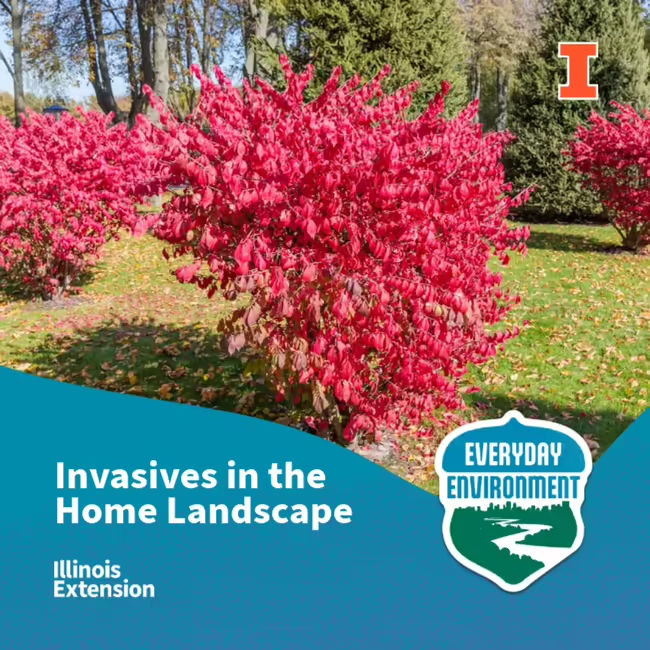
Welcome to another episode of the Everyday Environment Podcast where we explore the environment we see every day. I'm your host, Abigail Garofalo.
Amy Lefringhouse: 00:14And I'm your cohost, Amy Lefringhouse.
Abigail Garofalo: 00:17And today, we are here with Chris Enroth, the horticulture educator with Illinois Extension in Henderson, Knox, McDonough, and Warren Counties, here to chat with us all about invasives in the home landscape. Welcome, Chris.
Chris Enroth: 00:31Well, thank you for having me on the podcast today. I'm thrilled to be here.
Abigail Garofalo: 00:35We're really excited to have Chris. He's not new to podcasts. Listeners may know him from Good Growing, excellent podcast that I promote all across the state when I can because y'all do such good different features like short ones and long ones and interviews and just like information sharing. It's really, really great. So he's a fellow Extension educator with us.
Abigail Garofalo: 00:58And as we all know, Extension educators do many things, have many different kinds of jobs. So Chris, tell us a little bit about what you do at Extension.
Chris Enroth: 01:08Well, thank you, Abigail, for promoting Good Growing. It definitely lends well to Ken Johnson and our inability to focus on any one thing for a prolonged period of time. And so, yeah, but I'm a horticulture educator, and horticulture is a broad field, again, playing into that inability to do one thing for a long time. So I would say I'm a I tell folks I'm a glorified landscaper. I enjoy being outside, outdoors.
Chris Enroth: 01:39I enjoy plants. And then my colleague Ken Johnson with Good Growing, he really has got me hooked on insects now. So I think they're fascinating, and and more people should should like bugs, I think. They're they're pretty neat creatures.
Abigail Garofalo: 01:53I would agree with that.
Amy Lefringhouse: 01:55How long has the Good Growing been going on, Chris? It's been it's been around for a while, hasn't it?
Chris Enroth: 02:00Yes. It has been going strong since 2020, so five years. Uh-oh. I did dabble a little bit in podcasting with Good Growing before that, but it was very irregular. But we do weekly episodes for the last five years.
Chris Enroth: 02:17We've taken in that time, we've taken two weeks off, both around the holidays.
Amy Lefringhouse: 02:23That's amazing.
Abigail Garofalo: 02:25It's crazy. It might be crazy
Amy Lefringhouse: 02:29too, but
Abigail Garofalo: 02:30I'd say we do seasonal, so we do like ten to twelve week seasons in the spring and the fall. So in the winter and the summer, if you're missing out on, you know, hanging out with Amy, Erin, and I, check on over to Good Growing with Chris and Ken. They got some really good nice content.
Amy Lefringhouse: 02:47Alright. Well, during the season, we are focused all on invasive species, and we've talked about invasives communication. We've covered invasives regulation. We've covered kind of a lot of like big picture invasive species. What are invasive species?
Amy Lefringhouse: 03:04So Chris, obviously, as a horticulture educator, you're gonna bring us home. Right? So invasive plants, lots of times, start off as popular, you know, landscaping choices. How did we get to a point where we were like, oh my gosh, we want something cool and different and pretty in our yard. How did we figure out then that some of these pretty plants that we choose have now become kind of widespread problems outside of our yards in our natural areas.
Amy Lefringhouse: 03:38So how did that process happen?
Chris Enroth: 03:39Well, it did not happen overnight. It was a very long process. A lot of energy and effort went into it, and so that's always what I say when we talk later on about control, because we've worked so hard to bring these plants over here and get them established, it's going to take a lot of effort also to control them and manage them. But that's for later on in the show. But how did they become so easily established?
Chris Enroth: 04:03What makes them invasive? Would say, well, when you are a nursery grower or a landscaper who wants to sell plants, you know, you need there's several criteria, but I would say three main criteria you need. You need a plant that when you put it out in the landscape, nothing is going to eat it, nothing's going to damage it, no bugs, it's going to be resistant to deer, and so that's one. So nothing finds it appetizing. The other thing is it needs to be able to grow in a multitude of locations and soil conditions, site conditions, because you want to sell a lot of these plants and so you want to be able to sell them in Illinois, Missouri, Indiana, Washington State, California, Santa Fe, New Mexico, Florida, you want a very adaptable plant.
Chris Enroth: 04:48And then the third criteria is it's got to be easy to propagate. You know, easily takes cuttings or roots readily, it readily seeds itself, you can easily germinate a reliable stock. And when you have all three things, a plant that's easy to propagate, nothing eats it, and grows anywhere, you have a perfect recipe for an invasive species. And so that's really where I see that criteria that goes from a pretty landscape plant that looks great in the yard to then all of a sudden becomes a monster out in our natural areas.
Abigail Garofalo: 05:24I was just gonna say as you're describing that, I'm like, what are the classic characteristics of invasive species? The three things you described. You know, we often hear the word invasive. People use it pretty loosely. I feel like in extension, we truly try and button up our language.
Abigail Garofalo: 05:39But you know, my mom will even say she'll be like, oh, that milkweed. Isn't that really invasive? Right? And she's talking about like common milkweed. Right?
Abigail Garofalo: 05:48And so in simple terms, what actually separates an invasive plant from one that's just like aggressive or hard to manage in your yard?
Chris Enroth: 05:55This comes up a lot. And I agree, Abigail. I do think it is really important for us to be pretty clear about this language because when I talk about an invasive species, I'm talking about like a list that has been created legally through the process of politics at the state level to deem these particular species as an invasive species. And so that is actually if people want to learn more about it, it's actually the Illinois Exotic Weed Act is the actual name of that particular legal thing. And there's a few other rules and regulations of different lists that also we could discuss later the noxious weed law and the injurious plant rule and all that.
Chris Enroth: 06:39But really when we talk about invasive species, we are talking about the Illinois Exotic Weed Act, which is it defines specific species as invasive. And for a particular plant species to get on this, it has to meet some criteria. So it has to be non native, so it has to not originate in North America, and it also has spread in a way that damages our local ecosystems, that can degrade our local wildlife, our local aquatic habitat, and there's also some economic harm that usually goes into play here as well. So environmental economic harm and a non native species. And when it meets all that criteria, then they deem it as invasive.
Chris Enroth: 07:25But you're right, I hear so many times folks will say, oh, that big bluestem, it sure is an invasive species. Well, it sure is aggressive. Yes, it is definitely aggressive, but maybe not invasive. I mean, if you have a small backyard and you put cup plant back there, which is a type of silphium, I think I love cup plant. It is one of the neatest things to have out in a prairie.
Chris Enroth: 07:54Maybe not in like a 10 by 10 planting bed where it's going to take over and become a monster. You know that's an aggressive plant. It's a native plant but it's aggressive. But we're not going to put this on an invasive species list and tell folks you're not allowed to sell or propagate this. And that's really what the Illinois Exotic Weed Act does.
Chris Enroth: 08:14It states you are not allowed to sell, propagate, divide, distribute this plant. It's not saying anything about removing it. It's just saying don't spread it, don't sell it. So yeah, we have lots of aggressive species. We have aggressive non natives.
Chris Enroth: 08:31We have aggressive natives. We even have aggressive non native but adapted plants. So I like to point folks to dandelion. Dandelion is not a native species. Neither is creeping Charlie, neither is like a narrow leaf plantain, but they're super aggressive in our home landscapes, but they're adapted plants, which means they're not going out and out competing our native plants.
Chris Enroth: 08:54So they're not a threat to our native ecosystems, our wildlife habitat. So yeah, if you have an aggressive plant, that's definitely one thing, but to be an invasive plant, it's a whole other level of legal definition.
Abigail Garofalo: 09:09So well, this leads me to kind of ask, if it's not on the list in Illinois, but maybe it's on another state's list or it's maybe on, like, a watch list. Like, for example, Callery Pear was just added. But we had been kind of been talking about its detriments or issues prior to that. How would you could we call that plant invasive because of its qualities, but it's not quite gone through the legal process yet?
Chris Enroth: 09:35When I'm giving a formal presentation, no.
Abigail Garofalo: 09:39That's a really good point.
Chris Enroth: 09:40Yeah. Yeah. When I'm talking to an audience, I want to, again, make sure that my terms that I'm using are accurate, well defined. I would call some of those like callery pear, what I define, I call them species of concern. And maybe like Abigail and Amy, you're on sort of the separate team within Extension.
Chris Enroth: 10:01You've had these conversations like what do we call these plants that are not added to the invasive list, but are acting as an invasive. They act like an invasive species. So with our team with Extension, we call them species of concern. Do you have a name that you call these particular plants like Callery Pear?
Abigail Garofalo: 10:19Sometimes for us, I think we look at consensus in the literature or among so if it hasn't gone through the legal process yet, I think there's the scientific definition of invasive, and then there's the legal definition, the political boundaries that we have to because those so I think we and I think that's a huge struggle because, like, it's not as clear of a line. I really like the way that your team has approached it because it's very nice to be like, there is no like, this is the black and white, and I feel like people, as a communicator, like, need that boundary. So it kinda makes me think about how I communicate with it now, especially because I've talked with forest preserve managers who are like, well, I manage it like an invasive in this area because it's a problem in this area, even though it's native or it's not listed or whatever. So it kind of provides a lot of those clarifications that I think I have been struggling with communication wise because I'm often relying on messy scientific consensus, which is difficult to achieve but also takes a lot more background work. And anecdotal evidence tends to override those too quickly in in our kind of public spheres.
Amy Lefringhouse: 11:30So There's a lot of stakeholders
Amy Lefringhouse: 11:32in the sphere, in in the sphere of plants, you know, retail and scientific and, you know, education and, you know, kind of there's lots of different stakeholders within there so that as clear language as we can provide is best. But like you said, Abigail, sometimes it can get a little fuzzy gray.
Abigail Garofalo: 11:51The example I'm thinking of is, like, burning bush. Like, we know burning bush is a problem. We've seen it. Land managers are managing it. But if you go to Facebook groups, the home gardening Facebook groups, you will see people be like, I don't know.
Abigail Garofalo: 12:05It's been around for this many years. I don't see it in my natural like that anecdotal evidence feels really overwhelming for these home gardeners versus if it's on a legal list. So calling it a species of great concern is a great way to, like, showcase and just tighten up that language. So that way it's not like, well, it's on the list, but it's not on the list, but like, you know, it feels a little
Chris Enroth: 12:28more When when we when we communicate these things too, it it it's also important that we are clear with definitions of things because when we have a consumer go somewhere and they say to the nursery owner, How dare you sell burning bush? Don't you know this is an invasive species? Well, nursery owner would know that because remember the Illinois Exotic Weed Act, it prohibits the sale of these plants, and so it would be illegal for them to sell that. So then the nursery owner can say this is not an invasive species, and the person will say well no, I heard Illinois Extension say it was. And it was like, well, no, hang on.
Chris Enroth: 13:04It's a species of concern. It's not yet a listed invasive species. That helps with communication outside of this area, yeah.
Abigail Garofalo: 13:16And credibility. Right? Like, if I go and they said, well, they said it was invasive and then I have a trusted seller tell me that it's not. Now I'm like, well, now I've lost trust in one of
Abigail Garofalo: 13:28those institutions. And we definitely don't wanna be the institution they lose trust in either. And we don't wanna, in good faith with certain with industries as well, like, we wanna be on the same page about that language. So really, really good point.
Amy Lefringhouse: 13:39Well, we talked a little bit about burning bush, and we talked a little bit about language. How do you think homeowners should think about plants that maybe aren't regulated but do raise concerns? Like, you know, how how should they approach those, like, species of concern that we were talking about?
Chris Enroth: 13:55I think it is important, you know, from the get go, to avoid planting them. So like step one, don't plant this plant. Step two, if you have this plant, consider removing it. But then when kind of we back up a little bit to like before step one, if you want to go out and you want to purchase plants, I think it is worth having a conversation with your local nursery dealer, you know, saying, hey, know, I wish you had more native plant options. Might not necessarily be beneficial to you or them to go in and then accuse them of selling burning bush, which is an aggressive spreading species of concern.
Chris Enroth: 14:33But instead having a conversation of what would you like to see, Because in the end of the day, that nursery grower, that garden center retailer, they want to stock what people will be buying. And so the economics is a big player here because it's really hard to regulate plants that are in high demand. So consider what is that investment of the nursery grower as well. So a horticulture, I have to talk a little bit for the green industry, the landscapers out there. They spend a significant amount of time and money getting especially woody plants ready for market.
Chris Enroth: 15:08So shrubs is going to be a couple years, but when we talk about trees getting those ready for market, you might be spending like half a lifetime getting a particular tree variety, cultivar, whatever prepared for market. So that's a significant investment of time and money. And then when they're growing those out to then distribute them at these nurseries, I mean, we're talking at least five years and sometimes ten years to have viable plant stock for sale when we're talking about trees. So it's a significant time thing that goes into that. So like with Callery Pear recently being listed, it's not going into effect right away.
Chris Enroth: 15:45They're still dragging their feet on kind of having an actual invasive species, so retailers still allowed to sell Callery pear, I think, until is it 2028?
Abigail Garofalo: 15:55I yeah. I just looked it up. It's 2028, January 1.
Chris Enroth: 15:582028. Okay.
Abigail Garofalo: 16:00Yeah. So the growing season of '27. Right? Like, you're not gonna plant and buy a tree in January 1. Yeah.
Chris Enroth: 16:07So so so even that, like, they're and and, you know, conservationists have been talking to our legislators here in the state and so has the green industry, and so there's kind of these two sides of this coin here that they're trying to balance out. But again, if a lot of people are buying Callery Pear, if they're making a lot of money off of that high demand, it's gonna be harder for them to say, well, maybe we'll make it illegal to sell this plant that people like.
Amy Lefringhouse: 16:35Mhmm. Right.
Abigail Garofalo: 16:36Yeah. I definitely like that supply and demand. Right? It's like it always goes back, I think, back to our water season, right, when we talked about economics, and we were like, it's supply and demand. Right?
Abigail Garofalo: 16:44That's what we remember about economics. And that's a big thing for a lot of these aspects. And, you know, time for two, like, policy changes internally. A lot of these, like, Callery Pear, for example, was like the standard parkway tree for a lot of neighborhoods and communities. And so these policy changes have to go into effect in these pieces and the investment and time.
Abigail Garofalo: 17:03And think about your favorite local nursery. Right? Like, you pay a little extra for their prices because you know the plants are good. You tell them they can't sell one of their biggest inventories, they might go out of business. So giving them time to prepare those so these small and, like, these local growers could transition.
Abigail Garofalo: 17:24We get a lot of calls in extension. We, you know, we get, you know, what should I plant? Where does it sit? Where where should I put this? So we get a lot of questions that are like, does what I plant really matter beyond my property line?
Abigail Garofalo: 17:36Like, it's this it's my space. My neighbor planted something I didn't like of theirs. Does it affect mine? Does it actually affect, like, the nearby forest preserve or natural area or things like that? You know, what would you say to some of those homeowners who are asking those questions?
Chris Enroth: 17:51Yeah. I do get a lot of that, you know, when presenting topics of especially plants that maybe people have a more personal connection with. Maybe they planted that callery pear or that burning bush with their child or a loved one. So it's hard to then hear someone like me standing up at the front of a room saying, you should cut it down. And so there are various personal connections people have with certain plants and so it's complicated, it's not necessarily black and white for that.
Chris Enroth: 18:24But I would say think about, yes, it definitely does impact those adjacent areas and then even sometimes beyond that. I recall, you know, when I first started training my brain to see callery pear escape the natural areas, I couldn't recognize, I didn't know what it was. And I was, we were at a property near Macomb, over a 100 acre woodland property deep into this forested area, and we're all kind of just standing there staring at this tree like, what is this tree? It was growing probably 25, 30 foot tall, like nobody knew what it was. And it wasn't until like, you know, maybe the next day, like the light bulb went off, like it's callery pear growing in the middle of an oak hickory forest, no other callery pear, no other landscaped areas nearby, and some bird must have deposited that seed there.
Chris Enroth: 19:20And so they do spread And we do see this because remember our criteria for becoming an invasive plant, that also makes it so that they can outcompete a lot of our other native plants. And they can become, in the case of Callery Pear maybe a dominant mid canopy, upper canopy tree, in the case of burning bush or bush honeysuckle was once also touted as a plant to put in your yard and your field edge, that can become a dominant understory shrub. Garlic mustard can become a dominant ground cover, and so they can outcompete and we can lose a lot of diversity this occurs. Another instance where I saw kind of the effect of the invasive qualities of burning bush and bush honeysuckle, it was a place in Macomb. It's with Western Illinois University called Horn Field Campus.
Chris Enroth: 20:16And what they did is they had these two slopes that terminated down at the bottom was a creek. On one side they did a treatment. They controlled and removed all the invasive bush honeysuckle and the aggressive burning bush, and on the other side they left it alone. And this wasn't an official research project, it was a demonstration. Yeah.
Chris Enroth: 20:39So I can't quote any published data, but when we toured there, the professor said, now look at both slopes. And we looked at the treated slope, it was covered in herbaceous vegetation that was already there in the seed bank, it re sprouted once the invasive plants were gone. It was a nice little blanket of understory woodland plants. We look at the other side of just burning bush and bush honeysuckle, completely denuded soil underneath those plants because it wouldn't allow anything herbaceous to grow there, and what they had observed in this demonstration was increased erosion from runoff coming off the top of the hill down the slope into the creek. So again, not published data, just observational from this demonstration project at Horn field Campus in Macomb.
Chris Enroth: 21:29But I mean, you could clearly tell this is bare soil underneath these plants and this is covered soil on this other side. So it was definitely eye opening for the effect that these plants can have in our natural areas.
Abigail Garofalo: 21:41And then a water quality challenge created there as well.
Chris Enroth: 21:45There you go.
Amy Lefringhouse: 21:45Was buckthorn was that encouraged in landscapes too? Yes. Like to be I we found some on some parkway area or not park way, but like a boulevard in Quincy on our tree inventory. And I was like, oh, did people do people plant I didn't know that they were horticulturally planted. We don't really mess with buckthorn a lot down here in this part of the state, but I know Abigail up north.
Amy Lefringhouse: 22:07It's bad bad.
Abigail Garofalo: 22:07Yeah. There are 30% of the tree cover in Cook County is buckthorn. That's like a crazy number. They did an assessment with the Morton Arboretum. And so it's I think it's actually higher than 30%, but like 30% I know it's, like, in the one third of tree story.
Abigail Garofalo: 22:26But, anyways, the you will see, like, hedges up here, people's properties of Buckthorn. And I remember, actually, they have, like, very good documented records of of the forest preserves of Cook County. They've gone through like a whole like if you want to know the history of how restoration has evolved as a science, look at an old forest preserve and how they used to manage and how they manage now. Because they were called like, they're like, we're a forest preserve, so we just plant forests and trees. And so even if it was prairie historically or a different like a wetland or anything, they're just gonna plant trees on it at one point.
Abigail Garofalo: 23:07Like, that was kind of their mindset. And so they you they have an inventory of all the trees that were planted, and European buckthorn is on the list as, like, planted in the forest preserves of Cook County, which just, like I said, is, like, very telling of restoration culture and how it's shifted over time and how we manage and how this science has grown.
Chris Enroth: 23:29Someone actually brought in an old I think it was Illinois Department of Natural Resources flyer that maybe they or their folks picked up back in the 50s or 60s, and it was for bird habitat. Now, there was IDNR, but they said they got it at an extension event way back when. And they were like, plant these plants for birds. And I think it was like bush honeysuckle, autumn olive, buckthorn, like all of these things that we now try to fight and that are listed as an invasive species.
Abigail Garofalo: 24:03Mhmm. Which tells me why it's important to pay attention to the concern, like the plants of great concern. Right? Because at one point, a lot of these ones that, like, are, oh gosh. If you have buckthorn just, like, growing in your yard and you have to manage for it, like, it's not the hedge that you cut, it's actually like the piece you're managing, it it is a nightmare.
Abigail Garofalo: 24:24Right? Like there's it is just a giant woody invasive that's horrible and annoying to manage for. And so you're like, why on earth? Like but then when you think about that was a plant of great concern at one time, it has to fall it follows that pathway. So if you hear that something's a plant of great concern, you know, it's something it should buzzer in your brain when you're looking at what to plant or maybe assessing what what's on your site and where to prioritize because you can't redo your whole site at once.
Abigail Garofalo: 24:52But, like, where do you pick? Pick the barberry.
Chris Enroth: 24:56Oh, I hate barberry.
Abigail Garofalo: 24:58That's the staring at it right now.
Amy Lefringhouse: 25:00I can look at
Abigail Garofalo: 25:03my list.
Amy Lefringhouse: 25:03I can look out my window and see a few of them on the list for sure on this on the greatest concern or the species of concern list. So that brings us to then, like, if you do have it in your yard, invasive plants in your yard, you know you have it. Like, I know my parents have Callery Pear. I can see it in their front yard, and I well, my dad teases me about it. I think we're gonna go try to pick some more up before 2028, Amy.
Amy Lefringhouse: 25:28What do you think about that? And I'm like, no. Stop being mean. But no. So if if folks know that they have some of these invasive plants that we've talked about in their yard, what are some, like, realistic ways that they can start dealing with them without, you know, being over overwhelmed?
Amy Lefringhouse: 25:50Because they could be stuff that they planted, but they also could be like, you know I think in your blog, you talked about beyond the fence line, but lots of times, it's kind of it could be in a in a town setting, like maybe the edges of your yard or your property where you don't pay as much attention to and you've got tree of heaven, you know, growing.
Abigail Garofalo: 26:11A really popular thing up here, people don't think of it because we we don't have, like, ours are, like, quarter acre lots bigger. But they're like fences, and I see this a lot. It's like, it grows on the fence and into the fence. And so it's like nobody wants to manage for it because, like, it's like my neighbor should pay to remove that or I should pay to like, so, like, that's where a lot of those grow Mhmm. Is what I'm thinking of, Amy.
Amy Lefringhouse: 26:34Mhmm. Mhmm. So, Chris, what do you think what could homeowners do if they have these situations?
Chris Enroth: 26:41Well, my first maybe stop for them is maybe to check-in with their local extension office. We can give like general recommendations here today, but depending on the species that you're dealing with, so tree of heaven responds in certain ways versus Norway maple, which will respond in a different way to certain treatments. And so I would say first stop, check-in with your local extension office. And we also do have resources online. The management of invasive plants and pests of Illinois, there is a digital version of that.
Chris Enroth: 27:16I have this I have the printout of it next to me all the time. I mean, is next to me every day. I use it constantly. That goes into individual species and control recommendations for them. But I would say for most homeowners, we're dealing on a much smaller scale.
Chris Enroth: 27:33So you don't need to go out and buy a UTV with a fire skid on it so you can start burning your backyard. Don't have to invest all this money, and most of the tools that you need you're going to find them in your own garage or your neighbor will have them that you can borrow. I would say the easiest thing you can do right off the bat, cut it down. You know, if you want to control it, identify a particular plant, you just cut it down. Doesn't mean you're going to kill it, but you're at least starting with one step.
Chris Enroth: 28:04Now, that works with certain species. I mentioned tree of heaven. If you cut that one down, you're just going to upset it, and it's going to respond vigorous resprouts from its root system. And if you want to learn how far a tree root system goes, do that. You'll be shocked.
Chris Enroth: 28:25Where all of these suckers are going to sprout from that tree of heaven root system. Maybe it'll be very educational. I have seen a mature tree of heaven get cut down in a front yard, and there were suckers popping up going underneath the alley, and then in the neighbor's yard, and then under the fence and underneath the other neighbor's swimming pool. It's crazy how far these roots can go. And so with tree of heaven, there's a little bit different treatment for that.
Chris Enroth: 28:57But I would say generally, I mean, if you want to start somewhere, just start cutting them down. Bush honeysuckle will respond also very angrily, so you have to come back and continually cut that top growth off. And essentially what I mean by cutting it down is we're going to get rid of its food supply. Leaves, they photosynthesize, they feed the plant, and if it can't photosynthesize, if it can't feed itself, eventually those roots will starve themselves. Now at a backyard scale, that's totally achievable.
Chris Enroth: 29:21If you have like five acres of timber to do, that's not necessarily practical. But you you come in, you cut it over and over again, I call it the rope a dope method. It eventually will starve the plant to death. But it might take a couple years to do that. Especially with bush honeysuckle, what I really find satisfying is to pull it up out of the ground.
Chris Enroth: 29:45Bush honeysuckle is so shallow rooted, especially for the small to medium sized ones. Those pull up pretty easily or you can purchase a lever online. And the levers all have clever names. There's the polar bear. There's all these other I have a couple of them just because I like the names of them.
Chris Enroth: 30:01But there's these levers that help pull them out, but that's one way to do it. But probably if you don't want to come back and cut this particular plant over and over again, if you cut the stump and you treat it within ten minutes with a glyphosate or Triclopyr solution, it's a chemical herbicide that's systemic, it'll go down and kill the roots, that's going to be the quickest for you.
Amy Lefringhouse: 30:26Just to tag on to that then, because I'm like thinking of my dad, right, in his callery pear in his front yard. And I'm like, dad, you know, chop chop. Like, it needs to be, you know, those funny jokes online that you see. Maybe maybe we're the only ones that get these jokes, but it's like prune your calorie pear horizontally one to two inches off of, you know, from the ground. The things.
Amy Lefringhouse: 30:51But he's like, but I like my tree there. I like a tree. I want a shade tree there. Do we have recommendations that to replace those those maybe calorie pear or something some other kind of like shrub maybe that that can feed the birds that are not going to be on those lists?
Chris Enroth: 31:07Yeah, we do have alternatives, and so I think the if we go back to that old IDNR publication for feeding the birds, know, that's feeding them berries, which that's only focusing on one part of their life cycle. Yeah, sure, maybe a cardinal will eat a berry. It'll eat a bush honeysuckle berry or autumn olive berry, whatever. It'll eat a callery pear fruit. But that's not what they feed their babies.
Chris Enroth: 31:35To get new birds we have to grow them and to grow them we need protein. And so when you're selecting new plants and this kind of flies in the face of what the horticulture industry has been trying to do for so long, create plants that nothing eats, an unappetizing plant, consider your local food chain, your local food webs. We need bugs to eat our plants because then the birds take those bugs and they feed it to their nestlings, which then helps us to grow more birds, and it affects the entire food chain from there on up. So you know, when you are selecting new landscape plants, holes in the leaves are not necessarily a bad thing. Now there are some cases, so like with linden trees, I love linden trees.
Chris Enroth: 32:20The American linden is a beautiful tree, amazing pollinator tree even. Bees love this particular one, but so do Japanese beetles. Japanese beetles being an invasive species, and if you want to protect your linden tree, well now you have to treat it with a systemic insecticide which gets we know we have proven that that systemic gets into the pollen of the flowers which then affects the bees. So it's so complicated. I think it's so complicated but really at its core you know our Oaks are a great replacement species, want to see diversity, So we do have some resources online.
Chris Enroth: 32:59We do have our Illinois pollinator website. We've started listing tree species on there as well as herbaceous perennials. And then we have a few webinars also people can check out online that goes into alternatives for those. So instead of burning bush, which yeah, it's got red fall color, that's about all it does, consider planting aronia, black chokeberry. It's got beautiful red fall color, it has berries for the birds to eat, and it's got white flowers in the spring, and so it provides multiple seasons of interest, it provides habitat, it provides food for more than just the adult life stage of say a songbird.
Chris Enroth: 33:40So yeah, let's think about the wider spectrum of the life cycle of our wild creatures that we share this world with, our backyards with, consider food for their babies, food for the adults, because I really feel like and you probably have Peggy Anesi on this program a lot, so I'm gonna steal a quote from her. When they start reproducing in your backyard, you have succeeded. And that's the goal. Right? If if you are conservation minded, you want them to reproduce in your yard.
Abigail Garofalo: 34:09You know, I don't know if Peggy has ever quoted that on our on our podcast, and she's on our podcast, like, all the time. Yeah. She's on our pod, like, like, almost every season. We're like, Peggy, will you be on the podcast? So so funny.
Abigail Garofalo: 34:24I also I think that's just like a great mindset. Like, I think that's what we all are trying to do here at Everyday Environment is like, think about it as a whole. You know, a lot of the times we want, like, easier fixes like, oh, I want birds, so I'm gonna put up a bird feeder. And our answer is always, well, think about the bird as a whole. Provide homes for the bird.
Abigail Garofalo: 34:42Provide protein for the bird. Right? Like, provide like, overall, if it's truly for the birds, think about how we can support the bird overall. And so I love this kind of, like, holistic mindset that a lot of our listeners can walk away with of, like, this think about it as a whole. It's I know it's more complicated, and this is why I love that you offered, like, talk to your local extension office.
Abigail Garofalo: 35:04We've already had that brain exercise. We know some good recommendations. We might ask you a few questions. Well, what are you looking to do? You know, what do you want out of a plant that you're looking in your yard?
Abigail Garofalo: 35:14Why are you putting it up? Is it for privacy? Is it for habitat? Is it for, you know, beauty? And then we already have a nice little, you know, index of of of plants that we're pushing through or we're sending resources to that that party does all those things for you a little bit.
Abigail Garofalo: 35:31And so you don't have to feel like you know everything if you're looking to do it. You just have to call the people. I say this all the time. You don't have to know everything. You just have to know the people who know things.
Chris Enroth: 35:41I would also say give yourself some grace. And give your neighbors grace too, but if money were no object, my yard would look totally different than it does today. But I can't I don't have the budget to put in the habitat that I want, to put in all of the plants that I may want. And so if again, one step at a time, if that's all it is, put in one plant this year. One plant that contributes is better than nothing.
Chris Enroth: 36:09So I would say that's how I put my landscape in. It is very piecemeal. It is one plan at a time. It is, you know, when do I have the money and the time to do this stuff? So completely understand.
Chris Enroth: 36:23And also extend that grace to your neighbors. As we mentioned before, people have different interactions and different life experiences with their landscape, they have different emotions towards it. Try to make those productive conversations that you may have if you're talking about their burning bush. Don't make them accusatory. Instead, invite them on a hike.
Chris Enroth: 36:44Let's go on a hike. And you're like, oh, Okay, there's that burning bush that you also have in your yard. Looks like it's spreading and kind of invading this area. It is I also feel like maybe we're preaching to the choir here to the folks listening, but there's a lot of people who just don't care either. They're just trying to go on day to day trying to do their thing.
Chris Enroth: 37:07So give everyone a little bit of grace. You know, nature is something that not everybody is tuned into. Some people are very afraid of it. So it takes little steps one at a time.
Abigail Garofalo: 37:19And I love what you offered was like offering the relationship with those people. Right? People you could say, well, my local extension educator and this local researcher said this until they're you're blue in the face, but it's their trust in you as the neighbor that's gonna help with those kinds of decisions. So it's like, you know, be the friend that people feel comfortable coming to you saying, what do I plant? I don't care enough to research or look into it.
Abigail Garofalo: 37:45What do I plant? Right? Like, you're not an expert, but I like you, and you lay, and your yard looks cool. Right? Like and I think that's a great way to approach these kinds of conversations.
Abigail Garofalo: 37:56So Yep. Well, thank you so much, Chris, for sharing your knowledge on just, like, insights into the horticulture industry invasive species and management in our home landscape. Now we are going to finish today's episode with everyday observations where we highlight the mundane and normal of our environment that is actually really interesting. So Amy, I'm gonna pick on you to go first.
Amy Lefringhouse: 38:19Okay. So my everyday observation is something that I've been watching that I did I think because I was going to do some talks on phenology, I paid a lot of attention to like what was blooming early. And, you know, a silver maple, you probably can find anywhere, you know, speaking of, like, the corners of your yards and things like that. There's silver maple are here, there, and everywhere. I've been watching a silver maple, just the red buds, then like the next step of like the bud burst, and then the next step of these really funky weird looking like flowers that it produces.
Amy Lefringhouse: 39:03So yeah, that's my everyday observation is something as simple as a maple that I probably just ignored most of my life and not paid attention to in the spring has some really cool things that are happening. In fact, I've cut some off and like put them in a vase just to bring in my house because they're so funky and weird. And you know, I've talked to my kids about them and pointed them out, and of course, they rolled their eyes and told me I was a nerd. But anyway, yeah, that's my everyday observation. Just kind of the cool buds and bud bursts and blooms on a on a red maple in the spring or silver maple.
Amy Lefringhouse: 39:43Excuse me. Silver maple.
Abigail Garofalo: 39:44Yeah. You know, Chris mentioned earlier, like, once you trained your eye to, like, the callery pear and seeing it, once you kind of train your eye to seeing some of these phenomena, you you very much, like, start to, like, oh, oh, like and your car rides might be just, like, a little distracting, so definitely be careful. But, yeah, definitely, like, really, really cool. I'd love I'm excited to see. I always love to see, like, when the flowers burst on the trees because unless it's like an obvious flowering tree, you don't think about it.
Abigail Garofalo: 40:13A lot of people don't think of it. Right? Like but they have flowers. Like so, yeah. Really, really neat.
Abigail Garofalo: 40:19Very cool, Amy. Alright, Chris?
Chris Enroth: 40:21You know what? I one time, one year, I spent the entire spring photographing it's a hybrid red maple we had in our backyard, a place we used to live, and I spent that entire spring photographing everything from bud expansion, bud break, flower expansion, leaf expansion.
Amy Lefringhouse: 40:39Yeah.
Chris Enroth: 40:41It was so neat. I still I still look at those pictures of this day and I'm like, all the colors and all of the texture, everything that goes on just in that window of a few weeks of that tree is just amazing.
Amy Lefringhouse: 40:53I have a really cool and I'm like blabbering, but my sister back in college made me this, and I still actually oh man, if you guys could see, I have it actually hanging on my wall in my office. But she got some little tiny early emergent leaves of some oaks, different oaks, red oak, white oak, you know, burr, And they're like tiny. I mean, probably like listeners, maybe like three quarters of an inch long, just like newly emerged, and she pressed them in books. And then she arranged them on this I don't know. It's like a piece of cardstock or some kind of like pressing, you know, paper and then just, like, smooshed them between some pieces of clear plastic, and I still have them.
Amy Lefringhouse: 41:37But I just think it's, like, this the neatest thing because we're early on. Those leaves are just, like, teeny tiny, but they look, you know, almost exactly like they do as an adult or adult leaf, a a fully, you know, developed leaf. So, anyway, I love that stuff.
Abigail Garofalo: 41:53Very cool. Yeah. And I love that it was also something that you could just observe anytime. Like, you're like, there's maples everywhere.
Amy Lefringhouse: 41:59Everywhere. Yeah.
Abigail Garofalo: 42:00You could just just keep an eye out. And it's a really recognizable leaf. Alright, Chris. What's your everyday observation?
Chris Enroth: 42:09Well, it it is probably my favorite springtime observation, and that is when I see my first morning cloak butterfly. So morning cloak butterfly, this particular species overwinters as an adult, and it will even come out in like warm days in February, March to feed, and then it will go back when it's a way to think it's cold again. But when I see my first morning cloak butterfly, I'm like, it's starting. Spring has begun. And so but at our old house that we used to live at, I would always see them.
Chris Enroth: 42:45And I was so sad when we moved because we went a few springs, I didn't see them, I didn't see them. And then just this last spring, I saw two. Two at once, and I was so excited. And so I look forward every year to seeing the morning cloak butterfly, and actually that same day I also saw a tiger swallowtail. I'm like, Where'd you come from?
Chris Enroth: 43:07But but the morning cloak, I think, is a it's a fascinating butterfly. You know, beyond the monarch, it has just a very interesting life cycle. So folks, check it out online.
Amy Lefringhouse: 43:17Check it out. What about you, Tell us.
Abigail Garofalo: 43:21Yeah. So mine is actually from last fall. So there was all over our community that we were in that I live in, there was this black, sticky substance that was showing up on everything, like on our trash cans, on the leaves of plants, on our Halloween decorations, on everything. And it was, like, whole community wide. And at one point, there was, like, questions about, like, environmental degradation of, like, was it from, like, airplanes flying overhead?
Abigail Garofalo: 43:57Was it from, you know, the local food factory plant or whatever, like, pollution in the air, whatever, all these things, and everybody's brain went to environmental degradation. And the EPA actually did come out and do an assessment, and it was cotton and maple scale. It was bug poop? It was it's a honeydew, but It was bug poop. So the cottony maple scale is a type of insect that is goes on on maple trees, and we have silver maples out the wazoo in my area, and is the leaf ones.
Abigail Garofalo: 44:37And so you could actually see them in the fall when the leaves fell. You could see the cotton kind of like insect. And they have a lot of these insects release something called honeydew, which is just like the excess sweet Chris, you probably know this a lot better than I do. Like sweeter sticky substance that gets released. It's not sap from the tree.
Abigail Garofalo: 45:01It's from the insect. And it gets sticky on everything, and then that particular honeydew is prone to something called sooty mold, which is what makes it that black, dark color. And so I just thought it was really interesting that it was like a natural resource phenomenon and not environmental degradation phenomenon Mhmm. That everybody was seeing that was due to, like, the fact that we have, like, an overabundance of maples. So it was seen community wide.
Abigail Garofalo: 45:26People were like, I didn't even park under a tree, and it's still there. And I'm like, well, there's still a maple across the street. Like, so it it was just kind of crazy to, like, think about. And I was like, wow. Like, this is like an extension educator's, like, dream to explain.
Abigail Garofalo: 45:41Like and so so, yeah, it was just really cool, really neat, and also really annoying to clean off my Halloween decorations. Yeah. I love my plants. So so, yeah, we're like, how do we get it off? People would be like, I, you know, sprayed three times, and, like, I would go to the car wash and it wouldn't come off.
Abigail Garofalo: 45:57And so whole thing. So but, yeah. So that's my everyday observation.
Chris Enroth: 46:03That's very cool.
Amy Lefringhouse: 46:04It's probably wasn't cool, but also cool, you know, at the same time.
Abigail Garofalo: 46:09I was nerding out in the sense that it was cool.
Amy Lefringhouse: 46:12Yeah. I did
Abigail Garofalo: 46:12not find it cool on my car. So well, Chris, thank you so much for joining us again. It's been a pleasure to have you and just to chat with you.
Chris Enroth: 46:21Well, thank you very much, Abigail Amy, for having me. I I really appreciate the opportunity to to come on the Everyday Environment Podcast. My first time, so this is fun. Thank you for having me.
Abigail Garofalo: 46:33Of course. And if you enjoyed hearing what Chris had to say and wanna hear a little bit more, definitely check out Good Growing. Great podcast, great blog as well. They also have an email listserv, so definitely sign up for their weekly emails. Theirs come out on Friday.
Abigail Garofalo: 46:47So if you're like, Thursdays, I get my fill, and then I'm just empty on Fridays. Definitely, you can get you can get, you know, that fill into the weekend. So well, this has been another episode of the Everyday Environment Podcast. Check us out next week where we talk with Kelly Estes and Tricia Bethke about invasive pests. This podcast is University of Illinois Extension production hosted and edited by Abigail Garofalo, Erin Garrett, and Amy Lefringhouse.
Abigail Garofalo: 47:13Marketing and communications are by Emily Steele.
Chris Enroth: 47:18University of Illinois Extension.