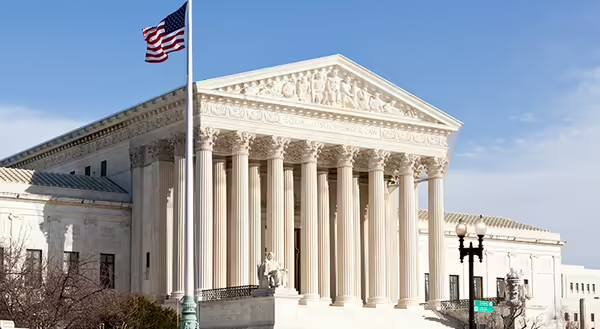
Among the many topics making headlines in 2025, agricultural trade policy has been one of the most discussed and impactful for agricultural producers in central Illinois and across the United States. At the center of this has been tariffs on imported goods. There have been legal challenges to these tariffs, with one reaching the Supreme Court of the United States. Argued on November 5, 2025, Learning Resources, Inc. v. Trump will significantly influence how tariffs are imposed and U.S. trade policy overall. This blog post will cover the history of tariffs and U.S. trade policy, the events leading up to this case, and the arguments on both sides. Understanding this case helps explain how tariffs and trade policy decisions in Washington, D.C. can affect farmers, businesses, and communities here in central Illinois.
What are tariffs, and how have they been used?
Before exploring the legal arguments and history of the case, it is important to first consider what tariffs are and how they have been used throughout U.S. history. As discussed in a previous post on this blog, a tariff is a tax imposed by a government on goods brought into the country (imports) or sent to other countries (exports). According to a Congressional Research Service report, the three main goals of tariffs are to generate revenue for the government, to protect domestic industries by raising the costs of imported goods, and to serve as leverage when negotiating trade deals with other countries. The authority to impose tariffs in the U.S. is exclusively reserved for the federal government, specifically outlined in Article I, Section 8, and Article I, Section 10, Clause 2 of the U.S. Constitution. The first law on tariffs was passed in 1789, recognizing tariffs as a tool to help pay the nation’s debt and protect U.S. manufacturers.
For much of the early period of our history, tariffs were the main source of income for the federal government. In fact, during the early 1800s, economic issues in Europe led to a decrease in transatlantic trade, which reduced tariff revenues and caused the federal government to raise taxes domestically. Around the time of the Civil War, land sales and income taxes became the primary sources of revenue. The ratification of the Sixteenth Amendment to the Constitution and the passage of the Underwood-Simmons Tariff Act in 1913 established income taxes as the main source of federal revenue.
In 1928, the U.S. Supreme Court ruled in J.W. Hampton, Jr. & Co. v. United States that Congress had the authority to allow the president to adjust tariff rates in response to changing conditions. In 1930, to protect domestic businesses and agricultural producers, Congress passed the Smoot-Hawley Tariff Act, significantly increasing tariffs. This act is seen as the last Congressional act that specifically set tariff rates. This is because, in 1934, Congress passed the Reciprocal Trade Agreements Act, which allowed the president to adjust tariff rates by up to 50% and to negotiate trade agreements with less Congressional oversight. This power was further expanded with the Trade Act of 1974, which allowed the president to modify tariff rates without needing approval from Congress.
Facts and events of Learning Resources, Inc. v. Trump
On April 2, 2025, President Trump declared an economic state of emergency. This declaration highlighted several issues that had contributed to worsening economic conditions and threatened the U.S. economy. These included unbalanced trade deficits with other countries, differing tariff rates, and a decline in domestic manufacturing. The declaration increased tariffs on many countries and used the International Economic Powers Act (IEEPA) as the basis for this authority. Section 1701(a) allows the president impose tariffs on countries that pose a threat to the U.S., and Section 1702(a)(1)(B) allows the president to regulate import and export activities with those nations.
Learning Resources, Inc. and other companies involved in this case are domestic firms that design educational toys and products for children, many of which are manufactured in other countries. Learning Resources, Inc. filed a lawsuit on April 22, 2025, challenging the president’s authority under IEEPA to impose tariffs. The U.S. District Court for the District of Columbia issued an injunction that prevented these tariffs from being enforced on May 29, holding that IEEPA does not authorize the president to impose tariffs. This injunction was stayed by the U.S. Court of Appeals for the District of Columbia days later while it reviewed the case. The Supreme Court agreed to hear the case, and oral arguments took place on November 5. The main question being considered by the Supreme Court is whether IEEPA allows the president to impose tariffs.
Arguments of both sides
At the core of the argument by Learning Resources, Inc. were four key elements.
IEEPA does not permit tariffs
Learning Resources, Inc. argued that IEEPA only allows the president to regulate imports and exports during a declared emergency. Imposing tariffs is not part of the plain meaning of the word “regulate,” and Congress did not intend to grant the power to impose tariffs when it enacted IEEPA. Even when looking back to the Trading with the Enemy Act (50 U.S.C. 53, also known as TWEA) of 1917, Congress has only permitted the president to regulate exports, not to impose tariffs. Learning Resources, Inc. also notes that no president has used IEEPA to impose tariffs before. .
Only Congress can impose tariffs
The next key point in Learning Resources, Inc. argument is that the Constitution only permits Congress to regulate foreign commerce and impose tariffs. While the president has broad powers over foreign affairs and policies, imposing tariffs is not included in that broad authority. Allowing the president to impose tariffs in this way could weaken the traditional separation of powers between the executive and legislative branches.
Emergency powers should be limited
A portion of the arguments presented by Learning Resources, Inc. focuses on the president’s ability to declare and exercise emergency powers. The Supreme Court has allowed the president to exercise special powers during emergencies. In Youngstown Sheet and Tube Co. v. Sawyer (343 U.S. 579, 1952), the Supreme Court ruled that President Truman could not use his powers as the Commander in Chief of the armed forces to resolve a labor dispute. Justice Jackson outlined three levels of presidential power: the first, when presidential power is at its highest, occurs when the president acts based on authorities explicitly granted by Congress; the second, when the president acts without explicit congressional authority, is described as a twilight zone that must be evaluated based on the circumstances; and the third, when the president acts against explicit congressional authority, is when the president has the least authority.
Economic harm caused by the tariffs
The last argument made by Learning Resources, Inc., and others who wrote in support of their case, is that allowing a president to impose tariffs whenever they wish could result in economic impacts and make it difficult to conduct their business as usual, especially internationally.
On the other side, the arguments made by President Trump revolved around similar points.
IEEPA’s authority and language are broad, and presidents have been able to use similar powers before
The President argued that earlier court decisions have allowed tariffs as a way to regulate imports. Specifically, the President cited McGoldrick v. Gulf Oil Corp (309 U.S. 414, 1940), Gibbons v. Ogden (22 U.S. 1, 1824), Board of Trustees v. United States (289 U.S. 48), and Free Speech Coalition, Inc. v. Paxton (606 U.S. __, 2025) as prior cases recognizing tariffs as an essential element of regulating foreign trade. .
The president needs to act swiftly during emergencies
When there is an emergency, President Trump argued that there needs to be quick decisions and actions taken to protect the United States. If the Supreme Court rules that the president cannot use IEEPA to impose tariffs during emergencies and must wait on Congress, this would limit the president’s ability to respond quickly.
Tariffs are important tools to protect the U.S. economy
The final part of President Trump’s argument is that tariffs must be used when negotiating trade deals with other countries. If only Congress has the power to impose tariffs, it could stop the president from securing favorable trade agreements and enable countries to harm the U.S. economy.
Why this matters to central Illinois
Trade policies and tariffs are topics that affect more than just policymakers in Washington, D.C.; they impact agricultural producers and other businesses across the U.S. and central Illinois. Imposing tariffs on other countries can influence how many agricultural products are exported, which can directly affect market prices for local producers and reduce their income. Tariffs can also raise the costs of production and increase prices for equipment and essential inputs. The Supreme Court’s decision in this case will settle an important question: Can a president use their emergency powers to impose tariffs without Congress? The ruling will shape how trade policies are made for years and decades ahead, sending ripples from Washington, D.C. to our fields, factories, and communities.