The United States Department of Agriculture (USDA) is one of the largest federal government agencies that employs thousands of employees and oversees countless areas of federal agricultural policy. From crop insurance to commodity support programs, to research at universities, and much more, the USDA plays a vital role in nearly every aspect of agricultural production in the United States. Another important role the Department plays is in administering is conservation programs. Programs such as the Conservation Reserve Program (CRP), the Environmental Quality Incentives Program (EQIP), and the Conservation Stewardship Program (CSP) aim to improve soil health, wildlife habitat, and water and air quality by offering incentives to landowners and producers. A recently published USDA Economic Research Service (ERS) report examines trends in funding and adoption of these programs between 2002 and 2025. This blog will go through the report and discuss information that is important for landowners and producers here in central Illinois.
A Brief Overview and IRA Changes
With all the conservation programs administered by the USDA, one important question comes up, where does the money come from? While the USDA administers and spends the money in these programs, it is Congress who allocates the funding. This is usually done during the Farm Bill reauthorization process. The “Farm Bill” is a piece of legislation that provides funding and parameters for nearly all the programs overseen by the USDA, usually reauthorized every five years. The report notes that, over the last 20 years, there has been a major increase in funding for these conservation programs. In the 2002 fiscal year, approximately $4.1 billion was allocated for conservation. This number has increased to approximately $5.7 billion in the 2024 fiscal year but was as high as $8 billion in the 2020 fiscal year. The following programs accounted for nearly 90% of conservation funding through the USDA:
- Conservation Reserve Program: approximately 26 million acres enrolled (as of October 2024), with $2.2 billion spent in fiscal year 2024.
- Environmental Quality Incentives Program: $1.9 billion spent in fiscal year 2024 on conservation practices such as cover crops and brush management.
- Conservation Stewardship Program: $922 million spent in fiscal year 2024 to help support the adoption of conservation practices.
- Agricultural Conservation Easement Program (ACEP): $416 million in fiscal year 2024 to preserve approximately 1 million acres of wetlands and agricultural land from commercial or residential development.
- Regional Conservation Partnership Program (RCPP): $283 million in fiscal year 2024 to partners such as state and local governments to solve regional conservation issues.
In addition to the funding allocated in the Farm Bill, additional funding was added for these conservation programs through the passage of the Inflation Reduction Act (IRA) in 2022. The IRA made approximately $19 billion available through 2031, with $8.5 billion allocated to EQIP, $4.95 billion to RCPP, $3.25 billion to CSP, and $1.4 billion to ACEP. As of the end of the 2024 fiscal year, approximately $5.26 billion has been allocated to these programs.
Trends and Benefits
The conservation programs administered by the USDA can be generally separated into three different categories. Working-lands programs provide assistance to adopt conservation practices on land being used for production. Long-term easement programs are used to prevent agricultural land from being developed for residential or commercial purposes. Land retirement programs preserve wetlands and agricultural land from erosion and other environmental changes. The report goes into the general trends and changes across the various programs.
Conservation Reserve Program
CRP was first established in 1985 and used contracts to convert land into vegetative cover or to preserve grazing grasslands. The program is capped at 27 million acres for the entire United States, which is lower than the original 40-45 million acre cap when the program first began. There are three general subprograms under CRP: general signups, continuous signups, and grassland. General signups allow for landowners to submit offers enroll parcels that meet certain requirements and request a rental rate to adopt a practice. At the end of the 2024 fiscal year, approximately 7.8 million acres were enrolled at an average rental rate of $57.25 per acre, which results in an approximate cost of $446.5 million. Continuous signup allows for partial field practices (such as filter strips), determined by environmental needs and feasibility of the practice. There were approximately 8.4 million acres enrolled in continuous signup at the end of the 2024 fiscal year at an average rental rate of $150.26 per acre, resulting in an approximate cost of $1.26 billion. Grasslands CRP allows landowners to enroll rangeland, pastureland, and other grasslands to maintain grass cover. This has become the largest subprogram since it was first introduced in 2014, with 9.8 million acres enrolled at the end of the 2024 fiscal year at an average rental rate of $15.74 per acre, costing approximately $154 million.
Environmental Quality Incentives Program
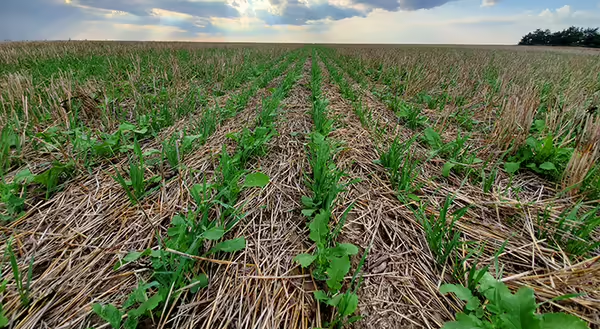
EQIP was first implemented in 1996 to help farmers and other producers adopt conservation practices on their operations. The program has seen its funding increase from roughly $400 million in 2002 to $2 billion in 2024. Cover crops have been the most funded practice in the program, accounting for around 20% of practices. Fencing to keep livestock out of waterways has been the second-most funded practice at slightly below 20%. The other highly funded practices include brush management, waste storage facilities, and sprinkler systems.
Conservation Stewardship Program
CSP is similar to EQIP, with the main difference being CSP being intended to help producers keep utilizing conservation practices, while EQIP seen more as an “entry-level” program. In fiscal year 2023, prescribed grazing practices were the most used (in terms of acreage), with pest management conservation system practices being the second-most used.
With all these programs and the significant amount of money available for these programs available to the USDA and farmers/landowners, what are the benefits of these programs? The report notes that it may be hard to fully understand the benefits, but there have been studies that have sought to offer some clarity. One study from 2022 estimated annual water erosion decreased by 70 million tons, and annual wind erosion decreased by 94 million tons due to the adoption of conservation practices supported by USDA conservation programs. Another study from 2024 estimated that CRP practices that aimed to improve water quality reduced nitrogen losses by 361 million pounds and phosphorus losses by 79 million pounds.
USDA conservation programs continue to play an important role in protecting soil, water, and wildlife while supporting productive farms. The ERS report shows that these programs have grown and changed over time, with more funding and more focus on practices that help farmers manage their land in a sustainable way. Whether it is CRP protecting sensitive acres, EQIP helping farmers adopt new practices, or CSP rewarding long‑term stewardship, each program offers tools that can improve the health and resilience of farms.
For Illinois producers and landowners, these programs matter a great deal. Our state depends on fertile soils and clean waterways, and many of the conservation concerns highlighted in the report—such as erosion, nutrient loss, and the need for more soil‑building practices—are challenges we face here at home. These programs also help support the goals of the Illinois Nutrient Loss Reduction Strategy and provide options for both row‑crop and livestock operations. As funding continues to grow and more opportunities become available, Illinois farmers and landowners can use these programs to strengthen their operations, protect their land for the future, and contribute to healthier natural resources across the state.