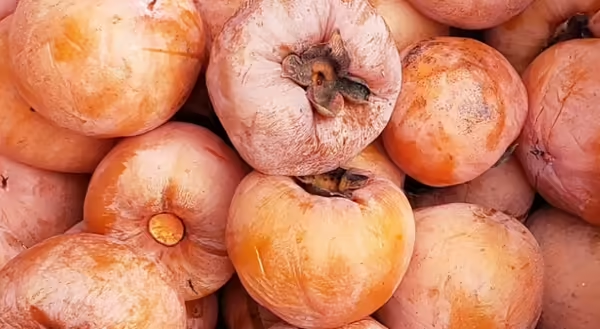
Two years ago, I wrote a column about American persimmon (Diospyros virginiana) to spread awareness about the lesser-known tree – especially as an option for Bloomington-Normal area home orchardists. Having learned, tasted, planted, and taught more about it, I wanted to provide more information about this up-and-coming fruit tree.
General information
Wild American persimmon is diecious – meaning that individual persimmon trees are distinctly male or female. Male trees produce pollen, while female trees produce flowers.
American persimmon is native to the southeastern United States, including much of Illinois – though not the Bloomington-Normal area. The northernmost point they can sometimes be found in Illinois woodlands is an imagined straight line drawn West to East through Decatur, according to the most recently published USDA map of the American persimmon’s native range.
Wild American persimmon fruits when ripe are typically ping-pong ball-sized or so, with a beautiful light to dark orange color. Like pawpaw, many of a tree’s ripe fruits fall to the ground when ripe. Their pulp is the desired component of the fruit, but their skins are extremely tannic.
To enjoy wild persimmon pulp, it is essential to process them through a food mill or conical sieve, to extract the pulp from the skins and seeds. Going to all this work yields a healthful reward. Persimmon is high in antioxidants, Vitamin A, C, fiber, and potassium, among other nutrients.
American persimmon can be planted for fruit production, wildlife attraction (deer and many others love them), and landscape aesthetic. Their large, green, glossy leaves turn beautiful shades of yellow, orange, or red in the fall, providing great color contrast.
Does American persimmon grow near Bloomington?
While we can’t find the persimmon naturally in McLean County, Diospyros virginiana IS very cold hardy, thriving in USDA Zones 4a and warmer. So, although it should do here well if planted.
For example, a nearby small farmer has a good track record of persimmon production for her fruit business. Teresa Brockman runs Sunny Lane Farm/Teresa’s Fruit and Herbs in Eureka, Illinois, and has several improved American persimmon varieties that have good track records of production.
“Some years are better than others with this variety or that, like any other fruit tree. This year, one variety dropped early – I suspect the late summer heat waves caused it – but our other varieties produced OK,” said Brockman.
McLean County Master Gardener trainees taste their first persimmon pulp
I reached out to Teresa in October to order and freeze some persimmon fruits for an upcoming Master Gardener training in November. I had created a PowerPoint presentation to spread the good persimmon word to our trainees, but I knew a taste test would provide the most interest.
I bought 5 pounds of a cultivar called ‘John Rick’, and I also had a couple of pounds of frozen native, wild persimmon that was purchased from a local farmer in December 2024. I processed both types of fruit easily through a food mill – though the wild-type fruits took longer due to many more seeds per fruit that blocked the food mill holes. After some work, I had several cups of pulp.
My persimmon presentation for the Master Gardener trainees went over well, but the tasting of wild and improved fruit samples was the obvious highlight of the morning; I took notes of what was said.
For those that have never tasted persimmon, ripe pulp has a sweetness comparable to an overripe apricot. The texture is smooth and custard-like, comparable to pumpkin pie puree.
Flavor notes of improved-cultivar persimmons include honey, caramel, pumpkin spice, dried dates, brown sugar, maple sirup meets apricot jam, and more. Wild-type pulp tastes to me like a less intense, less detectable version of all these words.
Back up – what does “improved cultivar” or “improved variety” mean?
As with many other species of fruit, plants, or trees found in the wild, native persimmon fruit is OK. They’re small, the skin is tannic (bitter, not good) but the pulp is tasty. The fruits are small – could be bigger. The fruits have too many seeds – could do with less. This was the case with the wild apple, the wild plum, the wild grape, and so-on.
Then passionate individuals (think Johnny Appleseed-types) played with crossing their pollen, saving and distributing their seeds, grafting the branches of a better tasting tree or vine onto an already-growing tree or vine – and eventually you get something like a Honeycrisp apple – probably the most well-known and better-tasting apples in the world. The same thing has been and is currently happening, with American persimmon.
Cornell University plant breeders in New York, many private persimmon breeders across the country, and most recently Savann Institute scientists in Illinois and Wisconsin have been trying for decades (or just a few years) to make this fruit better in pretty much every way – and there are now some well-known varieties of improved American persimmon, like ‘Early Golden’, ‘Lehman’s Delight’, ‘Claypool’, ‘Yates’ (Juhl), ‘Killen’, and many others. They all have fewer seeds, bigger fruits, less tannic/bitter/astringent skin, and some of them are even self-fruitful – not needing a male tree to pollinate them.
What I planted this past year and what I will plant in 2026 – and why
In 2025, I planted three ‘Nikhita’s Gift’ persimmon at the Refuge Food Forest in Normal, Illinois. This tree is especially interesting because it is an Asian/American hybrid persimmon cross, and because it is from a breeder in Ukraine.
Asian persimmons are typically much larger than American persimmons, don’t have astringent skin, have fewer seeds, etc., but they are not hardy to Zone 5b/6a – the USDA Grow Zones around Bloomington-Normal. Asian/American hybrids can provide the best of both worlds if they work out. I found ‘Nikhita’s Gift’ on a vendor’s website that sells persimmon trees for whitetail deer food plots, and according to the vendor and other sites, it is rated for Zone 5b. So, I figured we would try it out.
Later, I found reviews on other websites that say it has very iffy fruit production performance due to the flowers’ susceptibility to freeze damage – though those reviews also said the tree itself would probably live on. Two of the three trees seem to be growing well, with one lagging behind.
In 2026, I will try germinating the seeds from the ‘John Rick’ fruit. Germinating seeds of dioecious fruits like persimmon or apple will yield offspring that are like their parents but different in one or many ways. My goal for germinating these seeds is to try growing them out as persimmon seedling rootstock in 2026 for a full year, and then grafting dormant branches (scions) of improved-cultivar trees like ‘John Rick’ or others onto them in the spring 2027 season, for eventual 2027 planting.
Finally, I’ve ordered yet another improved cultivar American persimmon tree called ‘Garretson’ that I know nothing about, other than what is on the vendor description; “hardy to Zone 5, (a? b?), tasty, ripens in October, good producer.” The proof will be in the persimmon pudding, as they say.
Upcoming persimmon episodes on the Good Growing Podcast
The Good Growing Podcast will soon be releasing one full-length episode and one shorter, “Garden Bite” episode where the two hosts and I discuss American persimmon in more detail and cover various aspects of production not covered in this update. If readers would like to learn more, head on over to the Good Growing Podcast’s YouTube page and monitor the channel for new episodes. If you have any questions, comments, grower success stories or more, please reach out.
Though you may not be eating persimmon pudding as I will be this Christmas, consider ordering some wild-type or improved (hardy to Zone 5b) persimmon trees this off-season, plant some next year, water them, and wait a while.
WRITER: Nick Frillman is a Local Food Systems and Small Farms Educator with University Extension, serving McLean, Livingston and Woodford Counties. Nick provides research-based educational programs that empower growers to make sustainable choices on their farms.
ABOUT EXTENSION: Illinois Extension leads public outreach for University of Illinois by translating research into action plans that allow Illinois families, businesses, and community leaders to solve problems, make informed decisions, and adapt to changes and opportunities.
###
University of Illinois | U.S. Department of Agriculture | Local Extension Councils Cooperating
University of Illinois Extension provides equal opportunities in programs and employment.
If you need a reasonable accommodation to participate in this program, please contact us.
Early requests are strongly encouraged to allow sufficient time for meeting your access needs.