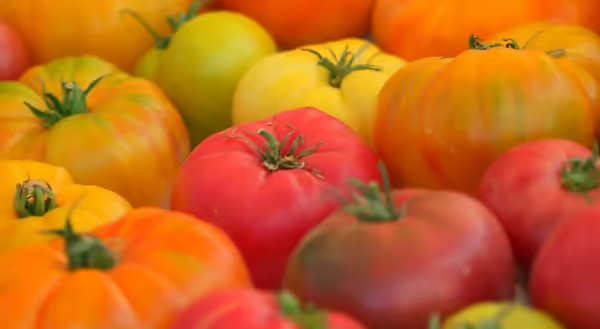
Winter may have just started, but now is the time for home gardeners and market growers alike to flip through troves of seed catalogs and plan the 2026 planting season. Many of the top performing varieties are labeled (F1) or (F1 Hybrid) after the cultivar name, while others might be labeled “heirloom”. While both options have annual impacts on our local food system, which to choose depends on user end goals, weather and soil conditions, personal philosophy, and much more.
F1 Hybrid – What Does It Mean?
“F1” stands for first filial hybrid. An F1 hybrid seed is produced by intentionally crossing two carefully selected parent plants of the same species. Each parent has been bred over time to express certain traits. Those might be good disease resistance, smaller or larger plant size, better fruit quality, etc. When the two parent plants are crossed, their offspring (the F1 seeds growers buy) will produce plants that are uniform, predictable, and have the best traits of their parents.
To name a few benefits, F1 hybrids will outyield heirloom varieties in less space, have increased disease resistance, and have increased drought or cold tolerance. Taken together, these and other benefits are often referred to as “hybrid vigor”. F1 hybrids are the typically the correct choice for growers seeking to maximize pounds of tomatoes, bunches of kale, heads of lettuce, etc.
Two other often-cited benefits of F1 hybrids are uniform size of the crop and near-identical harvest timing. For example, grape tomatoes ready to be plucked and packaged from F1 plants would be nearly the same size, and all arrive to dark-red color at once.
NOTE: F1 hybrids are not GMOs (genetically modified organisms). They’ve been created using traditional plant breeding, not genetic engineering.
What Do Heirloom Seeds Offer?
On the other hand, heirloom or open-pollinated varieties are not designed for absolute uniformity or maximum yield. Instead, they are stable cultivars that have been maintained through repeated seed-saving. When properly isolated (though few people do this), they will grow true to type, allowing growers to replant them year after year.
Heirlooms offer several benefits that might not show up on the yield chart, but that customers frequently note and value. For example, flavor, texture, and aroma of heirlooms are often superior to hybrids. For this reason, diversified growers that can reliably produce heirloom vegetables and market them to clients that value culinary quality over yield tend to be successful, especially by supplying higher-end restaurants with ingredients that are the dreams of chefs the world over. But that’s a gamble on the part of the grower – they may be vulnerable to pests or disease – or not.
Further, many well-known heirlooms – ranging from potatoes and tomatillos to lettuces, eggplants, onions, and more – originate from specific regions of the world. Those heirlooms can carry deep cultural meaning for both growers and consumers like shared histories, traditions, and foodways.
The Key Tradeoff: Seed Saving and Dependence on Seed Companies
For all their benefits, the biggest limitation of F1 hybrids appears in the next generation (F2). A grower who saves the seed produced by an F1 hybrid plant will see offspring plants that vary wildly in size, flavor, yield, disease resistance and more – typically for the worse. Why is this?
F1 plants are strong because they have two different good versions of many traits from their parents that are dominant, and suppress the weaker, recessive traits of the plant parents in the first year. But in F2, those good traits get separated or excluded, poor traits can show up again, and the special boost of the F1 method is gone.
What this means is F1 growers must purchase new seed each year to have a productive season. This DOES create a massive dependence on commercial seed companies, but it does also guarantee consistency of crop production season to season for both growers and consumers.
Heirloom seed has the upper hand in this situation because it can be saved annually without losing major traits. What’s more, if a grower continues growing a dent corn like Bloody Butcher or a tomato like Brandywine in McLean County year over year, over time these example varieties would adapt to our exact climate and soil type. It is not an uncommon occurrence to have heirloom growers report slow but sure increases in yield annually as they adapt heirlooms to their environment.
For growers big and small, the choice of F1 hybrid vs. heirloom is not about right versus wrong, it’s about strategy, customer preference and end-use, short and long-term goals, and more. Many successful home and commercial growers select BOTH heirloom and F1 hybrid crops every year, which allows for a nice balance of crop reliability, showcasing of flavor and diversity.
WRITER: Nick Frillman is a Local Food Systems and Small Farms Educator with University Extension, serving McLean, Livingston and Woodford Counties. Nick provides research-based educational programs that empower growers to make sustainable choices on their farms.
ABOUT EXTENSION: Illinois Extension leads public outreach for University of Illinois by translating research into action plans that allow Illinois families, businesses, and community leaders to solve problems, make informed decisions, and adapt to changes and opportunities.
###
University of Illinois | U.S. Department of Agriculture | Local Extension Councils Cooperating
University of Illinois Extension provides equal opportunities in programs and employment.
If you need a reasonable accommodation to participate in this program, please contact us.
Early requests are strongly encouraged to allow sufficient time for meeting your access needs.