Plant a Small Fruits Garden and Increase Perennial Household Food Security
The spring thaw is happening albeit in fits and starts. Gardeners across central Illinois are chomping at the bit to plant their annuals. But they should also consider planting certain perennials this year.
There has never been a better time to plant small fruits in the home garden. Small fruits – once be bearing fruit and in production – enhance household food security, enhance interaction with nature and the home landscape, and provide visual interest during the growing season, among other benefits.
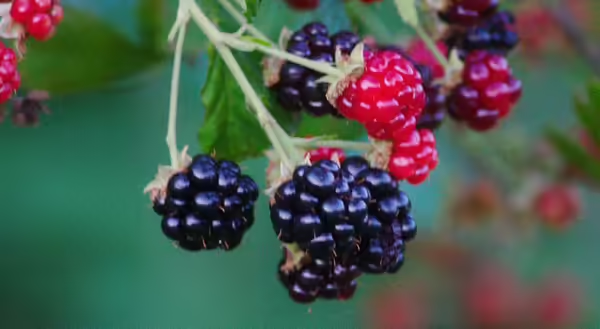
Strawberries, blackberries, red raspberries and grapes are tried-and-true additions to home gardens and small farms that with a little TLC will pay their way. These small fruits have been grown for generations and have a proven track record of production in central Illinois.
A good selection of strawberries, blackberries, raspberries, and grapes are now widely available annually at local mom-and-pop garden centers as well as big-box outdoor stores during the spring planting season. Growers should have no problem locating a business in their area that has these plants available.
All four of these crops establish well when planted spring, require minimal maintenance in their first year outside of regular watering, starter fertilizer, and occasional weeding, and are generally productive by their second or third season in the ground.
Culturally, these four types of small fruits make up most of all small fruits planted in the United States annually, and for good reason. There are never enough fresh berries to go around. Fruit growers in Illinois growing culturally common fruits typically sell out at farmers markets during the growing season before the markets themselves end.
Beginner-level varieties of these small fruits that Central Illinois growers should think about planting are as follows:
Strawberries: ‘Earliglow’, ‘Allstar’, ‘Honeoye’, ‘Jewel’, ‘Annapolis’
Blackberries: ‘Chester’, ‘Natchez’, ‘Ouachita’, ‘Ponca’, ‘Caddo’
Red Raspberries: ‘Boyne’, ‘Latham’, ‘Heritage’, and others
Grapes (Table/Fresh Eating): ‘Reliance’, ‘Somerset’, ‘Mars’, ‘Concord’, ‘Tomcord’, ‘Niagra’
It is recommended if home gardeners are thinking about purchasing and planting any of these plants to wait until danger of frost has passed if any leaves are present on purchased plants.
In Bloomington, on average, the last frost date is between May 1-May 7. More cautious growers should wait until May 14. Gardeners are advised not to wait any longer than that to purchase locally, as there will not be much selection left.
Gardeners may prefer purchasing online from reputable vendors of berry plants instead of purchasing locally. There can be several advantages to doing so. First, there is typically many more selections of these berry plants available online versus locally. Second, reliable nurseries will allow buyers to pay for plants now and then they will ship them only when it is an appropriate time to plant them upon receiving them.
Bare-root plants shipped from vendors to buyers typically arrive in April, do not have any leaves on plants, and can tolerate near-freezing temperatures with minimal if any damage. Notably, most commercial berry shippers will also have a 1-year survival guarantee. They should be planted when received.
Strawberries, blackberries, red raspberries and grapes all desire full to mostly full sunlight environments to grow to their true potential, but all of them will still produce some fruit if grown in at least 60% full sun. If a garden corner is empty but just a little shady, give a few small fruits plants a try there. They may produce well. Who doesn’t like the possibility of a fresh strawberry or blackberry right off the plant?
Gardeners take heed; some of these small fruits need support structures/trellises. Raspberries and blackberries, sometimes and grapes, always. If growers are just getting started with small fruits, strawberries or thornless, upright blackberries, or red raspberries are a great place to get started.
Finally, if growers would like small fruits candidates for their gardens but are struggling to locate a spot with 60% or more sunlight, black currant or American elderberry may be good options. These two small fruits plants are shade tolerant, thriving in 50% sun/50% shade areas consistently. Though they are not generally available at big-box outdoor stores, local nurseries in the area are beginning to stock these plants due to growing customer demand. Call around, and if they are not available locally, reach out to your local Extension office with questions about sourcing of high-quality black currant and American elderberry plants.
Elderberries when ripe need mild heat treatment by cooking to break down cyanide-based compounds in them that render them toxic if eaten raw. More cautious growers could instead elect to have American elderberry as part of the landscape for their beautiful flowers – a valuable nectar source for many native pollinators – and leave the berries for the birds. Alternatively, give elderberry a pass and plant black currant. No cooking necessary, and the berries are delicious.
WRITER: Nick Frillman-Local Food Systems & Small Farms Systems Educator, Livingston, McLean and Woodford Counties
ABOUT EXTENSION: Illinois Extension leads public outreach for University of Illinois by translating research into action plans that allow Illinois families, businesses, and community leaders to solve problems, make informed decisions, and adapt to changes and opportunities.
###
COLLEGE OF AGRICULTURAL, CONSUMER & ENVIRONMENTAL SCIENCES
University of Illinois | U.S. Department of Agriculture | Local Extension Councils Cooperating
University of Illinois Extension provides equal opportunities in programs and employment.
If you need a reasonable accommodation to participate in this program, please contact us.
Early requests are strongly encouraged to allow sufficient time for meeting your access needs.