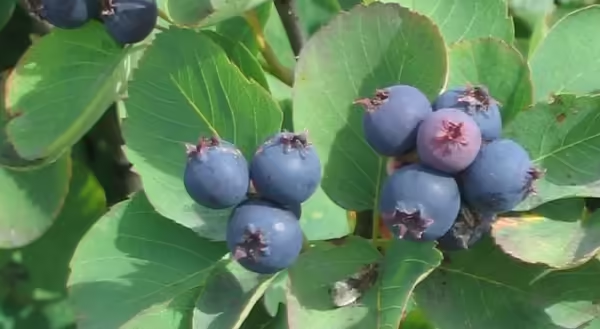
Serviceberry Success – new fruiting bushes at Refuge Food Forest will increase food access
It was a cold, windy late-winter morning at the southeast corner of the Refuge Food Forest in Normal when three of us gathered to talk about slightly expanding the site’s edible landscaping footprint to feature more of a particular up-and-coming berry crop in the Midwest.
Savanna Institute Program Manager Bill Davison, Town of Normal Parks Maintenance Supervisor Tyler Bain, and I met on-site to discuss adding a sizeable planting of high-quality serviceberries to the Refuge Food Forest this spring, with a generation of future berry harvests in mind for visitors.
Serviceberry (Amelanchier spp.)—also known as Juneberry or, in Canada, Saskatoon—is a group of 20–30 species of deciduous shrubs and small trees in the rose family. Serviceberries offer three seasons of interest and are well-suited to home landscapes, community gardens, and edible public spaces.
In early spring, they are covered in showy white flowers that attract pollinators. In Central Illinois, those flowers develop into small fruits by early June. The berries resemble a slightly underripe blueberry, with deep blue skins and hints of purple and green near the stem. In fall, many cultivars finish the season with brilliant orange-red foliage.
While serviceberries are widely sold by nurseries across North America, most commonly available selections have been bred for ornamental performance rather than exceptional fruit quality. Fruit from these landscaping varieties is pleasant but mild, often described as somewhere between a blueberry and a subdued apple. Their flavor improves dramatically when cooked or sweetened, making them excellent for pies, jams, and other baked goods.
Truly outstanding fresh-eating serviceberries are less common—and that was the opportunity we wanted to address at the Refuge Food Forest.
The idea to significantly expand serviceberry plantings at the Refuge Food Forest belongs to Bill Davison. Bill was instrumental in the original installation of the Refuge Food Forest back in 2015 as a collaboration between University of Illinois Extension and the Town of Normal and is always thinking about opportunities to expand the public’s awareness of up-and-coming crops that are the focus of his employer.
Today, through his work with the Savanna Institute, Bill and his team of many other amazing individuals all focus together on advancing agroforestry systems across the Midwest through research, education, and outreach. This winter, he reached out to Tyler and me with a proposal: let’s plant a diverse block of top-tier serviceberry cultivars and make the Refuge Food Forest a place where people can experience what truly great serviceberries taste like.
The Savanna Institute contributes to agroforestry development in part by conducting variety trials of perennial crops in regions where they haven’t been widely evaluated. These trials help answer two critical questions: whether specific cultivars grow well in new geographies, and whether enough consumer demand can be generated to support commercial specialty crop production. One such trial is underway at Fields Restored in Oregon, Illinois, where the highest eating-quality serviceberry cultivars from across North America are being evaluated side by side.
In 2025, Bill attended a Savanna Institute and Fields Restored U-Pick and tasting event at that site. Participants sampled fruit from many cultivars and shared their preferences, creating a rare, practical data set focused on flavor and eating quality. Bill brought those notes home—and they directly shaped what we planted at the Refuge Food Forest this spring.
As the Local Food Systems and Small Farms Educator for University of Illinois Extension in Bloomington, one of my responsibilities is stewarding the Refuge Food Forest, one of the most novel food access and edible landscaping projects in the state.
Stewardship includes winter pruning, growing-season maintenance, invasive species control, and hosting workshops to introduce the public to emerging fruit and nut crops. But the most rewarding part of the job is identifying what to plant next—whether that means introducing an entirely new crop or expanding plantings of something visitors can’t get enough of.
Serviceberries fall into both categories. We planted six ‘Thiessen’ serviceberries in spring 2025, but they haven’t fruited yet. When they do—likely next spring—the response will be enthusiastic, and the supply will be limited. Our plan this year addressed that likelihood.
After additional discussion and research, we selected eight of the best-eating cultivars available: ‘Thiessen’, ‘Honeywood’, ‘Autumn Brilliance’, ‘Martin’, ‘Nelson’, ‘Lee’, ‘Parkhill’, and ‘Pembina’. We were able to source eight plants of each cultivar from a nursery in New York that carried most of the top performers from Bill’s tasting notes.
The Town of Normal Parks and Recreation Department purchased the plants, which Extension staff planted on April 28. The following day, after a community call for help, three adults and three children joined me to mulch the new plantings.
In the coming years, as these serviceberries mature and begin bearing heavily, visitors will be able to sample and enjoy a wide range of exceptional fruit—sweet, complex, and unlike the serviceberries most people have encountered before.
Over time, this planting will not only increase food access in the area, but also demonstrate what’s possible when edible landscaping prioritizes flavor equally with diversity and long-term plant stewardship.
WRITER: Nick Frillman-Local Food Systems & Small Farms Systems Educator, Livingston, McLean and Woodford Counties
ABOUT EXTENSION: Illinois Extension leads public outreach for University of Illinois by translating research into action plans that allow Illinois families, businesses, and community leaders to solve problems, make informed decisions, and adapt to changes and opportunities.
###
COLLEGE OF AGRICULTURAL, CONSUMER & ENVIRONMENTAL SCIENCES
University of Illinois | U.S. Department of Agriculture | Local Extension Councils Cooperating
University of Illinois Extension provides equal opportunities in programs and employment.
If you need a reasonable accommodation to participate in this program, please contact us.
Early requests are strongly encouraged to allow sufficient time for meeting your access needs.
PC Credit: "Amelanchier alnifolia" by Wikimedia Commons is licensed under CC BY-SA 3.0