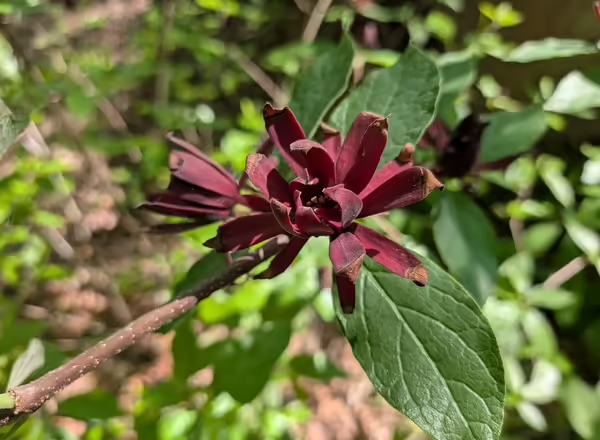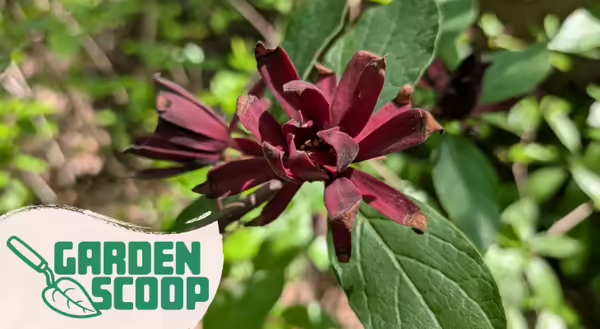
Chocolaty-brown, almost reddish flowers and an alluring scent are the major attractions of Carolina allspice (Calycanthus floridus) this time of year. Earlier this spring, I was admiring a specimen in full bloom down in southern Illinois. As its name implies, the fragrant flowers were projecting a sweet, spicy fragrance and an attractive display across the small shrub’s canopy.
Native Range and History
Carolina allspice is native to the southeastern US, from Florida to Virginia, but does not occur naturally in Illinois. Some botanical records identify naturalized populations in Illinois, but the plant’s native range is presumed to fall east and south of Illinois. However, it is hardy from Zone 8 to Zone 4 and grows well in our area.
Over the years, I’ve seen quite a few plant tags and commercial websites call this a “native” plant. I’m guessing they mean it’s a North American native plant, which is true, but I have also read some confusion on its native range, with some sources suggesting it’s an Illinois native. I cannot find evidence of native populations in Illinois, although there is good evidence of naturally occurring populations as close as Kentucky and Tennessee.
Historically, this plant has attracted much human attention due to its unique attributes. Although flowers are most noted as aromatic, nearly the entire shrub has a detectable scent, including leaves, twigs, and roots as well. These aromatic plant parts likely enticed past use, with the Cherokee and other indigenous groups using this plant for various medical purposes.
European settlers on this continent took note of the shrub, comparing it to the allspice plant (Pimenta dioica), which is a tropical, evergreen tree used to produce the culinary spice by the same name. During colonial times, P. dioica was used as a general substitute for Asian spices, like cinnamon, nutmeg, and cloves, which were harder to get in the Americas. When European botanists encountered Carolina allspice in the 1700’s, the common name “allspice” stuck as a nod to the popular allspice tree they already knew.
Flower Characteristics
At first glance, the reddish-brown blooms may appear similar to our native pawpaw (Asimina triloba) as their flowering times often overlap, although pawpaw is a bit earlier. However, this plant’s flowers have a distinct shape upon closer inspection, with more narrow and strap-like tepals (similar to flower petals) and a slightly more reddish color. The blooms are characteristically fragrant, often described as strawberry-like, though I have heard comparisons to pineapple or even banana from some.
Interestingly, the primary pollinators of Carolina allspice are beetles, which are attracted to its strong scent. Beetle-attracting flowers are also often dark in color and bowl-shaped, like Carlina allspice flowers. The inwardly curved tepals temporarily trap beetles inside the flower, maximizing exposure to pollen structures.
Beetles are among the earliest pollinating insects, beginning the coevolutionary relationship between plants and pollinators. Observation of modern-day flowers that still retain beetle-attracting characteristics is an interesting window in time. They are living relics of the angiosperm evolution, which drastically diversified the plant world leading to the great diversity of flowering plants we see today.
Selecting and Growing Carolina Allspice
Carolina allspice is a low-maintenance shrub that thrives in full sun to part shade. It is tolerant of a wide range of soil conditions, has no serious insect or disease problems and typically does well in Illinois.
Although the plant I enjoyed was quite fragrant, some are noted to have little or no scent. Although missing scent can sometimes be explained by genetics (certain individuals simply do not inherit the trait), many times site conditions are to blame, with sunlight, soil conditions, and even ambient temperature or time of day playing a role in flower scent.
If you are interested in planting a fragrant Carolina allspice, the best recommendation is to purchase your plant when it is in bloom. Give it the scent test in the nursery to ensure your new shrub has the genetics needed. The rest is up to you as a gardener to ensure that optimal site conditions and health are in place and the fragrant flowers will follow.