Maybe this is your first year with a farm-raised cut Christmas tree. Or perhaps you’ve used them for years, but something seems off. Drooping branches, fallen ornaments, and even a few bugs can make you wonder if a fake tree is the better option. Before you switch, let’s look at common issues with cut trees and how to handle them.
Needles Everywhere!
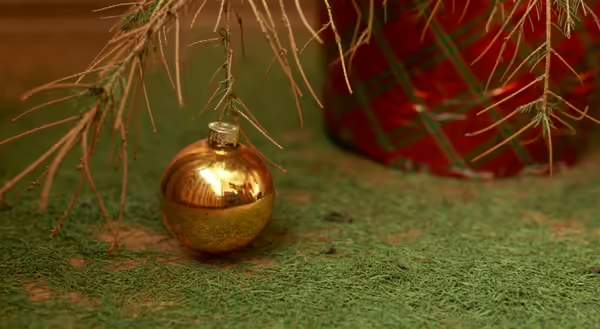
If it is unsafe to walk around your Christmas tree in socks or bare feet due to the risk of your toes being impaled by evergreen needles, the longevity of your tree stands on shaky ground. First thing to know is that needled evergreens can accumulate dead needles in the interior of the tree as it grows. That’s why it is always a good idea to mechanically shake the tree at the farm before bringing it home.
While we may sometimes call this a live Christmas tree, once we cut it down on the tree farm, it is dead. Needles will begin to fall off the tree as the upper part of the tree starts to lose access to water. To slow down needle loss, we need to keep the tree hydrated while it stands decorated in the house. Once a tree is cut, the tissue at the cut begins to seal off, which prevents the uptake of water. Here’s a process to keep the water flowing for your cut tree:
- Have the space ready where the tree will be placed.
- Get the tree stand ready
- Prune off enough of the lower branches so the tree will fit in the stand
- Make a fresh cut on the bottom of the tree’s trunk.
- As quickly as you can get the tree in the house, set it in the tree stand, and get water in the stand.
- Keep the tree stand filled with water. If it dries out, the cut end will seal off. A fresh cut would solve that problem, but that’s pretty hard to do once the tree gets decorated.
Colorado blue spruce is a striking tree with its blue foliage, but this particular species does not last as long as most other cut Christmas tree options. Keep it well watered and check on the tree daily. If the water reservoir runs dry even for a short time, Colorado blue spruce will start shedding needles. This is a tree you may want to get just a week or two before the holiday celebrations and then remove it soon afterward.
Drooping Branches and Fallen Ornaments
Different species of needled evergreens will vary in how well their branches hold up to heavy ornaments. Which trees are the best for your irreplaceable holiday ornaments?
- White pine has long, soft needles with flexible branches that don’t stand up well to heavy ornaments.
- Firs (Balsam, Fraser, and Concolor) all generally have soft needles and sturdy branches for holding ornaments.
- Douglas fir is not a true fir tree, but it is quite popular and is often the least expensive one in the lot. However, the branches will only hold lightweight ornaments.
- Colorado blue spruce is the tree for those with very heavy ornaments. With stiff branches also come sharp needles that will constantly stab your fingernail cuticles.
- Scotch (Scots) pine was one of the first commercially grown Christmas trees. Strong branches hold up well to heavy ornaments.
Missing That Piney Scent?
If you bought a cut tree hoping to impart a fresh holiday scent to your house, not every species is going to meet those expectations. On the opposite side of the spectrum, some folks are allergic to the chemical aromas of needled evergreens. So what tree smells good, and can any tree (besides a plastic one) relieve allergy sufferers?
- Firs generally are known to have the most “Christmasy” scent. If you want that resinous-evergreen aroma, Balsam fir delivers the biggest punch to the sniffer.
- Douglas fir has a pleasant scent, which is not as potent as many of the true firs.
- Scotch pine and Colorado blue spruce have a very slight aroma.
- White pine has a very faint aroma at first that dissipates quickly. This is great for allergy sufferers who still want a cut tree in the house.
Bugs on the Tree?
Depending on the insect, I personally don’t consider this to be a problem. Are praying mantises battling each other to the death on your festive tree? That's fantastic! Enjoy the gladiatorial display. Is the Elf on the Shelf covered in spider webs? Spiders are our friends and allies.
Trees are meant to support life, and bringing one into the house might bring a few unintended guests. Rest assured, our homes in winter are harsh for insects, and most will die naturally after being unexpectedly awakened from their winter sleep. And if your fear of insects stops you from buying a Christmas tree, just know that I have had cut trees all my life and have never been lucky enough to experience an insect outbreak during the holidays.
More Information on Christmas Trees
The many different species of trees that are grown to be cut and decorate our homes for the holidays have their own characteristics. Some are good for heavy ornaments, others will fill a room with a holiday scent. Some species will retain their needles for over a month, while others will only hold them for a couple of weeks. And of course, there is the chance encounter with a few harmless bugs.
We have a lot more information on Christmas trees. Check out more articles at the following links:
Christmas Trees After the Holidays
What's More Sustainable: Real or fake Christmas trees?
Disposing of Cut Christmas Trees
Good Growing Tip of the Week: Drilling holes or whittling the bottom of the trunk to a point will not help with water uptake.