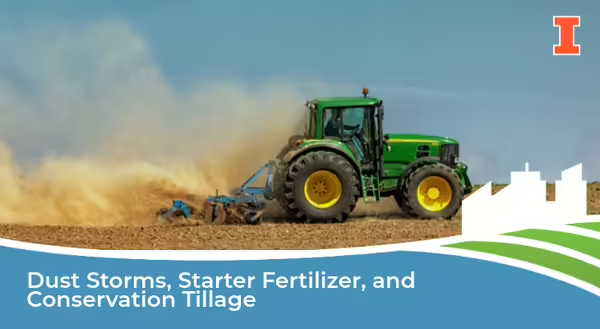
In episode 80 of the Illinois Nutrient Loss Reduction Podcast, University of Illinois Assistant Professor and Extension agronomist Giovani Preza Fontes shares results from a research project evaluating soybean performance across different tillage systems and fertilizer strategies. The study was initiated following recent dust storm events in Illinois and across the Midwest, including the tragic 2023 event near Springfield.
The conversation centers around one question: Can conservation practices help reduce soil erosion without sacrificing yield or profitability?
Why this research matters
Fontes[1] explained that this project started in response to recent dust storms and growing concerns about soil erosion. While practices such as no-till and cover crops are known to reduce soil loss, adoption across Illinois remains relatively low. Cover crop adoption is less than 10% on our corn and soybean acres, and about 15% of corn acres and 35% of soybean acres are managed with no-till.
He noted that some of that hesitation stems from the perception that these practices carry additional risk, particularly the risk of yield loss.
At the same time, these practices are a key part of the Illinois Nutrient Loss Reduction Strategy to reduce nutrients leaving agricultural fields. Keeping soil in place helps protect water quality while also supporting soil health and nutrient cycling in the field.
Comparing tillage and fertilizer systems
To better understand how these systems perform, researchers evaluated soybean production across several common approaches in Illinois and Iowa:
- Conventional tillage (fall chisel followed by spring cultivation)
- Strip-till
- No-till
- No-till with a cereal rye cover crop
Each system was also paired with different fertilizer strategies, including no fertilizer, nitrogen, and nitrogen plus sulfur. Fontes explained that the goal was to evaluate not just yield, but how these decisions affect overall costs and returns.
Early growth versus final yield
One of the first differences showed up early in the season. Soybeans that received starter fertilizer appeared greener and produced more early growth. However, Fontes noted that those differences did not last. By mid-season, tissue samples showed no meaningful differences in nitrogen or sulfur levels across treatments, even in plots without fertilizer. By harvest, there was no yield advantage.
Yield stability across tillage systems
He noted that soybean yields were similar across tillage systems. Across sites and years, conventional tillage, strip-till, and no-till all averaged about 76 to 78 bushels per acre. No-till with a cereal rye cover crop was slightly lower, by about two bushels, but still within a narrow range.
Fontes emphasized that these results reflect early transition years, yet reduced tillage systems still maintained competitive yields.
Looking at profitability
When the focus shifted to economics, Fontes explained that some clear differences emerged. Using a partial net return that included tillage costs, no-till emerged as the top option.
He noted that without the cost of multiple tillage passes, no-till reduced expenses and improved returns, even when yields were similar. Strip-till ranked next, followed by conventional tillage. No-till with a cover crop had the lowest return in this analysis. Fontes explained that this was mainly due to added costs for cover crop management, such as:
- Cover crop seed
- Planting
- Termination
Those costs were estimated at about $55 per acre, compared to about $26 per acre for strip-till.
He added that this is only part of the picture and does not include long-term soil health benefits or cost-share programs that can help offset some of the additional expenses associated with cover crop adoption.
Balancing costs and conservation goals
Fontes acknowledged that these results reflect a tradeoff many farmers are already considering.
Reduced tillage systems like no-till can lower costs while maintaining yields, making them a strong option both economically and environmentally. He noted that cover crops offer additional benefits, especially for soil protection and reduced nutrient loss, but may come with higher upfront costs, particularly in the early years. Cost-share programs and long-term improvements can help balance those costs, but each operation will look different.
The bottom line
Fontes said the results show that reduced tillage systems, such as no-till and strip-till, can maintain soybean yields while lowering production costs. Starter fertilizer improved early-season growth but did not increase yield. And while cover crops offer clear conservation benefits, they may require additional investment, especially in the short term.
As farmers evaluate these options, the goal is to find the right balance between profitability, risk, and long-term soil and water quality.
Explore more
- Evaluating soybean performance in conservation systems – project report
- FIND tool can help you find cost-share programs based on practice and location
- The Business Case for Conservation, published by PCM
- Dust storms in Illinois: Examining roles of weather and farming practices, Illinois Extension
- Extension guides: Soybean Seeding Rate in Illinois, Illinois Soybean Management 2025
About the blog
At Illinois Extension, we’re working to improve water quality at home and downstream. Every month, our Watershed Outreach Associates bring you stories highlighting agricultural conservation practices, current research, and insights from the field. The Nutrient Loss Reduction blog covers conservation practices recommended by the Illinois Nutrient Loss Reduction Strategy, timely updates, and decision tools to help farmers reduce nutrients leaving their fields.
About the authors
Rachel Curry is an Agriculture and Agribusiness Educator specializing in agriculture and watershed education, and she is part of the Illinois Extension's Nutrient Loss Reduction Strategy implementation team. She holds a B.A. in Environmental Studies from Knox College and an M.S. in Environmental Science and Soil Science from Iowa State University, focusing on soil fertility. Her work centers on education and outreach related to the Illinois Nutrient Loss Reduction Strategy, promoting agricultural conservation practices that reduce nutrient loss while enhancing water quality and soil health across Illinois.
Nicole Haverback serves as a Watershed Outreach Associate and is an Illinois Extension team member implementing the Nutrient Loss Reduction Strategy. She holds a B.S. in Agricultural and Rural Policy Studies from Iowa State University. In her role, Nicole coordinates watershed management efforts aimed at reducing nutrient losses in two nitrate-nitrogen priority watersheds, offers expertise on best management practices to minimize nutrient loss, and leads outreach initiatives promoting agricultural conservation practices outlined in the Illinois Nutrient Loss Reduction Strategy.
Luke Zwilling serves as a Watershed Outreach Associate and is an Illinois Extension team member implementing the Nutrient Loss Reduction Strategy. He grew up on a farm in Jasper County and earned a B.S. in Agriculture and Biological Engineering from University of Illinois. Luke coordinates watershed-based activities to reduce nutrient loss in two phosphorus priority watersheds, provides expertise on best management practices for nutrient loss reduction, and conducts outreach on agricultural conservation practices in the Illinois Nutrient Loss Reduction Strategy.