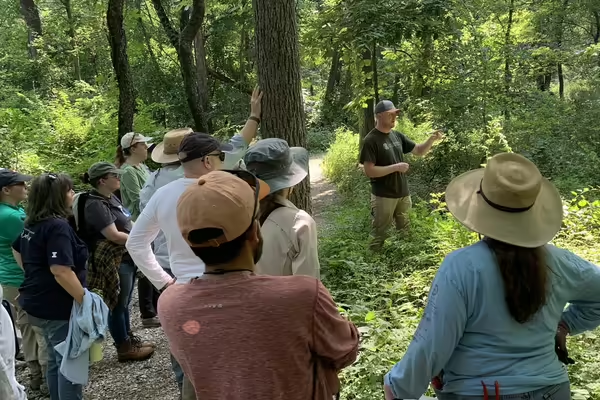
URBANA, Ill. — When it comes to managing invasive plants, having hands-on experience can be the difference between stopping an invasion before it takes hold and watching a single species overrun a forest. This summer, learn how to manage invasive plants in Introduction to Invasive Species Management, a two-day program led by University of Illinois Extension educators that starts with a day of online learning on June 9, followed by a regional hands-on field day available from June 10 to 12.
Non-native invasive species are plants, animals, and insects that spread quickly across property lines and cause ecological or economic damage, making them a major threat to natural areas. Illinois Extension staff and volunteers regularly work with communities statewide on invasive species projects. When Extension first hosted the Introduction to Invasive Species Management program in 2025, most field days were quickly fully booked, with more than 175 attendees.
“What we saw last year is that people care about how invasive species are affecting their property or local natural areas, and they want to know how they can help,” said Christopher Evans, forestry Extension and research specialist. “It’s not always easy to know what a plant is in the moment or what to do with it, but these field days give people the real-world experience they need to feel more confident managing invasives."
Participants will explore the basics of invasive species ecology, invasive plant identification, and management strategies in the online session. The field days are then an opportunity to understand local invasive species, identify plants, review tool options, and see live management demonstrations. The seven field days located across Illinois will be led by local Extension office staff:
June 10: LeRoy Oakes Forest Preserve, St. Charles; Montgomery County Extension Office, Hillsboro; McCully Heritage, Kampsville; and Humiston Woods, Pontiac
June 11: Dixon Springs Agricultural Center, Simpson
June 12: Wigwam Hollow Bird Sanctuary, Macomb; and Perkins Road Restoration Site, Urbana.
This program is open to early-career natural resource professionals, landowners, volunteers, students, and anyone interested in gaining experience managing invasive species.
Participants who attend the online training and the field day will obtain a certificate of course completion from Illinois Extension. The $25 registration fee includes lunch on the field day. There are a limited number of spots available for each field day. Sign up by June 8 at go.illinois.edu/IntroInvasives.
If you need a reasonable accommodation to participate, contact Chris Evans at (618) 695-3383 or cwevans@illinois.edu. Early requests are strongly encouraged to allow sufficient time to meet access needs.
Find more information about invasive species at go.illinois.edu/Invasive. To connect with Extension natural resources, environment, and energy staff about a program or for a consultation, visit go.illinois.edu/NREEstaff. Extension’s natural resources, environment, and energy program provides research-based education for awareness and action to sustain healthy environments and ecosystems that support quality living and resilient communities. Extension staff empower people across Illinois to make a difference through the Master Naturalists, Climate Stewards, and Watershed Steward volunteer and training programs.
SOURCE: Christopher Evans, Forestry Extension and Research Specialist.
PHOTO: By Karla Griesbaum at the Champaign County Introduction to Invasive Species field day in 2025.
University of Illinois Extension develops educational programs, extends knowledge, and builds partnerships to support people, communities, and their environments as part of the state's land-grant institution. Extension serves as the leading public outreach effort for University of Illinois Urbana-Champaign and the College of Agricultural, Consumer and Environmental Sciences in all 102 Illinois counties through a network of 27 multi-county units and over 500 staff statewide. Extension’s mission is responsive to eight strategic priorities — community, economy, environment, food and agriculture, health, partnerships, technology and discovery, and workforce excellence — that are served through five program areas — 4-H youth development, agriculture and agribusiness, community and economic development, health and community wellness, and natural resources, environment, and energy.