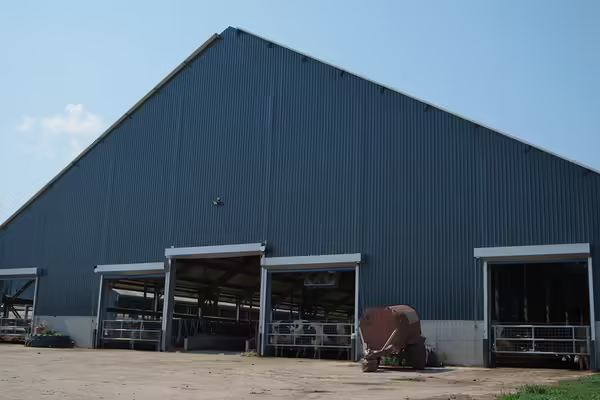
URBANA, Ill. — Livestock operations are strengthened by having certified individuals on staff. Certification helps minimize environmental impacts through increased awareness of regulations and proper manure nutrient management. Anyone responsible for managing a facility can benefit from increasing their knowledge and expertise.
Staff can get certified through one of University of Illinois Extension and the Illinois Department of Agriculture’s 2026 Certified Livestock Manager Training Workshops, kicking off on Feb. 3 in Effingham. Seven locations around the state will host training workshops that meet the Illinois Livestock Management Facilities Act training requirements for Illinois livestock managers.
Depending on the size of an operation, livestock manager training certification is required for many Illinois production livestock facilities. A certified livestock manager is a full-time employee who is familiar with the farm's manure management system and is located within one hour's driving distance of the farm, accessible by phone when needed. Find facility and size requirements described online at go.illinois.edu/CLMT.
Pre-registration is required to attend an in-person workshop. Class size is limited in some locations due to space constraints.
2026 Certified Livestock Manager Training Schedule
- Feb. 3, Effingham: University of Illinois Extension Effingham County Office, 1209 N. Wenthe Ave.
- Feb. 4, Breese: University of Illinois Extension Clinton County Office, 1163 North 4th St.
- Feb. 5, Pittsfield: University of Illinois Extension Pike County Office, 1301 E. Washington
- Feb. 6, Bloomington: Illinois Soybean Association, 1108 Trinity Lane
- Feb. 24, Freeport: Stephenson County Farm Bureau Bldg., 210 W. Spring St.
- Feb. 25, Sycamore: University of Illinois Extension DeKalb County Office, 1350 W. Prairie Dr.
- Feb. 26, Monmouth: University of Illinois Extension Warren County Office, Warren-Henderson Farm Bureau Bldg., 1000 N. Main St.
Each workshop location will open at 8:30 a.m., and training will begin at 9 a.m. The training lasts 3.5 hours, and IDOA staff will administer the exam after the training. The Illinois Extension training fee is $40, and IDOA’s certification fee is $30. To be certified, all participants need to attend the entire workshop.
Training covers a range of topics related to the operation, management, and utilization of livestock waste and waste facilities. The training manual used is the Livestock and Poultry Environmental Stewardship Curriculum. It is available online at go.illinois.edu/manual.
For those unable to attend, online training and testing are available year-round at go.illinois.edu/CLMT, following the same format as the in-person workshops. Those needing certification for over 1,000 animal units may take the test online following the training.
All participants must register in advance and check for weather-related updates at go.illinois.edu/CLMT. A Spanish version of the test is now available upon request. If you have program questions or need a reasonable accommodation to participate, please contact Stanley Solomon, Illinois Extension educator at jssolomo@illinois.edu or by phone at 815-235-4125.
SOURCE: Stanley (Jay) Solomon, natural resources, environment, and energy educator, Illinois Extension
WRITERS: Stanley (Jay) Solomon, natural resources, environment, and energy educator, Illinois Extension; Jenna Braasch, media communications coordinator, Illinois Extension
University of Illinois Extension develops educational programs, extends knowledge, and builds partnerships to support people, communities, and their environments as part of the state's land-grant institution. Extension serves as the leading public outreach effort for University of Illinois Urbana-Champaign and the College of Agricultural, Consumer and Environmental Sciences in all 102 Illinois counties through a network of 27 multi-county units and over 700 staff statewide. Extension’s mission is responsive to eight strategic priorities — community, economy, environment, food and agriculture, health, partnerships, technology and discovery, and workforce excellence — that are served through six program areas — 4-H youth development, agriculture and agribusiness, community and economic development, family and consumer science, integrated health disparities, and natural resources, environment, and energy.