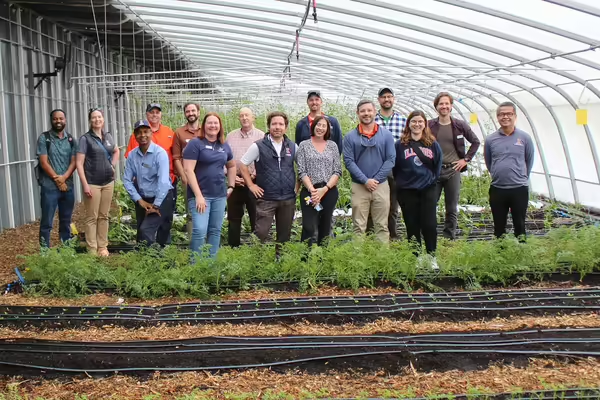
URBANA, Ill. — Collaboration and shared expertise strengthen every project, especially when advancing current research and best practices from the University of Illinois Urbana-Champaign campus to communities across the state.
With the start of the fall 2025 semester, University of Illinois Extension launched the second cohort of Extension Academy, a semester-long professional development program designed to help College of Agricultural, Consumer, and Environmental Sciences faculty deepen their understanding of Extension’s land-grant mission, values, and statewide impact. The program prepares faculty to engage more fully in Extension work by building meaningful partnerships and strengthening readiness to collaborate on initiatives across the state.
Meeting every other week, participants engaged in sessions that featured facilitated discussions, insights from current research, and team-building activities with Extension leaders and staff from across Illinois. This year’s cohort included 13 Extension specialists representing animal sciences; agricultural and consumer economics; human development and family studies; crop sciences; agricultural leadership, education and communications; food science and human nutrition; and natural resources and environmental sciences.
To conclude the program, the cohort participated in a statewide tour in May, showcasing the breadth and diversity of Extension programming. Participants visited Extension county offices and partner sites, met local staff and volunteers, and observed firsthand how research-based programming is implemented in communities. The tour also created opportunities to discuss local needs, explore collaborative projects, and engage with community partners and local officials.
“Traveling across Illinois with the Extension Academy offered a powerful look at how Extension strengthens communities through research-based education, local partnerships, and innovative programming,” said Sarah Low, professor and head of the department of agricultural and consumer economics. “Seeing these efforts firsthand reinforced the important role Extension plays in supporting economic opportunity, developing local leadership capacity, and helping communities address their unique challenges.”
The state-wide tour left Champaign to visit the Freeport High School Research Project and Stephenson County Extension Office. After a stop at the McDonough County Extension Office and 4-H Center in Macomb, the cohort visited the Orr Center and John Wood Community College Agricultural Education Center in Baylis.
Next, the group enjoyed an evening on the Illinois River in Hardin discussing local needs and programming opportunities. Cohort members next explored the new Jackie Joyner-Kersee Food, Agriculture, and Nutrition Innovation Center in East St. Louis followed by a tour of the Belleville Research Center. Finally, the group gathered with Clinton County Extension Office staff for an overview of local programming, concluding in Breese for a program with the Prairie Research Institute, Illinois Water Survey.
“Extension Academy was a great orientation to Illinois Extension and set an excellent foundation for getting started as a new assistant professor,” said Christopher Wirz, assistant professor and Extension specialist for the agricultural leadership, education, and communications program.
University of Illinois Extension develops educational programs, extends knowledge, and builds partnerships to support people, communities, and their environments as part of the state's land-grant institution. Extension serves as the leading public outreach effort for University of Illinois Urbana-Champaign and the College of Agricultural, Consumer and Environmental Sciences in all 102 Illinois counties through a network of 27 multi-county units and over 500 staff statewide. Extension’s mission is responsive to eight strategic priorities — community, economy, environment, food and agriculture, health, partnerships, technology and discovery, and workforce excellence — that are served through five program areas — 4-H youth development, agriculture and agribusiness, community and economic development, health and community wellness, and natural resources, environment, and energy.