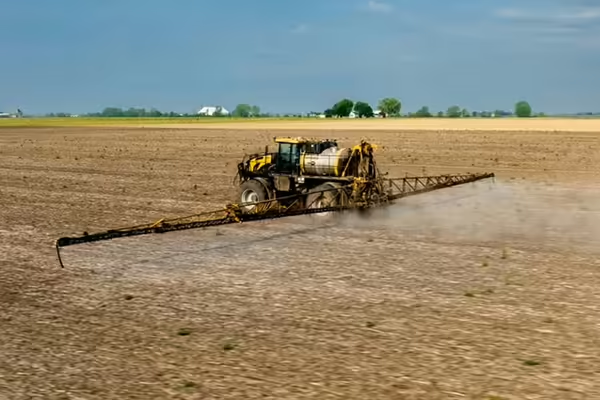
URBANA, Ill. — A new analysis from the University of Illinois Urbana-Champaign and the Illinois Soybean Association finds that Illinois corn and soybean farmers could lose up to $609 million per year — representing a 3.6% revenue loss — if the state banned the weedkiller glyphosate.
The estimate represents a realistic scenario in which farmers would replace glyphosate with more expensive and slightly less effective herbicide products, and accounts for modest yield losses. But the study’s authors say any yield loss, even equating to just 3.6% of a farmer’s bottom line, would be hard to bear.
“I don't know of any farmer who wants to take a revenue loss by any stretch of the imagination, and especially when we've got such tight margins right now,” said study co-author Aaron Hager, professor and faculty Extension specialist in the Department of Crop Sciences, part of the College of Agricultural, Consumer and Environmental Sciences at Illinois. “Profits have been projected to be negative again this year for a lot of Illinois farmers, many of which may be on the verge of not being able to survive.”
The researchers became curious about economic impacts after glyphosate bans were introduced in past Illinois legislative sessions. Considering increasing public attention and court cases related to glyphosate, they recognized that another ban could be proposed at any time. Meanwhile, multiple other pesticide bans were proposed in Illinois earlier this year.
The researchers say their analysis methods could be applied to other chemicals.
Read the full article from the College of ACES.
University of Illinois Extension develops educational programs, extends knowledge, and builds partnerships to support people, communities, and their environments as part of the state's land-grant institution. Extension serves as the leading public outreach effort for University of Illinois Urbana-Champaign and the College of Agricultural, Consumer and Environmental Sciences in all 102 Illinois counties through a network of 27 multi-county units and over 500 staff statewide. Extension’s mission is responsive to eight strategic priorities — community, economy, environment, food and agriculture, health, partnerships, technology and discovery, and workforce excellence — that are served through five program areas — 4-H youth development, agriculture and agribusiness, community and economic development, health and community wellness, and natural resources, environment, and energy.