Episode Number
82
Episode Show Notes / Description
Despite being the only in-field practice that efficiently reduces both nitrogen and phosphorus, cover crops are currently used on just 6% of Illinois cropland. To encourage wider adoption, the University of Illinois Extension launched the FLASH (Farmer-Led Advances for Soil Health) program, which incentivizes localized farmer-to-farmer networking to foster cultural and mindset shifts. During a recent panel, three Illinois farmers shared their distinct journeys toward embracing these conservation methods. Brent Fowler highlighted the challenge of overcoming institutional family resistance, explaining how an accidental equipment mix-up led to successful no-till testing that ultimately proved profitable and effective at preventing soil erosion. Adam Dahmer emphasized that while accessing information and equipment was difficult in the past, a farmer’s rigid mindset remains the biggest barrier today, stressing the need for adaptable management and open-minded approaches to seeding methods like drills and drones. Finally, Greg Thoren expanded on the broader environmental impacts, noting that transitioning from single-species cover crops to a holistic, multi-species management system not only improves soil health but also supports natural ecosystems by promoting cleaner water and air.
Transcript
NLRS 82
Cover crop conversations: Cultural and mindset shifts
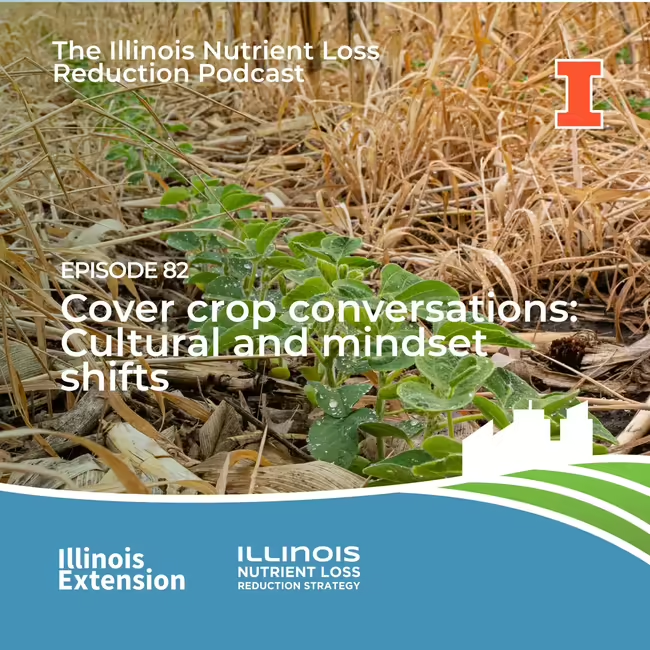
Todd Gleason: This is the Illinois Nutrient Loss Reduction Podcast, episode number 82: Cover Crop Conversations, cultural and mindset shifts. I'm University of Illinois Extension's Todd Gleason.
Todd Gleason: Did you know cover crops are the only in-field practice with both nitrogen and phosphorus reduction efficiency. Cover crops are used on about one-and-a-quarter million acres in Illinois. That sounds like a lot, but it is just 6% of the 21 million cropland acres in the state.
Todd Gleason: University of Illinois Extension, as it did with no-till starting in the 1970s, is working hard to change the culture around cover crops. There are, of course, many barriers to over come.
Todd Gleason: Something new Extension has been trying this year is called FLASH or Farmer-Led Advances for Soil Health. There are financial incentives within the program, but more importantly it puts farmers in touch with each other to explore cover crops and to talk about what they've learned. These groups are localized so it's easy for them to grab a cup of coffee and get together. We'll do something like that today, and then a couple more times over the summer months here on the Illinois Nutrient Loss Reduction Podcast.
Todd Gleason: University of Illinois Extension's Rachel Curry hosted a farmer panel on this subject. It included Adam Dahmer, Greg Thoren, and Brent Fowler. She asked the three of them to talk about their operations. Adam and Greg told stories of conservation minded families and landowners. Brent, on the other hand, had a different experience and part of that, he admits, lands on him.
Brent Fowler: Yeah, listening to Greg and Adam, our story is a little different. The main challenge that I have faced with conservation has probably been my family. I love my dad and my whole family, but that has definitely been the biggest challenge. My dad is very structured, being ex-military. He likes to do the same thing every single day, and he likes to do the same thing every year. I joke with people that I like trying new things—we are definitely different in that way—and I kind of have an uncanny ability to question everything my dad does or has ever done. That can be a little challenging at times, but I like trying new things, and I like testing and comparing different practices.
Brent Fowler: One of the things that got us started in no-till—and we are almost all no-till now—we had a worker who went to a field by mistake. He was supposed to take our ripper, and he took our vertical tillage tool instead. Long story short, it went really well, and it really got me questioning if it was really worth it to plow all of our cornstalk fields every year. I went to my dad and grandpa at the time, and I told them I wanted to do some tests. I wanted to try vertical till and not plow the whole field. They really hated that idea. I joke with people that the only thing I can kind of compare it to would be if you asked a non-farmer to paint their living room, but leave a strip in the middle unpainted. That is how my dad and grandpa felt about it. But they went along with it, and we started doing tests. The results kept showing that it just wasn’t paying to do all that heavy tillage. Over time, we did that for several years, and then we started where we were only plowing half the field, and then it got to where we were only plowing a strip in the center of the field. It just kept showing that the minimal till or no-till was better.
Brent Fowler: Another thing I kind of think about too is ditches or gullies in fields really bother me. I know dad doesn’t like it, but dad can go take a field cultivator and fill in the ditches and it doesn’t really hurt him as much as it does me. I look at it as that soil left our field and it is never coming back. So that’s what really led me to realize that we can do some of these conservation practices, keep our soil in our field, and be more profitable. That was really exciting when that happened. And now we are definitely doing a lot of cover crops. Almost all of our cornstalks before soybeans have a cereal rye cover crop. That is kind of our story.
Todd Gleason: Again that's Brent Fowler. He farms in the southern part of McDonough County. That's about an hour east of the Iowa/Missouri border on the Illinois side. His initial barrier to adopting conservation methods on the farm was, let's call it institutional, "why on earth would we change". That's not the barrier, conservation and cover crop, that Adam Dahmer ran into. He farms in Williamson County. It's in deep southern Illinois. Just trying to learn how to use and manage cover crops has been his biggest problem.
Adam Dahmer: As far as challenges are concerned, I would say early on, back in the late 1990s, it was information. We started with cereal rye in front of soybeans and cornstalks, and the whole purpose of that was to build organic matter. We successfully were doing that, but we still wanted to figure out how to get it across all the acres. As we moved forward, the industry grew a little bit, and we were able to source good seed to move forward, and that allowed us to expand our operation. The biggest struggle I see most people having is the mindset on how to achieve it. You have to change your entire scope of how you approach your equipment purchases, as well as your management practices. I really don’t care what color piece of equipment you drive; if it doesn’t work in the application, it is of no use for this operation. And that is the mindset that often holds most people back. They are diehard for a certain brand, even though that particular piece may not be best for the diversity that they are wanting to implement with cover crops. So we have always kept a really open mind as far as what equipment and so forth we were utilizing.
Adam Dahmer: As far as seeding goes, that is probably one of the biggest hurdles I hear: guys can’t get it in the field. We have done it. We started with airplanes. Drills, of course, by far are the best. We built a high-boy seeder in 2013, and that worked good, but the drill still outperforms it. Drones work very well; we have implemented those more and more as we move forward, as they don’t get the cover crop seed tied up in the whorl of the corn plant like other seeding methods do prior to harvest. As far as challenges, I would say that would be the only ones. I mean, the biggest challenge most operators have is their mindset, because if they do not keep an open mind and convince themselves they are going to make it work, they are destined to fail. I can’t really speak as far as anything that’s really prohibited us from expanding other than our own mindset, and we have been pretty progressive on that.
Todd Gleason: Mindset. I can do it. We can do it. We should change. Greg Thoren, the other farmer on the panel discussion agreed with Brent and Adam. And then he went a step further thinking more broadly about the reasons behind the change and the good he is doing.
Greg Thoren: I agree with everything that Adam and Brent said. I have experienced those things. The barriers might be, looking back now, it is a completely different management system. It’s a unique, holistic management system. And maybe this is for someone that’s more advanced, but as you start, we started with cereal rye again, like Adam did. That is a no-brainer; we did it for erosion purposes. I truly believe that no matter what cover crop you use, if it is even just a single species, that it does so many more things than just the one objective you wanted it to do. That is the fun thing about this. We as farmers think if you do one thing, you get this one return, but with cover crops, it just does a tremendous amount of things like any plant does. So I think that was the big takeaway for me. And of course nowadays, we are into multi-species cover crops. We try to plant at least four different families at a minimum for soil health purposes. And then of course we are getting into the soil health arena more, as the public even is, and that is a very, very good system because it basically all comes back to clean water, clean air. If we can get the soil health better, the system just makes sense. Mother Nature just makes sense in how she does things, and we have basically disturbed her a lot with our conventional farming practices that we have today.
Todd Gleason: Greg Thoren is from the driftless area of the state in the far northwestern corner of Illinois where the soils were not covered by glaciers in Jo Davies County. He, Adam Dahmer, and Brent Fowler all use cover crops. Each is from a very different area of the state. Yet, they all have a common thread that runs through their farms, conservation and innovation. In future episodes we'll take up some of what that means on the ground and in the ledger. We'll hear about profits versus yields and how to get it all done with planters, drones, and timing.
Todd Gleason: You've been listening to the Illinois Nutrient Loss Reduction Podcast. It is produced in collaboration withe University of Illinois Extension's Rachel Curry, Nicole Haverback, and Luke Zwilling. Until next time I'm your host Todd Gleason
Cover crop conversations: Cultural and mindset shifts
Todd Gleason: This is the Illinois Nutrient Loss Reduction Podcast, episode number 82: Cover Crop Conversations, cultural and mindset shifts. I'm University of Illinois Extension's Todd Gleason.
Todd Gleason: Did you know cover crops are the only in-field practice with both nitrogen and phosphorus reduction efficiency. Cover crops are used on about one-and-a-quarter million acres in Illinois. That sounds like a lot, but it is just 6% of the 21 million cropland acres in the state.
Todd Gleason: University of Illinois Extension, as it did with no-till starting in the 1970s, is working hard to change the culture around cover crops. There are, of course, many barriers to over come.
Todd Gleason: Something new Extension has been trying this year is called FLASH or Farmer-Led Advances for Soil Health. There are financial incentives within the program, but more importantly it puts farmers in touch with each other to explore cover crops and to talk about what they've learned. These groups are localized so it's easy for them to grab a cup of coffee and get together. We'll do something like that today, and then a couple more times over the summer months here on the Illinois Nutrient Loss Reduction Podcast.
Todd Gleason: University of Illinois Extension's Rachel Curry hosted a farmer panel on this subject. It included Adam Dahmer, Greg Thoren, and Brent Fowler. She asked the three of them to talk about their operations. Adam and Greg told stories of conservation minded families and landowners. Brent, on the other hand, had a different experience and part of that, he admits, lands on him.
Brent Fowler: Yeah, listening to Greg and Adam, our story is a little different. The main challenge that I have faced with conservation has probably been my family. I love my dad and my whole family, but that has definitely been the biggest challenge. My dad is very structured, being ex-military. He likes to do the same thing every single day, and he likes to do the same thing every year. I joke with people that I like trying new things—we are definitely different in that way—and I kind of have an uncanny ability to question everything my dad does or has ever done. That can be a little challenging at times, but I like trying new things, and I like testing and comparing different practices.
Brent Fowler: One of the things that got us started in no-till—and we are almost all no-till now—we had a worker who went to a field by mistake. He was supposed to take our ripper, and he took our vertical tillage tool instead. Long story short, it went really well, and it really got me questioning if it was really worth it to plow all of our cornstalk fields every year. I went to my dad and grandpa at the time, and I told them I wanted to do some tests. I wanted to try vertical till and not plow the whole field. They really hated that idea. I joke with people that the only thing I can kind of compare it to would be if you asked a non-farmer to paint their living room, but leave a strip in the middle unpainted. That is how my dad and grandpa felt about it. But they went along with it, and we started doing tests. The results kept showing that it just wasn’t paying to do all that heavy tillage. Over time, we did that for several years, and then we started where we were only plowing half the field, and then it got to where we were only plowing a strip in the center of the field. It just kept showing that the minimal till or no-till was better.
Brent Fowler: Another thing I kind of think about too is ditches or gullies in fields really bother me. I know dad doesn’t like it, but dad can go take a field cultivator and fill in the ditches and it doesn’t really hurt him as much as it does me. I look at it as that soil left our field and it is never coming back. So that’s what really led me to realize that we can do some of these conservation practices, keep our soil in our field, and be more profitable. That was really exciting when that happened. And now we are definitely doing a lot of cover crops. Almost all of our cornstalks before soybeans have a cereal rye cover crop. That is kind of our story.
Todd Gleason: Again that's Brent Fowler. He farms in the southern part of McDonough County. That's about an hour east of the Iowa/Missouri border on the Illinois side. His initial barrier to adopting conservation methods on the farm was, let's call it institutional, "why on earth would we change". That's not the barrier, conservation and cover crop, that Adam Dahmer ran into. He farms in Williamson County. It's in deep southern Illinois. Just trying to learn how to use and manage cover crops has been his biggest problem.
Adam Dahmer: As far as challenges are concerned, I would say early on, back in the late 1990s, it was information. We started with cereal rye in front of soybeans and cornstalks, and the whole purpose of that was to build organic matter. We successfully were doing that, but we still wanted to figure out how to get it across all the acres. As we moved forward, the industry grew a little bit, and we were able to source good seed to move forward, and that allowed us to expand our operation. The biggest struggle I see most people having is the mindset on how to achieve it. You have to change your entire scope of how you approach your equipment purchases, as well as your management practices. I really don’t care what color piece of equipment you drive; if it doesn’t work in the application, it is of no use for this operation. And that is the mindset that often holds most people back. They are diehard for a certain brand, even though that particular piece may not be best for the diversity that they are wanting to implement with cover crops. So we have always kept a really open mind as far as what equipment and so forth we were utilizing.
Adam Dahmer: As far as seeding goes, that is probably one of the biggest hurdles I hear: guys can’t get it in the field. We have done it. We started with airplanes. Drills, of course, by far are the best. We built a high-boy seeder in 2013, and that worked good, but the drill still outperforms it. Drones work very well; we have implemented those more and more as we move forward, as they don’t get the cover crop seed tied up in the whorl of the corn plant like other seeding methods do prior to harvest. As far as challenges, I would say that would be the only ones. I mean, the biggest challenge most operators have is their mindset, because if they do not keep an open mind and convince themselves they are going to make it work, they are destined to fail. I can’t really speak as far as anything that’s really prohibited us from expanding other than our own mindset, and we have been pretty progressive on that.
Todd Gleason: Mindset. I can do it. We can do it. We should change. Greg Thoren, the other farmer on the panel discussion agreed with Brent and Adam. And then he went a step further thinking more broadly about the reasons behind the change and the good he is doing.
Greg Thoren: I agree with everything that Adam and Brent said. I have experienced those things. The barriers might be, looking back now, it is a completely different management system. It’s a unique, holistic management system. And maybe this is for someone that’s more advanced, but as you start, we started with cereal rye again, like Adam did. That is a no-brainer; we did it for erosion purposes. I truly believe that no matter what cover crop you use, if it is even just a single species, that it does so many more things than just the one objective you wanted it to do. That is the fun thing about this. We as farmers think if you do one thing, you get this one return, but with cover crops, it just does a tremendous amount of things like any plant does. So I think that was the big takeaway for me. And of course nowadays, we are into multi-species cover crops. We try to plant at least four different families at a minimum for soil health purposes. And then of course we are getting into the soil health arena more, as the public even is, and that is a very, very good system because it basically all comes back to clean water, clean air. If we can get the soil health better, the system just makes sense. Mother Nature just makes sense in how she does things, and we have basically disturbed her a lot with our conventional farming practices that we have today.
Todd Gleason: Greg Thoren is from the driftless area of the state in the far northwestern corner of Illinois where the soils were not covered by glaciers in Jo Davies County. He, Adam Dahmer, and Brent Fowler all use cover crops. Each is from a very different area of the state. Yet, they all have a common thread that runs through their farms, conservation and innovation. In future episodes we'll take up some of what that means on the ground and in the ledger. We'll hear about profits versus yields and how to get it all done with planters, drones, and timing.
Todd Gleason: You've been listening to the Illinois Nutrient Loss Reduction Podcast. It is produced in collaboration withe University of Illinois Extension's Rachel Curry, Nicole Haverback, and Luke Zwilling. Until next time I'm your host Todd Gleason