Episode Number
105
Episode Show Notes / Description
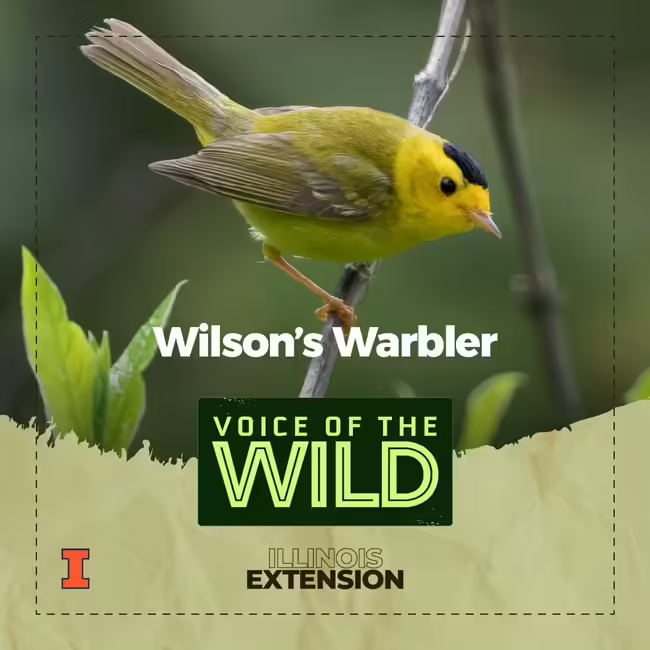
Wilson's warbler (Cardellina pusilla).
The warbler with a handsome black cap.
Voice of the Wild is a podcast about wildlife and the wild sounds they make.
The following Cornell Lab | Macaulay Library recordings were used in this episode:
- Wilson's Warbler song by Geoffrey A. Keller (ML509373)
- Wilson's Warbler call by Geoffrey A. Keller (ML509375)
- Wilson's Warbler song 2 by William W. H. Gunn (ML509371)
- Wilson's Warbler song 3 by Geoffrey A. Keller (ML509370)
Sources and more:
- Cornell’s All About Birds
- Audubon
- Peterson field guide to the birds (Fourth edition)
- Sibley birds East
Transcript
This is Brodie with Illinois Extension and I’m here with a new “voice of the wild”
A small and very active warbler that might be found in a stand of willows flitting about in a search for insects. They like the shrubby midstory plants, especially those that are growing near water. Both sexes have plain yellow plumage with a darker back that’s a bit yellow-green, however the handsome males have a very fashionable black cap. This is the Wilson’s warbler.
The Wilson’s warbler has a fairly plain song of repeated sharp notes. I often imagine them as starting their song with a single piano key and ending it with two, though I’ve also found that some birds put less emphasis on that final portion or merely pitch down or taper off. On our second playthrough, I’ll play a few variations of the Wilson’s song…and, here it is.
Thank you to the Macaulay library at the Cornell lab for today’s sound. Learn more about voice of the wild at go.illinois.edu/VOW
A small and very active warbler that might be found in a stand of willows flitting about in a search for insects. They like the shrubby midstory plants, especially those that are growing near water. Both sexes have plain yellow plumage with a darker back that’s a bit yellow-green, however the handsome males have a very fashionable black cap. This is the Wilson’s warbler.
The Wilson’s warbler has a fairly plain song of repeated sharp notes. I often imagine them as starting their song with a single piano key and ending it with two, though I’ve also found that some birds put less emphasis on that final portion or merely pitch down or taper off. On our second playthrough, I’ll play a few variations of the Wilson’s song…and, here it is.
Thank you to the Macaulay library at the Cornell lab for today’s sound. Learn more about voice of the wild at go.illinois.edu/VOW