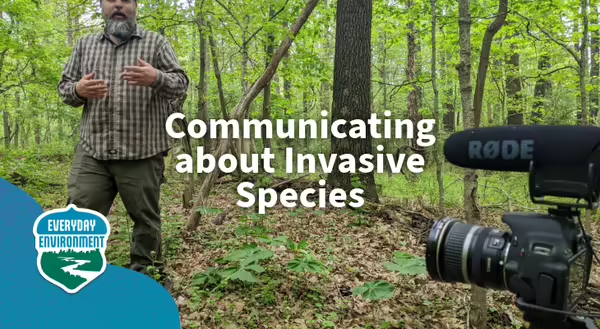
Emerald ash borer, bush honeysuckle, bighead carp – if any of those names made you shudder, you’re likely aware of the widespread environmental and economic harm invasive species cause in Illinois.
But the first time I passionately spoke with a friend about the impacts of invasive garlic mustard on our forests, after I stopped, he went, “Oh, that sounds tasty.” As a science communicator, that was humbling. The message didn’t get across. What happened?
So, to kick off the Everyday Environment spring series on invasive species, let’s talk about how we talk about invasives.
What is an invasive species?
Invasive species are ecologically or economically damaging exotic plants or animals that have been introduced by humans to areas where they were not found historically and can become established in the wild, where they harm the ecosystem. They are one of the biggest global environmental threats, second only to habitat loss. Their damages cost the U.S. $120 billion every year.
Check out the Extension website on invasive species for a quick “101” on invasive species in Illinois.
Invasive species are an environmental and human issue
Invasive species are an environmental and a human issue. Humans introduced them; we’ve altered native habitats in ways that benefit invasive species; and we struggle to manage them because plants and animals don’t recognize property lines.
How do you get people to manage invasive species?
Encouraging someone to take action against invasive species can be challenging. Motivating people often starts with understanding what they care about. To do this, identify who your audience is, what they value, their barriers to taking action, the benefits of taking action, and how you can overcome barriers. This helps narrow the scope and focus your efforts.
Here’s an example:
- Goal: Encourage people to manage invasive garlic mustard.
- Process: Reach resident homeowners in a 50-mile radius with trees on their property (target audience), encourage them to monitor for and remove garlic mustard (desired behavior) by appealing to their desire to keep their woodlands beautiful (value) and full of diverse flowering plants (benefits of action). Provide resources on how to identify and manage garlic mustard (knowledge barrier) and invite them to an upcoming workshop (skill barrier).
- Bonus: Identify that you can reach this audience through a zip code-targeted mailed postcard that connects to online resources.
Messages that motivate





How to talk about invasive species
There isn’t a one-size-fits-all approach when communicating about invasive species, but here are a few suggestions.
Have hope
Conservation efforts are making a difference. A 2024 review of global biodiversity studies found that most conservation efforts improved biodiversity or slowed declines. And targeted efforts, such as invasive species control, are highly effective.
Choose your words carefully. Use positive messages to inspire people to take action. A common communication strategy – used by marketers, legislators, and media alike – is an emotional appeal. “Are we losing the war against spotted lanternfly?” uses fear-based language. But research has shown that highly charged language can be ineffective and lead to panic, hopelessness, and xenophobia or racism.
New invasions can be prevented, stopped, or slowed. Early detection and rapid response is an effective strategy, and this approach is being used in the Chicago area, where spotted lanternfly was first discovered in September 2023. Citizen sightings are reported and followed up on.
Be specific, be accurate
Be accurate and trustworthy. In a world full of misinformation and AI-generated photos, only share research-based information.
Use the right terminology. In 2022, “spongy moth” replaced the “gypsy moth” common name in a movement led by the Better Common Names Project.
Appeal to values, then emotions
What is the value? People will care more about invasives if they affect things they care about, like hunting, bird watching, mountain biking, foraging, beautiful spaces, harvesting timber, etc.
Focus on the impact. Talk about big picture things like how an invasive species affects people and the environment.
Be creative. Whimsy meets science when University of Illinois students and associate professor Philip Anderson use live-action fantasy and mythical creatures to talk about invasive species.
General strategies
Awareness is not enough to encourage action. Sharing information about invasive species is good; engaging people in conversation, inviting them to a program, or to join an email list is better.
Keep educational materials simple. For signs or handouts, use a 6th to 8th grade reading level, keep the word count short, and include photos and illustrations. People need to understand the science to trust it.
Emphasize what could be lost with inaction. For example, “100 years from now, what will your forest look like? If you don’t remove garlic mustard, it might not be around.”
More Information
- Illinois Invasive Species, Aquatic Invasive Species, Illinois-Indiana Sea Grant
- Environmental communications: Professional Interpretive Planners Provide Recommendations for Writing Engaging Text; Community-based social marketing strategy cbsm.com; Competitive outreach in the 21st century: Why we need conservation marketing
- Communicating about invasive species: Lost in translation: The need for updated messaging strategies in invasion biology communication, Communicating Invasion: Understanding Social Anxieties Around Mobile Species, Recommendations from the Sea Grant-Led Invasive Species Language Workshop
About Everyday Environment
Everyday Environment is a series of blogs, podcasts, webinars, and videos exploring the intricate web of connections that tie us to the natural world.
See something cool in nature? Let us know! Send us your question or share your everyday nature observation with us at go.illinois.edu/EEconnect, and we may share it in a future blog or podcast.