
Think about a fond memory you have.
Think about how you felt, the excitement or happiness you may have felt. Think about how this memory smells or tastes. It could be the smell of your family home or the taste of a particular food. Think about what you heard during this memory. It could be a conversation you were having or music playing. Reflect on the physical touch of our surroundings. Were you sitting on a very comfy or uncomfy couch? Or were you walking barefoot in tall blades of grass? Think about the details of the story. What do you remember most?
This is the power of writing your stories on paper. It can bring back memories or moments you haven’t thought of in a long time. It can also motivate you to write stories that matter most to you to pass down to your family, friends, and more. So, your stories can live on.
Storytelling also has cognitive benefits. When we are listening to someone’s story, our brain is very engaged. We are trying to predict what is happening next. According to Uri Hasson, Professor of Neuroscience and Psychology at Princeton University, our brain waves actually start to sync with those of the storyteller. When we are processing the story that is being told, it is thought that the brain regions that are responsible for complex information processing are engaged. (Renken, 2020).
How can I write my own stories?
The beauty of this is that it’s very simple to get started! All you need is a pen/pencil and some paper!
You can simply start by writing down your most cherished, or not so cherished, memory. Think about the five senses (feel, touch, taste, smell, and hear) as you are writing. Remember to be descriptive in these areas. Don’t worry about good grammar or getting every detail correct. You can always go back and edit. Getting it down on paper is always the hardest step!
If you are having that dreadful writer's block, try to find some writing prompts that inspire you. This can help you think of stories that you want to write about. Or find a writing class that is happening in your local community. It can be as formal or informal as you would like.
You don’t need to be a published author or an expert storyteller to do this. Anyone at any level can write about their own experiences! I encourage anyone who has been thinking about starting their own life story writing to do so!
Now to help get us motivated. Your first homework assignment: put pen to paper!
Sources
- Shuka Kalantari, (Host). (2026, January 1). How Stories Shape Belonging. [Audio podcast episode]. In The Science of Happiness. https://greatergood.berkeley.edu/podcasts/item/how_stories_shape_belonging
- Renken, E. (2020, April 11). How Stories Connect And Persuade Us: Unleashing The Brain Power Of Narrative. NPR. https://www.npr.org/sections/health-shots/2020/04/11/815573198/how-stories-connect-and-persuade-us-unleashing-the-brain-power-of-narrative
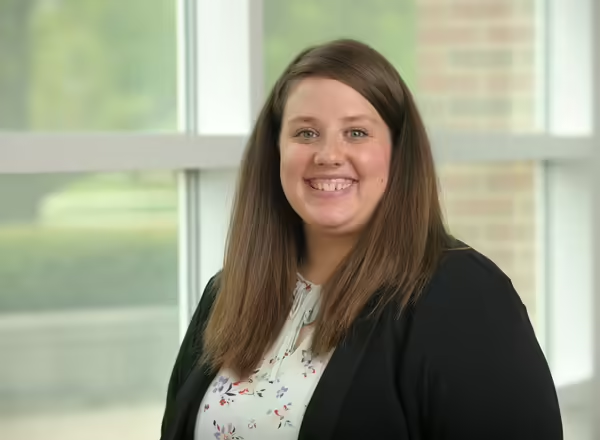
Emily Harmon is responsible for family life programming in the counties of Champaign, Ford, Iroquois, Vermilion, and other parts of Illinois as needed. Emily's areas of interest include working with older adults to provide healthy living and healthy aging programming. She is passionate about providing resources to empower individuals to make decisions for themselves to improve their overall well-being.
Emily is a Champaign County native and earned her Bachelor's and Master's of Science from Eastern Illinois University.