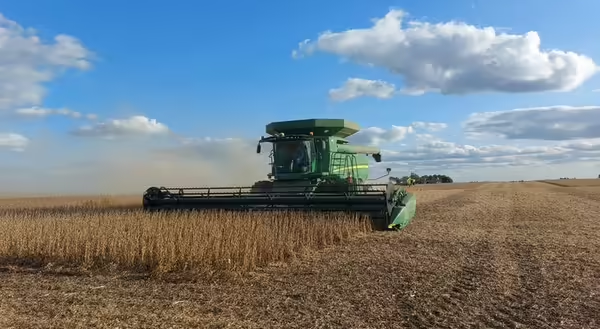
Illinois farmers and landowners have completed their farm lease negotiations for the 2026 production year. Forecasts indicate farmers will endure a fourth year in a row of operational losses. However, government payments have lessened this impact, and because each farm is different, the results are simply averages. Achieving higher yield levels on a farm can make a large difference in profitability if achieved through lower costs, such as reducing the number of tillage passes while simultaneously decreasing soil compaction.
Other factors that can impact profitability include: 1) the debt load on machinery and land, 2) farmer age (older farmers tend to be more financially secure, having less interest expenses from a lower debt load), and 3) the farmer's ability and willingness to cut back on input expenses without reducing soil fertility beyond university guidelines. Temporarily cutting back on phosphorus (P) and potassium (K) fertilizer will not likely cause significant yield loss in the short term, but it could create long-term yield problems. Rebuilding depleted soil is more expensive than maintaining steady levels.
Steady Cash Rents
Steady is the keyword for describing cash rents in most regions of the state for 2026 compared to 2025. Relatively minor fluctuations occurred in a few areas of the state. Sources for this article include the 2026 Illinois Farmland Values and Lease Trends compiled by the Illinois Society of Professional Farm Managers and Rural Appraisers (ISPFMRA) and Farmdoc Daily.
ISPFMRA classifies farms using the Productivity Index (PI). University of Illinois Bulletin 811: Excellent soils are PI-rated 133+, Good 117-132, Average 100-116, and Fair 100 or less. In simpler terms, Excellent soils are prime farmland with consistently high yields; Good soils can produce high yields but fall off during challenging conditions; Average soils yield close to the county mid-range; and Fair soils are consistently below the county average. Individual farms can perform above or below their PI rating, so verifiable yields are very important. Farmer skill, soil fertility, farm drainage, and other factors impact a farm’s average yields.
Farms in East Central and North Central Illinois showed the most reductions in cash rental rates, especially in Excellent to Good farmland soils. According to ISPFMRA, this trend ranged from steady to 10 percent lower in cash rent values. In contrast, Northwestern Illinois is experiencing steady to slightly higher rents on higher-value, excellent farmland. Southwestern Illinois rental values are slightly higher on Good, Average, and Fair/Poor farmland. All other areas of the state maintained a steady cash rent valuation.
Below are the cash ranges by soil quality measure in $ per acre on farm-managed land:
Category Excellent Good Average Fair
High 1/3 400 350 300 238
Mid 1/3 375 325 273 200
Low 1/3 320 277 222 181
Individual rents can be higher or lower than the listed rental rates, depending on land quality. Almost all current cash rents were negotiated by farmers and landowners before the war with Iran began.
Fixed Cash Rent v. Flexible Cash Rents
Cash rents are the dominant method by which farmers pay landowners for leasing land. Crop share leases are decreasing over time as landowners seek less risk and greater simplicity. Cash rental agreements have consistently delivered higher returns to landowners, depending on the cash rent level. Flex Cash Leases can increase rent over the base rent per acre if yields and/or grain prices rise. Currently, there are more fixed cash rent contracts than variable cash rent contracts in the state.
Fertilizer Rates are Important to Track
Soil fertility (Phosphorus-P and Potassium-K) levels are important to track over time. A farm that tests at levels below the University of Illinois Agronomy Handbook recommendations can lead to higher fertilizer expenses than maintaining recommended levels. pH levels are also very important to maintain. If nutrient levels or pH values decrease, this can lead to reduced future profits for the landowner. Under a cash-rental lease, cash-rent farmers typically pay 100 percent of the cost of these inputs, depending on the lease terms.
Cash Rents and Land Values
Farmers consider cash flow and profits during lease negotiations. Negative profit levels are difficult to sustain over the long term. On the other side of the negotiation table, landowners are receiving lower returns on land's value from cash rent payments vs the early 2000s, and returns from that period are at or near historically low levels.
Summary
Farmland rental rates have been mostly steady into 2026. Continued low prices, government subsidy programs, and high input costs will continue to weigh on farmer profitability and their ability to maintain current cash rents. These factors will all be important to consider when 2027 rents are negotiated in the fall of 2026.
For More Information:
https://farmdocdaily.illinois.edu/2024/09/setting-2025-cash-rents.html
https://farmdocdaily.illinois.edu/2026/01/revised-illinois-crop-budgets-for-2026.html
/blogs/farm-coach/2025-09-30-farm-leasing-series-determining-cash-rent-illinois-farmland
/blogs/farm-coach/2025-10-30-farm-leasing-series-using-flexible-cash-farm-lease