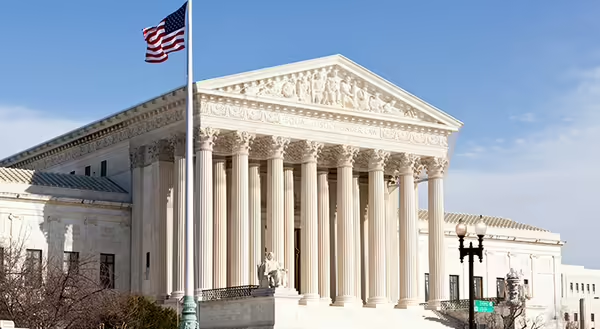
In a presentation I gave during the Springfield Agronomy Summit last week, I mentioned that the landscape of trade policy was constantly changing. I discussed, among other things, the tariffs that had been imposed in 2025 and the court challenges to those tariffs. The Supreme Court must have heard me talking, cause on February 20 they issued their ruling in Learning Resources, Inc. v. Trump. I wrote about this case in a previous blog post in which I covered the facts of the case, and the arguments made by both sides. This blog post will analyze the decision, covering the reasoning used by Chief Justice Roberts and what other justices wrote in their concurring or dissenting opinions. There is a lot to unpack in the 170 page-decision, but every page carries significant meaning and change for trade policy.
Brief Recap
It is worth recalling some of the basic facts of the case before going into the full decision. On April 2, 2025, President Trump signed executive orders that imposed tariffs on numerous countries. The rates of these tariffs varied by country, and most went into effect in August 2025. The President used the International Emergency Economic Powers Act (IEEPA) as the authority to impose these tariffs. This resulted in two legal challenges – one in the U.S. District Court for Washington D.C., the other in the U.S. Court for International Trade – alleging IEEPA does not allow the President to impose these tariffs. The Supreme Court combined both cases into one, with the main question being whether “regulate…importation” in Section 1702 of IEEPA allowed the President to independently impose tariffs.
Majority Opinion
Chief Justice John Roberts wrote the opinion, which was joined by five other Justices: Kagan, Sotomayor, Jackson, Barrett, and Gorsuch. He starts by reviewing how the power to impose tariffs has been left to Congress, citing not only Article I, Section 8 of the Constitution, but also decisions in cases such as Gibbons v. Ogden (9 Wheat. 1, 201, 1824). This is because a tariff is a tax, and the framers of the Constitution wanted the power to tax to lie solely with Congress.
There is then the issue of how IEEPA is worded. The words “regulate” and “importation” in Section 1702 are of specific importance here. Do these words allow the President to impose these tariffs? When dealing with a question of ambiguous text, the Chief Justice notes that the Supreme Court is often reluctant to give Congress’s authority to the Executive Branch. He notes that normally, when Congress delegates its power, it does so expressly and is clear on its intent and limits. He reasons that because the word “tariff” is not covered by any of the eight verbs in Section 1702, including “regulate,” that Congress did not intend for the President to have the unilateral power to impose tariffs.
Concurring Opinions
Several justices offered concurring opinions, which gives them the opportunity to explain their thoughts or clarify their position. While the concurring and dissenting opinions do not carry the force of law, they do provide an insight to the Court’s thinking.
Justice Gorsuch wrote on how the “major questions doctrine” does not align with the President’s arguments. In short, the Court has used this doctrine to settle issues that arise when an agency makes a decision that had major national significance, which must be supported by clear Congressional authorization. This doctrine has been applied in recent cases such as Alabama Association of Realtors v. HHS (594 U.S. 758, 2021), National Federation of Independent Business v. OSHA (595 U.S. 109, 2022), West Virginia v. EPA (597 U.S. 697, 2022), and Biden v. Nebraska (600 U.S. 477). He argues that even if the doctrine is applied, it would not allow the President to impose these tariffs. Justice Barrett further clarifies her position on the doctrine as it applies to this case, which is different from Justice Gorsuch’s.
Justice Kagan also wrote a concurring opinion, which was joined by Justice Sotomayor and Justice Jackson. Justice Kagan argues that the major question doctrine does not need to be applied in this case. Rather, she argues, standard interpretation of IEEPA leads to the same conclusion, that Congress did not intend for the President to unilaterally impose tariffs. Justice Jackson wrote a separate concurring opinion, exploring the full legislative history to really understand what Congress intended when they wrote IEEPA. When looking at the legislative record, Justice Jackson finds that Congress intended IEEPA to allow the President to control transactions involving foreign property.
Dissenting Opinion
Dissenting opinions, like concurring opinions, do not carry and weight of law, but they give justices who disagree with the outcome an opportunity to explain why and how they would have ruled on the matter. The first dissenting opinion in this case was written by Justice Thomas. He writes on how the power to impose tariffs can be delegated by Congress, and he notes that it has been done in the past, especially in the early days of the United States. This is mainly based on his belief that because trade with other nations is an area of foreign policy, the Constitution gives that power to the Executive Branch, not Congress.
Justice Kavanaugh also wrote a dissenting opinion, which was joined by Justice Thomas and Justice Alito. His argument centers on the idea that tariffs are included under “regulate” in Section 1702 in IEEPA. He also cites the case Federal Energy Administration v. Algonquin SNG, Inc. (426 U.S. 548, 1976), which upheld tariffs imposed by President Nixon and President Ford under the Trading with the Enemy Act (TWEA). TWEA had similar language to IEEPA, and thus Kavanaugh argues that the same authority should carryover to IEEPA. He argues that the ruling made by Chief Justice Roberts causes two larger issues. The first how much money will need to be refunded to importers who have had to pay these tariffs. The second is how trade deals decided since the tariffs were announced will be impacted.
So, what next?
The end of Justice Kavanaugh’s dissenting opinion does provide an excellent question that has to be asked: what happens now? The best answer I or anyone else can provide is no one can really say. The President announced in the days since the Supreme Court announced its decision that he will be altering the tariff rates yet again. It will undoubtedly take time for new tariffs to be implemented, and for any legal challenges to those tariffs to play out in the courts. Tariffs and trade policy more broadly have an enormous impact on agricultural producers here in Illinois and across the United States. Not only do we rely on foreign markets to buy our products, but also rely on products from other countries to support our agricultural production. All of these combined can have a significant impact on the profitability of operations as we move ever closer to planting the 2026 crop here in Illinois.