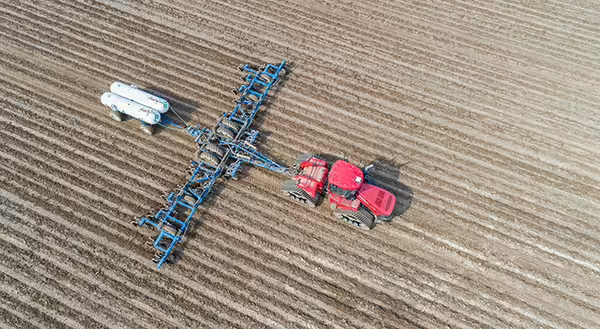
Spring planting is right around the corner here in central Illinois. As the weather warms up, more producers are beginning to prepare their equipment to get into the field at the right time. While getting the seeds in the ground at the right time is important this time of year, equally important is adding fertilizers that might be needed for the growing season. One common nitrogen fertilizer used by producers in central Illinois is anhydrous ammonia. While most anhydrous is applied in the fall after harvest, some producers will apply anhydrous in the spring before planting. But this product does require extra safety precautions to protect applicators, those who transport it, and local communities. This blog post will discuss the chemical composition of anhydrous, the damage it can cause to humans, and the necessary safety steps applicators needs to take.
Chemistry and Characteristics
Anhydrous is commonly referred to by its chemical symbol, NH3. This means it is comprised of one nitrogen atom and three hydrogen atoms. The difference in the weight of nitrogen and hydrogen atoms means that the weight of the compound is roughly 82% nitrogen and 18% hydrogen, according to North Dakota State University Extension. At normal temperatures and pressures, anhydrous is a gas that has is lighter than air, clear, and colorless but has a distinct odor. Purdue University notes that the odor can be detected between five and 50 parts per million (PPM), with a concentration of more than 5,000 PPM resulting in suffocation. When anhydrous is compressed or cooled, it transforms into a liquid; and one cubic foot of liquid anhydrous produces approximately 850 cubic feet of anhydrous gas according to North Dakota State University Extension.
Exposure Risks and First Aid Response
The “anhydrous” name means that the compound does not contain water, which makes it different from other ammonia solutions. Because it does not contain any water, it seeks out and attaches itself to water molecules. When it does attach itself to water, it takes a hydrogen atom from water (H2O) to form ammonium (NH4+) which has a pH level like bleach. It also leaves behind hydroxide (OH-). When this process occurs in the soil, the ammonium stays in the soil and is a nitrogen source for plants. This is a good thing. However, when this occurs in the air, on the skin, in the eyes, or other parts of the human body, the results are much more serious. North Dakota State University Extension discusses the affects of exposure to people, and how to provide first aid to an affected person.
Exposure on the skin can be serious, mainly because human skin is approximately 44% water. When anhydrous contacts moist clothes, it freezes the clothes to the skin. When exposed directly to the skin, it quickly kills tissue and cells that result in a chemical burn. Since the cells are killed, they are unable to heal or replace themselves. The only way to stop the chemical burn is applying large quantities of water to the affected area, rather than using creams or ointments. Iowa State University Extension recommends keeping a five-gallon jug of water on hand to stop the burning process.
Eyes are constantly moist, making exposure to the eyes extremely dangerous. When anhydrous makes it to the eyes, it can result in cataracts or even permanent vision loss. Because of this, the eyes need to be flushed with water immediately and the affected person needs to be taken to a doctor. Iowa State University Extension recommends carrying a small squeeze bottle to provide immediate relief to a victim. While this may not be the full cure, it can buy some time until the victim is taken to a doctor for treatment.
As mentioned earlier, high concentrations of anhydrous in the air can lead to suffocation. Like the eyes, our respiratory system is very moist, making it highly susceptible to anhydrous exposure. When inhaled, anhydrous will start to burn the lungs which can make it too painful to breathe. While water helps with exposure to the skin and eyes, oxygen is needed or victims who inhale anhydrous. Respirators can offer some protection from short-term and some long-term exposures, but if the levels are too high, a self-contained breathing apparatus (SCBA) and hazmat suit are needed to adequately protect anyone in the area.
Personal Protective Equipment and Other Safety Steps
The risks of exposure to anhydrous requires all applicators and handlers to exercise extreme caution and utilize proper safety precautions to limit the risks of exposure. Personal protective equipment (PPE) is one line of defense for anyone who is filling or transporting tanks, coupling hoses, or applying anhydrous. This includes proper eyewear, clothing, and other equipment.
Not all eye protection is created equal when it comes to anhydrous, with regular glasses or contact lenses offering no protection. Ventless goggles that are rated for anhydrous are needed to ensure adequate protection. The same can be said for gloves. Having long-cuffed gloves that are rated for anhydrous are necessary. Ohio State University recommends keeping an extra pair in the truck or tractor cab, in addition to the pair you normally use. Heavy, tightly woven clothing will slow anhydrous exposure to the skin more than lighter clothing, but a plastic hazmat suit offers the best protection, especially in high concentration areas.
In addition to these PPE requirements, there are other practical steps that handlers and applicators can take to protect themselves and anyone else in the area. University of Minnesota Extension recommends, in addition to exercising extreme caution when handling hoses/transfer lines, standing upwind while connecting/disconnecting or bleeding lines can reduce inhalation exposure. Furthermore, it is recommended to put all equipment downwind from any houses or populated areas to reduce the risk of exposure.
Anhyrdous ammonia is a commonly used nitrogen fertilizer in central Illinois and across the Midwest. While important for crop production, it does carry some important safety requirements for applicators and handlers. Using proper PPE, exercising caution, and being mindful of the area around you are important considerations for using this product. Despite the risks and harms from exposure, the resources available through this blog post can help applicators and handlers protect themselves, local ecosystems, and local communities.