This month, I took on something I’ve only done once before—fruit tree grafting for Extension food access projects across the tri-county area. Last spring, I grafted 24 apple scions onto 24 rootstocks. 23 of those grafts were successful, leaving me a great problem to have – finding homes for 23 young apple trees last fall.
This spring, I’m “pearing” down the effort slightly (ha!) by grafting four pear scions onto four rootstocks. The goal is twofold: to expand long-term food access through perennial fruit plantings, and to continue building my own skills and confidence in fruit tree grafting for future Extension programs and trainings. Now, let’s clarify some of these words, then explain the process.
The scion is the shoot (1-yr-old branch) from the desired cultivar - let’s say ‘Granny Smith’ that forms the trunk, branches, and fruit of a grafted tree. The rootstock is the lower portion that provides the root system and can influence tree size, disease resistance, and adaptability to soil and climate conditions. But wait, why are grafted trees necessary, anyway?
One cannot simply save seed from beloved apple trees and plant them and expect the same characteristics in the seed tree as from the parent. That is because apples are highly heterozygous.
In plain terms, heterozygosity means apple trees carry many, many different versions of genes, so seeds produced from apples will not grow “true to type.” Apples grown from seed almost always produce fruit that is different (and usually inferior) to the parent variety. They will also be way too tall. Therefore, named apple cultivars must be clonally propagated by grafting rather than by seed.
For example, a seed from a Granny Smith apple, if planted, could yield a tree up to 40 feet tall—the typical size of a mature wild apple. Years later, when it finally bore fruit, apples might be falling on people’s heads like they were Isaac Newton discovering gravity. And the fruit itself? It might be sour like Granny Smith, but mealy. Or green and firm but very sweet, with no sourness at all. The possibilities are nearly unlimited. If aspiring orchardists want to know what they’re getting, they need to either buy grafted trees—or learn to graft themselves. I am interested in the latter.
Buying grafted trees is fine, but being able to choose not only the cultivar of apple but the rootstock it will grow on can allow orchardists to customize aspects of their trees like maximum height, stability, disease resistance, and more. For beginner grafters, I suggest the whip-and-tongue graft.
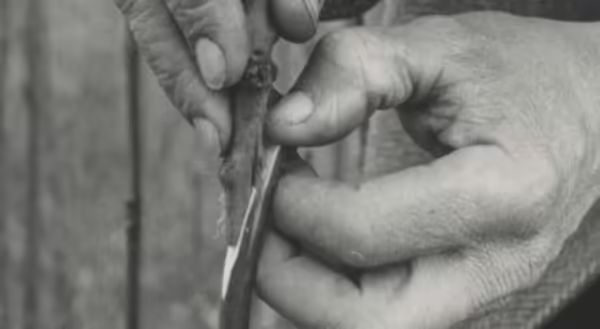
A whip‑and‑tongue graft joins two pieces of wood (scion and rootstock) using matching sloping cuts with added “tongue” cuts. The “tongues” allow the pieces to interlock, creating a strong, stable graft union (see photo). I order rootstocks and scions in January for shipment in late March. I then refrigerate both until early April when I graft on a picnic bench outdoors.
I believe the whip-and-tongue graft is the easiest graft to learn and seems to be forgiving to the beginner in terms of success rate. Here is a more specific description of the process.
Most of the rootstock tree except for 6” of growth is first removed with a sharp grafting knife. From there, a scion with similar diameter to the rootstock tree is chosen, a matching cut is made on it, then the reverse “tongue” cuts on both the scion and rootstock is made before pushing them together tightly. Cut resistant gloves are a good idea for beginners.
This graft is difficult to explain further but there are many high-quality educational videos of this grafting technique available online that helped me greatly.
Once joined, the graft joint is wrapped tightly, first with a broken and tied-off rubber band, then parafilm, so the graft union stays locked together and does not dry out. Wrap the entire graft union in at least parafilm, tightly. Eventually, the tissues heal and grow together into one tree, and the parafilm can be removed in mid-summer.
I graft my trees in early to mid-April, and that day, pot them up into 2-gallon pots, using a mix of 20% perlite and 80% high-quality potting media. After watering in thoroughly, I put them in a shady area up against a building to prevent drying effects of wind and heat stress from sun.
The scion’s buds eventually leaf out after a week or two, and by the end of the year, they can add a few feet of growth. I plant them in later fall, and I head back any main leader growth on the new trees the following February during dormant pruning to facilitate branch development.
Only buds above the graft union should be allowed to grow. Typically, one bud emerges as the main growth driver. Any leaves on the rootstock tree that emerge from below the graft union should be rubbed off at emergence.
Pro-tip: use masking tape and permanent market to create a label indicating the cultivar and the rootstock either on the pot or on the grafted tree as soon as it’s done. This same information should go on a permanent label upon planting.
Whip-and-tongue grafting can be daunting, and there’s no other way to learn it except by trying it with your own two hands. Once a few successes are had, it becomes more fun and less intimidating. Take your orcharding to the next level and learn how to graft.
WRITER: Nick Frillman-Local Food Systems & Small Farms Systems Educator, Livingston, McLean and Woodford Counties
ABOUT EXTENSION: Illinois Extension leads public outreach for University of Illinois by translating research into action plans that allow Illinois families, businesses, and community leaders to solve problems, make informed decisions, and adapt to changes and opportunities
COLLEGE OF AGRICULTURAL, CONSUMER & ENVIRONMENTAL SCIENCES
University of Illinois | U.S. Department of Agriculture | Local Extension Councils Cooperating
University of Illinois Extension provides equal opportunities in programs and employment.
If you need a reasonable accommodation to participate in this program, please contact us.
Early requests are strongly encouraged to allow sufficient time for meeting your access needs.