The thing I love most about fruit tree and small fruits management is that there is always more to learn. For example, regarding fresh eating grapes or wine grapes, I am very familiar with selection of varieties of grape vines for our area, best practices of dormant season pruning, and some (not all) grape diseases and pests, and their management. But until last week, I had never read up on spring and summer pruning of grape vines or done any spring pruning myself. It turns out there is a lot to learn!
Long story short, as grape growers, we are not done with pruning for the season once we get done with dormant season pruning of grapes, if the goal is to grow great grapes. Dormant-season pruning in late winter stimulates many new shoots to grow along grapevines in spring – too many, in fact. So, the next stage of grapevine tissue removal is known as shoot thinning.
According to Penn State Extension’s “Early Season Grapevine Canopy Management: Shoot Thinning” article, shoot thinning should take place after last chance of frost, when new shoots on vines are about 5-6” long. Shoot thinning can bring vines into vegetative and fruiting balance by reducing shoot density and the number of fruit clusters per vine. Their recommendation for how many shoots to leave on, per linear foot of grape vine, is:
- 3-5 shoots per ft. for most Vitus vinifera wine grapes
- 4-6 shoots per ft. for most hybrid cultivars (European grape crossed with American or Asian species to be more resilient)
- Up to 15 shoots per foot for Vitis labrusca native American grapes like Concord – though I don’t believe this would turn out well, and would recommend 6-10…
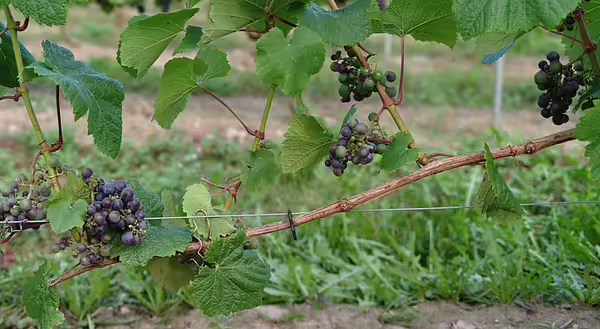
If all emerging shoots on vines are left to grow, they can quickly form dense grapevine canopies by late spring that have decreased airflow, increased humidity, and more places for insect pests to hide, making them ideal locations for grape pest and crop disease outbreak in summer. Worse yet, shaded flower clusters can have decreased pollination which means less fruit…
I hosted a workshop at the Refuge Food Forest in Normal in early March on dormant-season grape pruning, and after I learned I had missed my shoot-thinning window last week, I went to check on our vines more closely. They weren’t horribly overgrown, and some vines did have a decent handful of fruit clusters developing. And I was coming right up on hedging time.
Hedging is the next and final pruning occasion to mention for now, and according to Michigan State University Extension, should be done when remaining shoots begin to grow about 12” past their supports, whether that’s a trellis, arbor, or etc. If left un-hedged, they will start to flop, tangle, and shade their own leaves, as well as developing fruits. Just like in shoot-thinning, we are aiming to enhance sunlight penetration into the canopy, onto leaves that will assist in ripening our fruit clusters – as well as increase airflow which will decrease the chance of common diseases like powdery mildew and botrytis.
In the North Carolina Extension Winegrape Growers Guide, the recommendation is to hedge-cut productive shoots on vines such that they retain 15-20 leaves per shoot, and that this should be done no less than 30 days after bloom – to prevent lateral regrowth. This is confusing and tedious to me, and as a beginning summer canopy manager, I would err on the side of a recommendation like, “After fruit clusters have formed and fruits are pea-sized, hedge shoots to keep growth within trellis or support structure but leave plenty of healthy leaf area above fruit to help ripen the crop.”
The MSU article called “Early Hedging for Healthier Canopies and Better Ripening in Cool Climates” by Nasrollahiazar and Sabbatini recommends hedging no later than mid-summer, “which reduces risk of excessive shading in the fruit zone, …. And redirects vine energy toward fruit development and ripening.”
So, with Penn State, North Carolina, and MSU Extension articles dancing in my head I returned to the Refuge Food Forest on a sunny Friday afternoon to shoot thin (late) and hedge-prune, probably make some mistakes, and learn. All resources were unanimous that late shoot thinning was better than no shoot thinning at preventing disease and enhancing vine photosynthesis.
There is one last very important item to point out. Any time any shoot thinning or hedge-pruning is being done, it is crucial to do so on a sunny afternoon when ambient humidity is low, to minimize the chance of infection on grape vines and give the vines a chance to heal the wounds we make when we do these activities. Also, always spray hand pruners, snips, etc. with isopropyl alcohol after moving to the next vine, as well as any time a suspected diseased vine is cut, to avoid spreading grape disease issues.
I will write a follow-up article next spring after I shoot-thin at the appropriate time in spring and report back what I have learned.
WRITER: Nick Frillman-Extension Educator, Livingston, McLean and Woodford Counties
ABOUT EXTENSION: Illinois Extension leads public outreach for University of Illinois by translating research into action plans that allow Illinois families, businesses, and community leaders to solve problems, make informed decisions, and adapt to changes and opportunities.
###
COLLEGE OF AGRICULTURAL, CONSUMER & ENVIRONMENTAL SCIENCES
University of Illinois | U.S. Department of Agriculture | Local Extension Councils Cooperating
University of Illinois Extension provides equal opportunities in programs and employment.
If you need a reasonable accommodation to participate in this program, please contact us.