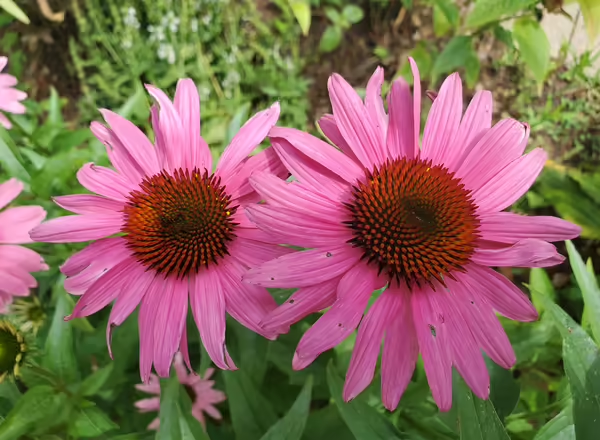
Purple coneflower (Echinacea purpurea) is a popular and iconic native and a mainstay of my plant palette for the garden. It’s one of the first native plants I began to incorporate into my own gardens and remains an all-time favorite to this day.
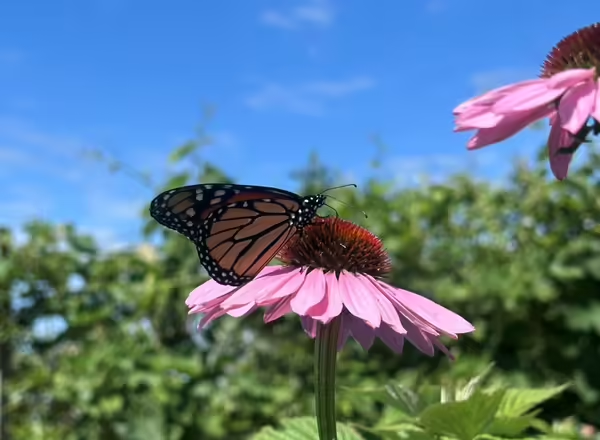
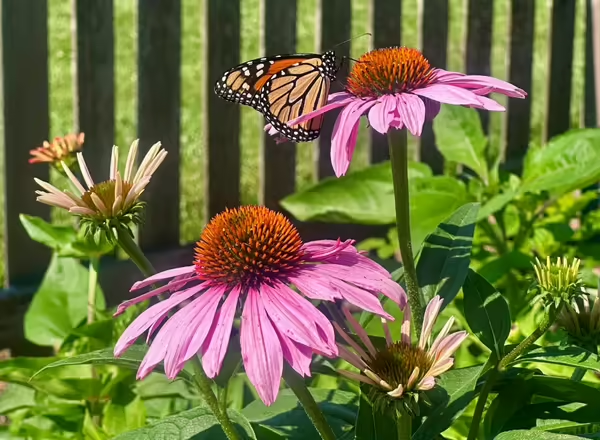
This Illinois-native plant performs great in the garden, offers a long bloom season and is attractive to a wide range of pollinators. The coarse texture of its leaves and chunky flowers contrasts nicely with more fine-textured native grasses, adding ornamental beauty to its list of accolades.
In recent years, purple coneflower, along with other native coneflowers, has received quite a bit of interest in the US, as well as globally. This has sparked the arrival of new hybrids and cultivars each year, which stand to unlock the full horticultural potential of this native plant group.
Newer Echinacea
The genus Echinacea is native to North America with a total of nine species, three of which are native to Illinois: purple coneflower (E. purpurea), pale purple coneflower (E. pallida) and glade coneflower (E. simulata). Visit any garden center and you can typically find an eye-catching array of cultivars and hybrids. Some of these plants dependably reproduce from seed, but others require tissue culture to carry on the traits sought. While there are quite a few hybrids among Echinacea species, many trace their roots to purple coneflower.
The list of new Echinacea offerings over the last 30 years is truly mindboggling, presenting all shapes and sizes of what we traditionally think of as a coneflower. In all cases, these new introductions were developed for some kind of improvement in the plant form, typically for ornamental reasons. However, many gardeners report poor garden performance over time from some of these newer coneflowers, leaving me to constantly question them.
Changes to Flowers
Changes or “improvements” to flower color and form have been something very common among new coneflowers, and I think most gardeners can picture the stark, sometimes unreal-looking colors of Echinacea flowers at the garden center. However, some of these changes may not benefit pollinators, creating a more ornamental bloom at the expense of pollen and nectar production.
Coneflowers fall into the Aster Family, known for its attractive composite flower structures that are often pollinator favorites. Each coneflower is comprised of hundreds of individual ray and disc flowers to create its spiny, composite inflorescence. The spiny appearance is created from pointed, bristly bracts that accompany each disc flower. It's these disc florets that offer pollen and nectar for pollinating insects. The colorful “petals’ we see are actually modified ray flowers designed to attract pollinator attention but offering no nectar or pollen reward.
Double-flowered coneflowers have become popular for their more showy flowers. However, the ornamentally attractive flowers were developed through breeding to promote genetic mutations that result in more petal-bearing ray flowers at the expense of the pollen and nectar-producing disc flowers. This change has made double-flowered varieties much less valuable or attractive to pollinators. On the plus side, this change makes them bear fewer seeds, which can be beneficial to reduce spread, but, in turn, also reduces the benefit to birds who may feed on the seed.
Other changes to flowers have included an extended bloom season or more abundant or larger flowers. Some newer coneflowers offer more reflexed petals (bending downward) vs more horizontal petals to create a new look. Along with changes in form or petal orientation, there has been an amazing array of color variety, with coneflowers now sporting the traditional pink to purple, along with white, red, yellow or even green.
Changes to Habit
Breeding and development have also focused on improvements in habit. Echinacea species evolved to compete in nature, tolerating poor soils and plant competition that may not exist in our garden space. When grown in the garden with some of these natural pressures removed, coneflowers are sometimes prone to flopping over from excessive growth. Breeding for shorter or more sturdy stems has helped with this issue, with some cultivars even claiming a compact or miniature stature.
Some cultivars or hybrids also offer a more branching habit that leads to a greater number of blooms. New varieties also offer a more uniform growth habit to produce stems and flowers at similar heights, versus the tendency many coneflowers have for irregular height among stems and blooms. This combined effect of abundant flowers and more uniform growth often creates a more dramatic and distinct display.
Garden Performance
Many gardeners report poor performance in the garden from newer Echinacea hybrids or cultivars, often noting that they fade away after a season or two. While it may be the case that some of these plants just don’t last, it does help to understand what may be at play when making selections.
Numerous coneflower hybrids or varieties include purple coneflower in their lineage, which can be a misunderstood plant. Gardeners often overlook or just don’t understand that individual plants of this short-lived perennial typically only last 2-3 years in the garden. However, prolific seed production creates a whole new generation of new plants each year, which easily sustains a patch or block of coneflower over time.
The shifting, changing pace of a coneflower patch is one of my favorite aspects of growing this plant. This constant dynamic makes the space seem more alive and closer to the way plants function in a natural ecosystem. Abundant new seedlings are great for transplants but also offer the opportunity for change by allowing a seedling to grow or removing it to adjust the density or distribution of coneflowers in the garden.
Gardeners often report that coneflowers change or revert back to the genetics of their origin over time, but this change is often simply part of the dynamics of a coneflower patch. Not only are individual plants dying each year, but coneflowers readily hybridize, and new seedlings may have entirely different traits. So, your cultivar may not have reverted, but rather the plant you see in the same space this year is simply a hybridized seedling with new or different traits. Garden spaces with multiple coneflower hybrids or cultivars growing in close proximity are more prone to these shifts over time since there is an abundant opportunity for cross-pollination.
Coneflower Care
Understanding coneflower needs can also be blurred by the numerous hybrids available, but it does help to think about straight-species needs when considering care of any hybrid or cultivar. I always compare purple coneflower needs to pale purple coneflower as they represent the two ends of the coneflower spectrum in terms of site condition preferences. Purple coneflower typically prefers moister conditions and can tolerate more clay, versus pale purple coneflower, which is more adapted to drier conditions and poorer soils.
The root system of each plant differs according to their preferred site conditions. Pale purple coneflower, like many other coneflower species, has a root system driven by the development of a deep taproot. This is advantageous in competitive environments with lots of plant competition for water. However, in a garden setting, it makes E. pallida a little more sensitive when transplanting, but more resilient to plant competition once established. Conversely, purple coneflower produces a more fibrous and shallow root system that does well in richer garden soils, handling higher clay content better. This plant is very easily transplantable as its shallower roots are easier to dig up and transport.
I’ve had the best luck with purple coneflower in richer soils, often containing more clay and located in more full sun locations. Whereas coneflowers that fall into the pale purple coneflower preferences for drier, less fertile sites seem to do better in full sun or partial shade conditions in areas where tree roots or other plants may compete.
Coneflowers typically benefit from deadheading, although many do rebloom without much attention. Consider deadheading or even removal of seed heads when new seedling production is not desired. However, I really enjoy watching gold finches (Spinus tristis) frequent the seedheads in my garden late in the year and throughout winter. So, I tend to leave all seedheads on the plants. Any deadheading effort will typically reduce seed production and forage value to birds.
In general, coneflowers are relatively disease and insect-free. However, aster yellows is a pathogen of increasing concern for coneflower growers. To learn more about this serious threat to coneflowers and many other members of the Aster family (Asteraceae), check out this past Garden Scoop Blog, “Aster Yellows on Coneflower”.
Which Echinacea Should I Choose?
The jury is still out on which new coneflower is the best, and it all depends on what traits you are after. Whether it’s awe-inspiring wonder from a flashy new color, gaining an improved habit or simply trying to maximize pollinator support, there is a coneflower out there for every garden.
A few reports I have reviewed recently can help you stack the odds in your favor for coneflower success. While it is difficult to keep up with the constant stream of new introductions, these reports can help you understand a large swath of what is out there before you head to the garden center.
The Mt. Cuba Center in Delaware has published two research reports over recent decades documenting the performance of Echinacea hybrids and cultivars. Their more recent trial report, released in 2020, also took into account pollinator preferences along with plant performance.
Some plants assessed in their 2009 trial were top performers again in 2020, making them good choices given their consistent performance. The report notes that top performers were generally the semi-compact habits that did not need staking to avoid flopping over. Find all the info plus some spectacular pictures in their report titled, “Echinacea for the Mid-Atlantic Region”.
A little closer to home for us are the trial reports from the Chicago Botanic Garden. Since the 1990’s, this institution has been trialing and evaluating coneflower species, hybrids and cultivars. Their reports are focused on garden performance, taking into account a variety of evaluations across the growing season, although pollinator use is not formally assessed.
Interestingly, some of their past trials were heavily impacted by aster yellows, which puts a real exclamation point on this pathogen. Historically, these projects have assessed 222 coneflowers, with their most recent trial comparing 52 plants. Ratings of this most recent effort are based on ornamental qualities as well as health and longevity over the 5-year trial period. Findings from this study, as well as their multiple decades of assessment, are summarized in the latest report from 2024 titled, “A comparative Evaluation of Echinacea Cultivars”.
Ryan Pankau is a University of Illinois Extension Horticulture Educator serving Champaign, Ford, Iroquois, and Vermilion Counties.