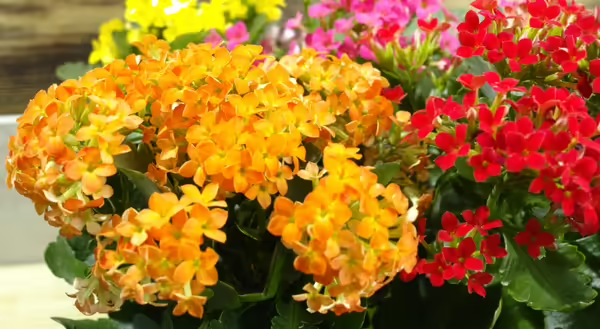
Traditional holiday plants get a lot of attention this time of year, and the Good Growing team has made an effort to write about the most popular ones. We have an article for poinsettia, paperwhites, holiday cacti, mistletoe, and more. A nontraditional holiday plant that is available in abundance this time of year is Kalanchoe spp. This easy-to-grow, long-blooming succulent might be the perfect gift or addition to an already abundant plant collection this winter season.
Kalanchoe is a genus of tropical succulents native to parts of Africa and Asia. There are approximately 174 accepted species of Kalanchoe. For this article, Kalanchoe blossfeldiana, also known as the Christmas kalanchoe, is the primary focus.
Kalanchoe blossfeldiana
Kalanchoe blossfeldiana is a compact, upright succulent that is cultivated as a house plant or used in rock gardens as an annual. Plants can grow up to 2 feet in height and width.
K. blossfeldiana are easy to propagate, require low maintenance, and are available in a wide variety of bloom colors, including red, orange, yellow, pink, salmon, purple, and white. Individual flowers include four petals, although double flowers exist on some cultivars. Flowers are borne above the leaves in umbel clusters and can last six weeks or more when cared for well.
Attractive, large, thick, fleshy, dark green leaves are often scalloped along the edges, although some species have smooth leaf margins. Leaves grow in opposite pairs on most Kalanchoe species, including K. blossfeldiana, although some are arranged in a whorled pattern.
Care for Kalanchoe
As a house plant, Kalanchoe prefers bright indirect sunlight, very well drained soils, and relatively low humidity. Actively growing plants should be provided with a well-balanced fertilizer or a bloom-enhancing fertilizer that has higher levels of phosphorus. As a short-day plant, blooms will be initiated following six weeks of minimum fourteen-hour nights. Ideal room temperature ranges from 60 degrees Fahrenheit at night to 70 degrees Fahrenheit during the day. Temperatures outside of this range may negatively impact flower development.
When growing in a container, take care to avoid the plant from becoming unstable in the container. The thick leaves can retain water and become top-heavy. If the plant falls over, it could be damaged.
Plants can be transplanted or moved outdoors during Illinois’ summer months—plant in full sun to part shade in light, sandy soils. Little water and light fertilizer are needed throughout the growing season. Treat the plant as an annual or transplant it into a container to bring indoors when temperatures drop.
Watch for mealybug, mites, and scale on the plant and take appropriate actions if present. Overwatering can lead to stem or root rot challenges.
Propagation
Kalenchoe blossfeldiana can be propagated from leaf or stem cuttings. To take a leaf cutting, gently twist or cut a healthy leaf from the stem. Allow the leaf to dry and form a callous for a few days before laying the leaf on or inserting it into a moist soil mix. Keep the cutting in bright, indirect light and keep it moist but not soaked. Roots should emerge in a few weeks at the base of the leaf.
To propagate by stem cutting, collect a two-to-three-inch segment of stem, cut just below a leaf node. Allow the stem to form a callus for two to three days to prevent rot. Place the cutting in a cactus or succulent potting mix. Lightly moisten the soil and keep in a location with bright, indirect light. Roots will develop in a few weeks.
Kalanchoe and pets
The ASPCA lists Kalanchoe as toxic to dogs and cats. The group of compounds responsible for pet harm is cardiotoxic steroids known as bufadienolides. These compounds are found in all plant parts, with higher concentrations in the blooms. Signs of toxicosis in pets include excessive salivation, depression, and gastrointestinal distress beginning a few hours after consumption. With increased exposure, signs of arrhythmias, tachycardia, and dyspnea may be exhibited, as well as signs of weakness and cold extremities due to reduced heart function. If it is suspected that a pet has ingested any plant part, contact a veterinarian professional immediately for further guidance.
Good Growing Fact of the Week: The species Kalanchoe daigremontiana has earned the common name of Mother-of-Millions due to its ability to produce plantlets on the edge of the leaves. When the plantlets fall from the mother plant, they will take root where they land and grow as a new plant.
Bonus Good Growing Fact of the Week: Green leaves may develop a red hue along the outer edge as a natural sunscreen in response to intense light exposure.
Thank You for Reading!
Sign up for our emails! Want to get notified when new Good Growing posts are available? SIGN ME UP
Give us feedback! How helpful was this information (click one): Very helpful | Somewhat helpful | Not very helpful
MEET THE AUTHOR
Emily Swihart is a horticulture educator with University of Illinois Extension, serving Henry, Mercer, Rock Island, and Stark counties since 2021. Emily provides horticulture programming with an emphasis on the home gardener, the urban forest, native plant ecosystems, and landscape design. Additional responsibilities include supporting local county Master Gardener and Master Naturalist volunteers - providing training, continuing education, advanced training, and their involvement in seasonal events and community outreach programs.