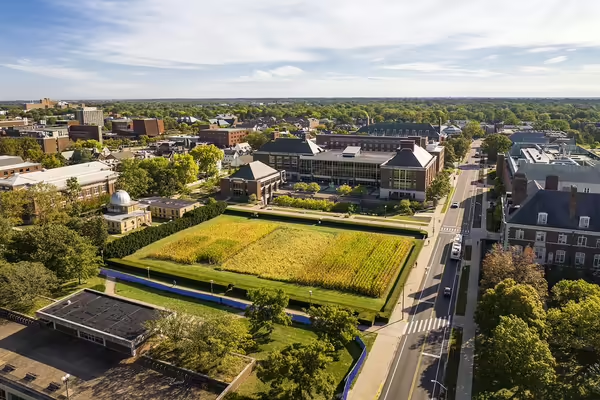
The College of Agricultural, Consumer and Environmental Sciences at the University of Illinois Urbana-Champaign often cites its land-grant legacy, but the land-grant university system is not a well-known concept outside of higher education. In fact, many current students, staff, and faculty struggle to define it. So, let’s get into what it means, how it came about, and why it still matters.
Today, the land-grant mission centers on three equally important components: education, research, and outreach. While many universities excel in teaching or research — or both — only land-grant institutions are federally mandated to bring the knowledge generated on campuses out to the public. In other words, land-grant institutions don’t lock their discoveries away in an ivory tower. We share useful, science-backed recommendations via University of Illinois Extension staff and volunteers embedded across the state. What’s more, our Extension network informs our research priorities.
How did we get here? The throughline of the land-grant origin story, described below, is access and practicality. Those principles have guided us for more than 150 years, and they’re every bit as relevant today.
Read the full article from the College of ACES.
University of Illinois Extension develops educational programs, extends knowledge, and builds partnerships to support people, communities, and their environments as part of the state's land-grant institution. Extension serves as the leading public outreach effort for University of Illinois Urbana-Champaign and the College of Agricultural, Consumer and Environmental Sciences in all 102 Illinois counties through a network of 27 multi-county units and over 500 staff statewide. Extension’s mission is responsive to eight strategic priorities — community, economy, environment, food and agriculture, health, partnerships, technology and discovery, and workforce excellence — that are served through five program areas — 4-H youth development, agriculture and agribusiness, community and economic development, health and community wellness, and natural resources, environment, and energy.