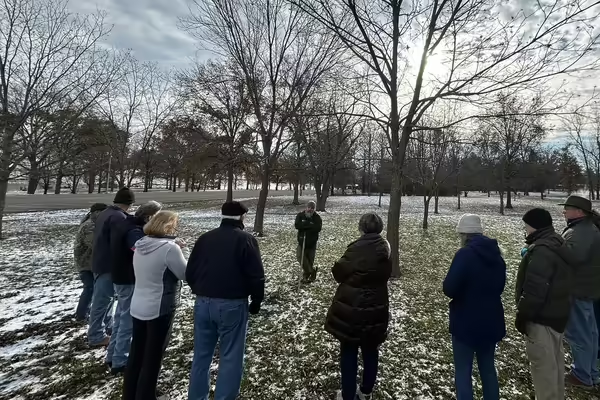
URBANA, Ill. — As the saying goes, the hope is that trees will “bloom where they’re planted.” Still, sometimes even these plant powerhouses need help overcoming challenges like invasive species, urban environments, and overharvesting. A core University of Illinois Extension program area — natural resources, environment, and energy — shares research-based resources with communities through a network of statewide educators, specialists, and foresters. Forestry Extension and research specialist Christopher Evans leads programs and research projects across Illinois to help anyone with trees on their property better understand and manage them to meet their goals.
What do you specialize in, and what motivated you to start working in that area?
I work in forestry, and I specialize in forest health, vegetation management, and invasive species. I am also very involved in native plants and environmental restoration work. I originally majored in Wildlife Biology in college, where I took a dendrology course, which is the study of trees. I really enjoyed working with trees and kept delving deeper into plants in general. I decided that is where my passion is and what I wanted to do for a career.
What brought you to University of Illinois Extension?
Way back in graduate school in Iowa, I was asked to give a presentation on invasive plants at an Extension conference. After my presentation, the Iowa State University Extension forester, who had asked me to give the presentation, came up and said I was a good presenter and that I should consider a career in Extension. Before that, I had never really thought about Extension as a career option. That stuck with me, and I started seeking out positions that included public engagement and outreach. Extension is great for me as I really find a lot of satisfaction in helping people, especially people who want to take care of their land and do the right thing.
What does a day of work at Extension look like?
Extension forestry work is very varied. We provide a lot of hands-on training and work directly with landowners in the field to increase their forestry skills. This could include tree identification, chainsaw use, treating invasive plants, or how to properly use herbicide sprayers. As a specialist, I work statewide, so I travel a lot throughout Illinois to deliver programs. Other days, I answer questions, either directly from landowners or I help other Extension staff by providing information and resources for a question they have received at their local office. I also conduct applied research, mostly based at the Dixon Springs Agricultural Center, which keeps me in the field as well.
What is a question you get asked a lot?
A big one I get a lot is "What is wrong with my tree?" People love their trees and don't want to see them in decline. It can be difficult to diagnose tree problems, so I try to help either figure out what is wrong or connect them with the right contact who can.
What are you looking forward to working on this year?
I’m part of a team that is planning a second run of our new Introduction to Invasive Species Management course in 2026. This statewide program provides landowners, volunteers, and early career professionals with an opportunity for hands-on field experience controlling invasive species. This is a big program that involves collaboration across Extension.
About the Illinois Extension Forestry Program
Extension foresters provide natural resources education, technical assistance, programming, and awareness to the estimated 132,000 private forest landowners who own 82% of all forest land in Illinois. They lead public training programs on chainsaw safety, forest management and restoration, agroforestry, invasive species, timber harvesting, and more. The forestry team also maintains demonstration sites, conducts research, and teaches undergraduate courses at U. of I. The program is housed in the Department of Natural Resources and Environmental Sciences under the College of ACES and has offices on campus and at the Dixon Springs Agricultural Center.
To connect with Extension natural resources, environment, and energy staff about a program or for a consultation, visit go.illinois.edu/NREEstaff. Explore more about Extension’s work on natural resources, environment, and energy across Illinois.
University of Illinois Extension develops educational programs, extends knowledge, and builds partnerships to support people, communities, and their environments as part of the state's land-grant institution. Extension serves as the leading public outreach effort for University of Illinois Urbana-Champaign and the College of Agricultural, Consumer and Environmental Sciences in all 102 Illinois counties through a network of 27 multi-county units and over 700 staff statewide. Extension’s mission is responsive to eight strategic priorities — community, economy, environment, food and agriculture, health, partnerships, technology and discovery, and workforce excellence — that are served through five program areas — 4-H youth development, agriculture and agribusiness, community and economic development, health and community wellness, and natural resources, environment, and energy.