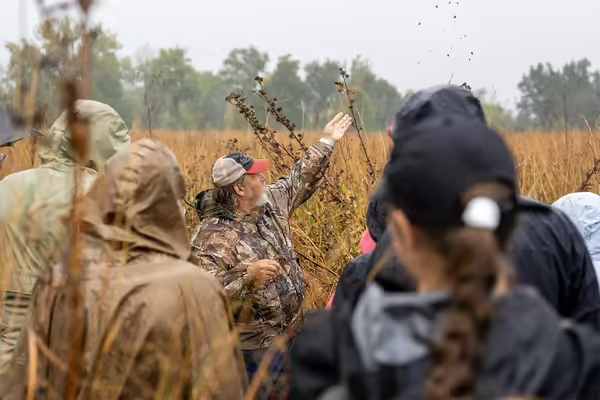
Urbana, Ill. — The sky was overcast and spitting rain on a mid-October morning when Master Naturalists from across the Prairie State gathered in central Illinois for a hike. But as the saying goes, there’s no such thing as bad weather, only bad clothing. It turns out that it’s hard to keep a nature lover inside when there are new trails to hike and plants to identify. The first day of the 2026 University of Illinois Extension Master Naturalist conference was set aside for hands-on learning, with several options for tours of local natural areas.
A hike with any Master Naturalist is more about the journey than the distance. The steps are deliberate, and the conversation is deep. With raincoats at the ready, volunteers explored the historic cabin and trails of the Rexroat Prairie in Virginia, a 50-year-old community restoration project. They learned how local stewards raised funds and worked with the community to turn farmland on the edge of town into a natural area. Northeast of Jacksonville, at the Tyner-Lael Wetland and Prairie Restoration, Master Naturalists gathered native plant seeds in repurposed plastic gallon milk jugs as they walked along grassland trails. Those with binoculars scoped for birds flying overhead, while others took out their phones to get a picture of a shrub they were trying to identify. Some ventured into the backyard of the Hillsboro Illinois Extension office to identify invasive species and participate in a hands-on help desk activity. Working together in small groups, they tackled common naturalist scenarios and strategized answers to the questions.
On day two, speakers carried the call for learning beyond the prairie landscape, offering workshops on topics including grass identification, climate conversations, and the history of bird banding. The day also featured keynote speaker Michael D. Wiant, who explored Indigenous history in Illinois. Drawing from his archaeological portfolio, Wiant offered a glimpse into the ongoing narrative of Indigenous people, their relationship with the natural world, and what we can learn from them to inform today’s decision-making. A live podcast panel discussion explored beavers as keystone species, uncovering themes from Ben Goldfarb’s book Eager: The Surprising, Secret Life of Beavers and Why They Matter.
“This is such an awesome opportunity for volunteers from across the state to connect with one another, learn from professionals and Extension educators, and discover more about the natural world," said Abigail Garofalo, the state Master Naturalist specialist.
With over 900 Illinois Extension Master Naturalists across the state, the annual conference serves as a grounding place for deep-rooted knowledge, connections, and ideas that reach back to local communities. These environmental stewards come together to share experiences, gain insights, and fuel project growth with fresh ideas that strengthen their impact in their local environments.
To amplify the statewide impact these nature enthusiasts are making, Illinois Extension’s Master Naturalist program established a new impact webpage. The webpage features volunteer projects from across the state, with an interactive state map visitors can use to gain insights on projects happening in their county.
This conference was made special by the local Extension staff serving Logan, Mendard, and Sangamon counties. Along with volunteers and state staff, they shared their time, effort, and enthusiasm to create an engaging experience for Master Naturalists.
Whether Master Naturalists are trekking waist-deep through prairie paths or leading community initiatives, they continue to build deep connections and make a lasting impact in Illinois. Through their dedication to healthy environments and thriving ecosystems, volunteers help build resilient communities and support a higher quality of life for years to come.
The Master Naturalist program is offered through local Illinois Extension offices around the state. It includes training on topics like botany, environmental ethics, archaeology, climate, forestry, geology, prairies, mammals, birds, insects, urban and agricultural systems, and more, taught by University of Illinois experts. Learn more about becoming an Illinois Master Naturalist and bringing positive change to your community’s natural areas at extension.illinois.edu/MN.
Extension’s natural resources, environment, and energy program provides research-based education for awareness and action to sustain healthy environments and ecosystems that support quality living and resilient communities. Extension staff empower people across Illinois to make a difference through community volunteer programs such as Master Naturalists, Climate Stewards, and Master Watershed Stewards.
University of Illinois Extension develops educational programs, extends knowledge, and builds partnerships to support people, communities, and their environments as part of the state's land-grant institution. Extension serves as the leading public outreach effort for University of Illinois Urbana-Champaign and the College of Agricultural, Consumer and Environmental Sciences in all 102 Illinois counties through a network of 27 multi-county units and over 500 staff statewide. Extension’s mission is responsive to eight strategic priorities — community, economy, environment, food and agriculture, health, partnerships, technology and discovery, and workforce excellence — that are served through five program areas — 4-H youth development, agriculture and agribusiness, community and economic development, health and community wellness, and natural resources, environment, and energy.