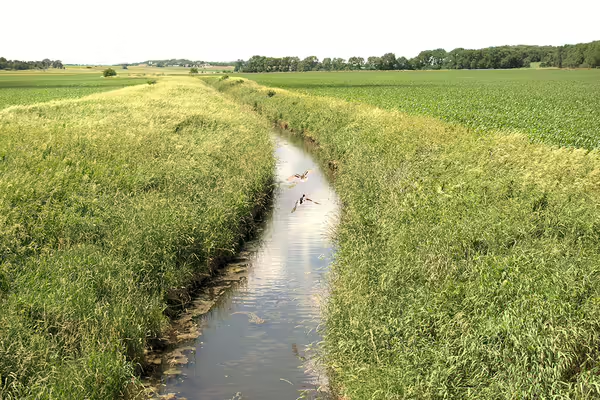
URBANA, Ill. — Conservation practices play an increasingly important role in maintaining productive farms, protecting natural resources, and supporting long-term profitability. University of Illinois Extension invites farmers, landowners, Certified Crop Advisers, and agricultural professionals to participate in Sustainability on the Farm, an eight-part winter webinar series starting Jan. 26, that explores the latest updates on conservation agriculture and natural resource research, programs, and farmer management strategies.
"Illinois farmers and landowners are faced with balancing economic realities with the need to protect our soil, water, and wildlife resources," said Emily Hansen, Illinois Extension natural resources educator. "This series brings together agricultural and land management experts from across the country to share practical, research-based information that can help producers make informed decisions for their operations."
The series will feature speakers from Extension, the University of Illinois, Cornell University, The Wetlands Initiative, American Farmland Trust, and Wild Farm Alliance. Participants can join from anywhere and attend as many sessions as they like. Participants will gain research-based information and real-world insights that can support both environmental stewardship and farm productivity. Certified Crop Adviser continuing education units are available.
Sessions in the free series will be on Tuesdays from noon to 1 p.m. from Jan. 26 to March 16. Register in advance at go.illinois.edu/SustainableFarms.
Cover Crops, Jan. 26: Explore how cover crops can improve soil health, reduce erosion, enhance nutrient retention, and contribute to long-term farm resilience.
Nutrient Loss, Feb. 2: Learn about Illinois’ Nutrient Loss Reduction Strategy and the practical conservation practices farmers can implement to improve water quality while maintaining productive farming operations.
SMART Wetlands, Feb. 9: Discover how constructed wetlands, including The Wetlands Initiative's SMART Wetlands, can reduce nutrient losses from agricultural drainage systems while providing additional benefits for water quality, wildlife habitat, and farm sustainability.
Integrated Weed Management, Feb. 16: Gain practical strategies for managing weeds through a systems-based approach that combines cultural, mechanical, biological, and chemical control methods.
Pesticides and Pollinators, Feb. 23: Get updates on the latest research on pesticide impacts on pollinators and best management practices that help beneficial insects.
Trends and Economics of Conservation Practices, March 2: Examine current trends in conservation adoption and the economic factors that influence the costs, benefits, and return on investment of conservation practices.
Managing Nutrients for Conservation and Profitability, March 9: Learn how nutrient management strategies can balance conservation goals with farm profitability by improving nutrient use efficiency and reducing input losses.
Farming with Wildlife, March 16: Discover how farms can support birds and other wildlife through habitat-friendly management practices that complement productive agricultural landscapes.
For questions or if you need an accommodation to participate, please contact Hansen at emhansen@illinois.edu or 815-433-0707. Early requests are strongly encouraged to allow sufficient time to meet your access needs.
Extension’s natural resources, environment, and energy program provides research-based education for awareness and action to sustain healthy environments and ecosystems that support quality living and resilient communities. Extension staff empower people across Illinois to make a difference through the Master Naturalist, Climate Stewards, and Watershed Steward volunteer and training programs.
University of Illinois Extension develops educational programs, extends knowledge, and builds partnerships to support people, communities, and their environments as part of the state's land-grant institution. Extension serves as the leading public outreach effort for University of Illinois Urbana-Champaign and the College of Agricultural, Consumer and Environmental Sciences in all 102 Illinois counties through a network of 27 multi-county units and over 500 staff statewide. Extension’s mission is responsive to eight strategic priorities — community, economy, environment, food and agriculture, health, partnerships, technology and discovery, and workforce excellence — that are served through five program areas — 4-H youth development, agriculture and agribusiness, community and economic development, health and community wellness, and natural resources, environment, and energy.