Learn more
- Merlin bird ID app
- eBird bird recordkeeping app
- Illinois Extension Pollinator Plant Selector Tool
- National Wildlife Federation Native Plant Finder
- Cornell BirdLab Right Bird, Right House
- Fall Migration Mini-Sit Birdwatching Event - Cache River Wetlands Natural Area, Cypress IL
Questions? We'd love to hear from you!
Abigail Garofalo aeg9@illinois.edu, Erin Garrett emedvecz@illinois.edu, Amy Lefringhouse heberlei@illinois.edu
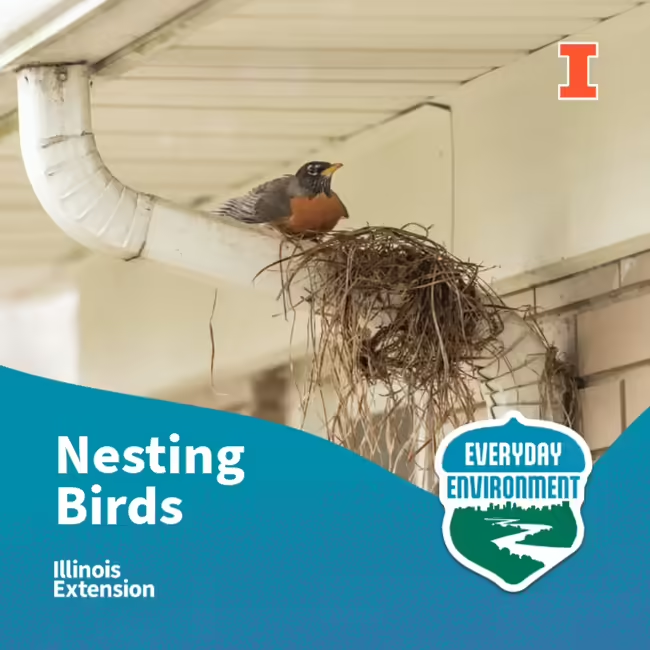
Welcome to another episode of the Everyday Environment Podcast where we explore the environment we see every day. I'm your host Erin Garrett.
Amy Lefringhouse: 00:14And I'm your cohost Amy Lefringhouse.
Erin Garrett: 00:17And today we are here with Kim Rohling. Kim is a horticulture educator for Illinois Extension. She works down in Southern Illinois right next door to me, and she's here to chat with us about coexisting with nesting birds. Welcome, Kim.
Kim Rohling: 00:35Thank you so much for that introduction.
Amy Lefringhouse: 00:38Yippee. It's your first time on Everyday Environment. Yay.
Erin Garrett: 00:43We're so excited to have Kim with us today, and I'm excited to chat with you specifically about this topic because if anyone knows Kim, you know that Kim is a birder with a capital b, so we're excited to chat birds with you today, But before we get into the podcast, can you just tell us a little bit about kind of your background in wildlife and a little bit about your current work in Extension?
Kim Rohling: 01:09Sure. So my undergraduate degrees are in oceanography and environmental studies, and I was able to do a lot of field work before I worked with Extension. And so some of the projects that I worked on included actually managing a project for project feeder watch at Eckard College. I worked on the seabird ecological assessment network where I did research on beached seabirds and shorebirds. I assist with spring bird count, the North American breeding bird survey, Christmas bird counts, and this year, I helped out with the Illinois stopover project.
Kim Rohling: 01:43So I've done some field experiences that have point counts, assisting with bird banding, doing habitat assessment for birds, and even some avian husbandry when I was volunteering. I used to to work with birds of prey, so it was really fun.
Amy Lefringhouse: 02:00That's awesome. My sister worked at, as an intern at World Bird Sanctuary in St. Louis, so she did some of that work and got to learn a little bit about I don't know the official terminology, but she was able to hold a few of them, did a lot of the grunt work behind the scenes, cutting up really smelly, stinky food items, we'll just call it that, for the birds of prey, but, yeah, that's that's super cool too. Different.
Kim Rohling: 02:30It's it's a lot of fun. That's very similar to what I did at Boyd Hill Nature Preserve. So I helped prepare food for the raptors, helped clean their enclosure, and as I put my time in, I did get to do some falconry strolls, and so that was a lot of fun to give programs to the public.
Erin Garrett: 02:46What's your favorite type of bird that you've banded before? Because I'm curious.
Kim Rohling: 02:52So I was working as an assistant, and so the my favorite bird that I actually have not banded a bird, but my favorite bird that I have pulled out of a net was a northern cardinal, even though it was very unhappy that I pulled it out of the net.
Kim Rohling: 03:08You know, they have very, very big bills. And so Yeah. It bit, and it held on, and it was telling me, you are putting that band on my leg, and it's no. No. I wasn't.
Kim Rohling: 03:20But it's, you know, banding is really important to be able to collect information on migration and longevity of species, and so it's neat to just be able to be a part of that project. And if you look locally, different areas have banders. I know that there's a bander in Springfield as well as, some banders up north at Colored Sands near Winnebago County.
Amy Lefringhouse: 03:42Cool. Also, oceanography. What? Where was that at? Like
Kim Rohling: 03:46So I was in Saint Petersburg, Florida and Eckert by Eckert College, and it was a lot of fun. I graduated there about the time that we had our first recession, and so it did not turn into a career in oceanography. But I went to study the world's ancient oceans by doing fieldwork out in the desert, and then, I did a lot of turtle work at Eckard College, and so that moved into tortoise work, which then moved into my master's research at SIU studying ornate box turtles. So a lot of herpetology there too. And what I found is when I was doing the reptile and amphibian work, I'm looking down.
Kim Rohling: 04:25I wasn't looking up at birds, but the second those field experiences kind of disappeared, I was back looking to the sky.
Erin Garrett: 04:31Well, Kim, you've done a little bit of everything. You've gotten one step closer to fulfilling my dream of being a marine biologist that I feel like all of us had back in the day with your degree, but tell us a little bit about what you do now Extension.
Kim Rohling: 04:47So I currently am a horticulture educator, and I do some bird centered education through the Master Naturalist training program. I help with the ornithology unit quite a bit. I've worked with partner organizations to host training workshops on, different curriculum like flying wild. I've also tried to help local Audubon organizations create Christmas bird count training workshops because I've noticed that we've had a decline in volunteerism in our area, and some of these counts are over 50 years old and really require assistance to keep them going. For fun, because I, have my horticulture background, I really enjoy birdscaping programs just to help people learn how that they can garden to best provide habitat for, birds in our backyards.
Kim Rohling: 05:34I've also done some work with Master Gardener and Master Naturalist to provide book club opportunities where we'll read some books that are focused on, different birding topics.
Amy Lefringhouse: 05:44Awesome. Well, I let's see. It wasn't last year, but the year before, I did go on my first Christmas bird count, so I can't say that I'm a birder with a capital b, probably a little bitty B, but in the Christmas and wintertime, I usually can identify those birds. So if you're out there and you're like, I can't do that because I don't know all of the bird species. The Christmas bird count might be one that you might be able to do, especially if I can do it.
Amy Lefringhouse: 06:17So trainings like that, Kim, that's a really cool idea and really neat to bring to people because some folks can be a little bit intimidated by trying to be an expert, quote, expert to count their birds, but you don't really have to be a full full birder expert to do those those counts. Mhmm.
Kim Rohling: 06:36I I agree. It's about dipping your toe in, and I feel like once you find that spark bird, it's gonna really increase your excitement and wonder and get you studying. Some of the best things you can do is going to your local library, checking out some field guides, learning those field marks, birding behavior. Certain birds are gonna exhibit different behaviors, and that can help you with identification. And, you know, we live in this wonderful world of technology where we have apps like eBird and Merlin ID.
Kim Rohling: 07:06The one caveat I'll put out there with Merlin Bird ID, it does help you if you use photographs or if you use their questions, you can, identify what type of bird it is based on a few simple questions about their color, their size, what they were doing, but also you can use Merlin to listen to the soundscape around you. And where I caution folks is if you if Merlin is telling you that you're hearing something, can you find it in your yard? Don't report it on eBird or on another site if you physically can't identify that bird by sound or by sight because, Merlin is still learning, and we are still smarter than computers. Right? So but it is a great way if you have never tried to listen to bird sound and to really try to parse those sounds out.
Kim Rohling: 07:56It can be a great way to start looking up or start looking in that understory to identify new things.
Amy Lefringhouse: 08:03Awesome. Well, today, you talked about a little bit you mentioned bird behavior and studying bird behavior and helps to identify birds, but we're looking at bird behavior during this episode, specifically nesting, and we're kind of talking about I guess coexisting with birds within our yards, within our home landscaping, and kind of focused in on nesting. And while this is a spring topic and we're talking now in the fall, we wanted to take this time to prepare listeners for when you're gonna move into the spring, when nests might become, you know, more prevalent in your yard. So can you tell us, Kim, a little bit about nesting season and the bird nests that we are likely to encounter in, you know, our home landscapes?
Kim Rohling: 08:55Sure. So nesting season is one time where birds actually are more active and visible to us. So males are going to be singing to attract territory. We're going to see the parents constructing nests, potentially also foraging and then feeding their young. And so it can be a great time that if you aren't a birder to get out there and start making these observations.
Kim Rohling: 09:19And so, most songbirds are nesting late spring through midsummer, and the timing is really gonna vary by species and region. So we're a really long state, And in Southernmost Illinois, we could have birds scouting as early as late February to find nesting locations. And one example I can use is the Carolina chickadee where, they'll be scouting, and they might be nesting already in March. At the same time, if we were to look at a similar bird in Northern Illinois, the black capped chickadee, this bird is probably going to be delayed in nesting because of the colder winter season. They are going to potentially start scouting in March and be nesting by April.
Kim Rohling: 10:01So during this time, in general, birds are focusing to find a safe place to create that nest, then they're going to raise their young, and their job is to find food and avoid predators so that their chicks can then fledge. When we look at neotropical migrants, so a Carolina or a black capped chickadee would be a resident bird, so they're staying with us through the winter. A neotropical migrant is a bird that is going to be like a thrush, an oriole, some of our sparrows, tanagers, vireos, swallows. And they are breeding in North America to take advantage of our habitat and the insects that are there, but they're wintering in Mexico, Central America, The Caribbean, or even South America, so that they can find food resources in those locations. So in Illinois, these migrants are arriving usually mid April through May, and they're going to nest in the summer, which is roughly late May through July.
Kim Rohling: 11:00That's why we have our spring bird count at the time that we have it as well as the North American breeding bird survey, which are two different volunteer opportunities that you could be a part of at that time. Once the nestlings fledge, the parents will take care of them for a little bit of time, and then they are on their own. And these young birds will start to leave late August through October to go back to their overwintering sites in the tropics. Many species have that very short breeding window then, a few months to establish these territories, build these nests, raise their young, and then go back and migrate. So time is of the essence for them.
Amy Lefringhouse: 11:39The other day, I read something about birds becoming quieter after the breeding season, and I had never even I don't know. As long as I've been in this world, I'd never even thought about that. Birds sing all the time to me, but that makes sense. Right? They're not out there singing for to attract their mate.
Amy Lefringhouse: 12:01They're a little less vocal, I guess. Is that talk to talk to us about that, Kim.
Kim Rohling: 12:07Yeah. So birdsong, at least in North America, there is there are different species that are going to be singing more often to attract mates, but we also haven't given female birds enough credit. And so some scientists are really looking into, the vocalizations that female birds make, and they're finding that there's stronger repertoire with some of our species. Really, in North America during the breeding season, males are advertising for their mates. They're, defending their territories.
Kim Rohling: 12:36So something to think about is if you do enjoy using different Merlin apps, for example, don't play birdsong during the breeding season next to birds who are breeding. That is a number one no no in the ABA birding ethics. You want these birds to successfully nest, and there's a chance that by overplaying recordings in the wild that you could if it's a bird who maybe hasn't nested before, that could startle that bird and have it abandon its territory. And in other cases, you could just start making some of those male birds, more territorial, and they could be agitated in their environment. In the fall, since we don't need since those birds don't need to vocalize anymore, they're not defending that territory, they do start getting more quiet.
Kim Rohling: 13:23And so fall is a very difficult time for beginner birders sometimes to identify birds because you're you're lacking that critical piece of information there at their birdsong. They also will start molting, to do their flights. And so instead of having their showy plumage, it'll be a little bit more dull or can be different. Learning plumage is important because some of our first year birds will not look like their parents quite yet, and so you can have a wide variety of of things to be studying and looking for. So those those field guides are important so you can get those field marks under your belt.
Amy Lefringhouse: 13:57Makes sense. Makes sense. I got us a little bit off topic, but thanks for that explanation.
Erin Garrett: 14:02The podcast, Amy. It's I know. That's what we do.
Erin Garrett: 14:07Okay. So that was great background info on nesting in general. We're gonna move kind of into maybe when homeowners find nests where they don't expect them or where they don't want them, which hand raised over here definitely experienced that, but before we get into that can let's back up a little bit because there are some legal protections for active nests that we kind of want to be aware of before we get into that conversation, so there are two different things we wanna talk about, the Migratory Bird Treaty Act and the Illinois Wildlife Code. Can you fill us in on the basics of those and what protections they provide for nests?
Kim Rohling: 14:46Sure. So the Migratory Bird Treaty Act of 1918 makes it illegal for anybody to take, possess, transport, sell, or purchase wild birds or their parts, like feathers, nests, or eggs, unless you have a permit. If you have an active nest with eggs or chicks inside, you may not touch them or destroy those nests without a permit from the US Fish and Wildlife Service. The state of Illinois decided to create the Illinois wildlife code to reinforce those federal protections here. And so this was established in 1979, and it also prohibits the taking or disturbing of birds in their nest without authority.
Kim Rohling: 15:27And so that's why when we're we're thinking about what can we do to minimize conflict with nesting birds, the fall is the perfect time to start scouting for what was there a problem spot on your property where you were finding a lot of droppings? Do you see nests, sticking out of your your gutters or your soffits? So that's the time to start making some of those repairs.
Amy Lefringhouse: 15:50Yeah. Looking for ledges. I feel like I have ledges around in my porch area where I'm like, oh, yeah. They tend to go there every single year.
Kim Rohling: 15:59Well, and so a lot of birds are going to go to different like, in our developed landscapes, they're gonna go into trees, shrubs, our hanging baskets, maybe the wreaths on our doors, even signage that we have in our houses. The worst ones that I always get nervous about are porch lights and fixtures, and so I always pay attention to that, because I don't want the risk of fire. Right?
Erin Garrett: 16:22That's a good point. My my favorite one, joking, that I found this year is in my town, I was out shopping, an outdoor shopping area, and like right where you walk in, the door handles like covered in bird droppings, and I was like, that's a great that's a great choice. Maybe we need to look at the sign above and maybe block some of those nesting sites for the future, because that's just really not fun for all of your customers to have to walk through that and leave.
Kim Rohling: 16:59And that was probably bought brought to you by your local house sparrow. Right? House sparrows and European starlings take the cake for those Mhmm. Nests like that.
Amy Lefringhouse: 17:09So when you talk about the the the act, migratory bird treaty act and the wildlife code, is that all are all of our songbirds underneath the fall underneath those two regulations?
Kim Rohling: 17:23So those regulations are actually protecting our native birds. So we do have a few non native species, like the European house sparrow and the European tree sparrow, the European starling, and even feral rock pigeons. These birds are all naturalized here, but we have noticed that they are, our pests, and they do sometimes nest to the detriment of our native species because they're trying to take over those nesting sites.
Amy Lefringhouse: 17:49Gotcha. Interesting.
Amy Lefringhouse: 17:51So how can homeowners identify if we're taking a look or kind of like assessing our property, so how could we identify when birds are nesting in vents, maybe in chimneys? You talked about gutters, attics, so we're looking for nests in those different places, and then if they do find something there, what are the next steps that they can do to protect both, you know, themselves, the their home, but also the birds, kind of like a balanced approach?
Kim Rohling: 18:21So what's really important is to take that time to scout around your property. So, again, you're gonna be looking for vegetation where it shouldn't be. You're gonna look for an accumulation of droppings or feathers. If you're trying to scout during the breeding season, so, again, you won't be able to do anything necessarily to prevent nesting, but things to to keep an eye on. Are you seeing repeated bird behavior activity?
Kim Rohling: 18:47Like, they're consistently flying to and from that vent or roof line. Are they flying into your chimney? Are you hearing scratching in your walls or vocalizations? That is a really good way to tell that something is going on. Again, if you're able to physically see if a nest is constructed, if there is no egg inside and there are no nestlings inside, you have that opportunity to prevent that that nest from happening by taking it down.
Kim Rohling: 19:13But if there is a an egg or a fledgling inside, you really need to leave that that space alone. And so, you know, if you're noticing that you have blocked airflow or reduced vent performance in your home, that can be a hint for your bathroom kitchen vents as other things to check on. And so things that you can do, you can actually consult licensed wildlife control professionals to help you, make some of these judgment calls. They're going to be very familiar with the the two federal and state laws that we kind of talked about, and so they'll be able to help you make some changes. Different actions that you would take would be to install those vent covers, clean out your gutters, potentially add screening to prevent entry in those unwanted spaces.
Kim Rohling: 19:59If you have a chimney that you haven't capped, you can add a chimney cap to prevent access. You may wanna replace any loose soffits or gaps in your siding. And when you think about it, we're in the fall, so another way that we sometimes intrude upon birds during the nesting season is by our early spring pruning. And so once your trees and shrubs are dormant, that's actually the best time to do your pruning anyway, and so that might be a good way to remove some vegetation if that's an unwanted space.
Amy Lefringhouse: 20:32We've heard all about Erin's chimney.
Erin Garrett: 20:35Okay.
Amy Lefringhouse: 20:35And it's not only birds that go down chimneys. For Erin, it's other wildlife as well.
Erin Garrett: 20:43Yes. We affectionately call the raccoons now our chimney cats. So Oh, no. They're not in there anymore. They vacated, but I laugh because I like with this question, I'm like, yeah, hearing birds twittering for weeks on end in your chimney is a sign that there's birds in there, and one plopping out into your living room is a way that you know that you have birds in your chimney.
Erin Garrett: 21:07That poor little, he didn't make it. We put him outside. I mean, there was nothing we could do for him. Right? Yes.
Erin Garrett: 21:13Getting a chimney cap, which I now successfully have, thank you everyone, only took three years. It's very difficult to find someone who wants to do that apparently, but very important for keeping raccoons and birds and other things out of your chimney.
Kim Rohling: 21:31Definitely. I remember as a kid, we had a chimney swift get through the cap and into our chimney, and, we we had to escort it outside as well. So chimney swifts are a really interesting bird where they've evolved to use small spaces or they've adapted rather to use use our small spaces to nest. Historically, when humans would not have been using chimneys, they would have been using the hollows of trees.
Kim Rohling: 21:56And so when you think about large trees that are hollow, maybe not existing in your places and spaces, when we do cap our chimneys, we remove a place for them to nest. I've we had a really, really neat spot, in Marion where when I would do my spring bird count, I would sit and watch. And one year, I saw hundreds of chimney swifts flying in and out of a chimney. Unfortunately, they had to do repairs to the building, and so those birds were definitely displaced. If you are interested in chimney swifts, there are plans where you can make chimney swift towers, and you'd be able to install them in your in your yard, to encourage them to nest.
Amy Lefringhouse: 22:37I am so glad that you brought up chimney swifts because I sit out on my porch in the evening, and when the sun is going down, and there's always these erratic flying things. And for a long time, I thought those are bats because they just have like this erratic kind of flight pattern, and that's what a bat looks like, right, around a street light or something like that, a bat's flying. And I was like, man, they're making a lot of vocalizations, you know, they're loud, and they're just like, you know how they do, and exactly like that. So I'm like, you know what? Are those really bats?
Amy Lefringhouse: 23:20Because they didn't have the silhouette of a bat, you know? You're looking at it in the sunset, you're kind of looking at a silhouette of this animal flying around, and so I get out my Merlin because again I'm a beginner birder, and it says chimney swift, and I was like, duh, that is a chimney swift, and they are so cool, and they are so acrobatic, and they're flying around, because I'm assuming they're running around trying to get some of those, like, kind of dusk insects that are flying around, and I don't know, but yeah, I am I have a new entertainment time period each night watching the chimney swifts fly around.
Kim Rohling: 24:04Yeah. Chimney swifts, and again, like most of our our North American nesting birds, they're really going after insects. So during the breeding season, we know that our young birds to develop the right muscles to be able to then migrate and fly need a lot of protein. And so a lot of our birds are unsung heroes of pest control, and it's really important that they're there in our environment. Mhmm.
Kim Rohling: 24:28So when when we go kind of back to the nesting season and once our eggs are hatching, we know baby birds need food. And so there are so many different actions that homeowners can take to support nesting in their backyard. And so creating a space that is, stable, parents who are going to be very efficient at finding their food, so the best thing that we can do is is avoid disturbing their feeding activity. So watching these birds from a distance that can and can help them, efficiently forage and bring food back. Something that we don't always think about is that timing of when the parents are leaving the nest.
Kim Rohling: 25:08They're opening our nest up to, different risks. Right? So they could be risking that a cowbird lays their egg in their nest if it's an open cup shape. They could risk that a crow is flying by and might take away those eggs or nestlings for their own babies. When we have nests with eggs or very, very young, nestlings, the the temperature of those animals is so important, and their parents are protecting them and keeping that temperature stable.
Kim Rohling: 25:37So if we have a really cold, wet, rainy day and the parents aren't there, that can be really detrimental to those nestlings. At the same time, if we have a nest later in the heat of the summer, the parents aren't there to help give them some shade, that can be a a really difficult time causing heat stress for those birds. So
Erin Garrett: 25:59can I have a question about that? So we had I think it's the European house sparrow that you were talking about, that we have build nests under our carport Yep. Every year, which is fun, because that's right where we walk every day, and I like, so we had a nest, and we had all the little hatchlings, and then they left, and we cleaned up all the droppings and everything under it, and then probably in the last probably in June, like, there was one that came and built another nest and now every time I walk there's like a bird flying out of it. Are they gonna like lay eggs again? What's happening there?
Erin Garrett: 26:38Do you know? Help me out.
Kim Rohling: 26:40So different birds have the ability to actually have multiple broods in one season, and it's so it could be that the parents are going to try again. It was good to try to prevent them, when their birds when their their fledglings had left the nest, because now it'll take more effort for them to build a nest. Mhmm. But but at the same time, yeah, you're you're in for another generation.
Erin Garrett: 27:02It's been a lot of that. It's one side of the carport, and now it's on the other side of the carport, so I just have to change which way that I walk, but I did have we're gonna talk about it in a little bit, but the one night at dusk, I walked outside very confidently under the carport, and I had a bird, like, basically, I felt the feathers, like, swipe me on the head, and I was like, nope. I'm done. I'm done. I'm sorry.
Erin Garrett: 27:28I know I'm near your house. I apologize. I will not go outside when you cannot see. Like, you need to be able to see me in the day. I understand.
Erin Garrett: 27:37But okay. I was just curious because I'm like, what? There's another nest Yeah. Happening. What is going on?
Erin Garrett: 27:44Is am I gonna have this all over again? And now you're telling me the answer is probably yes. So
Kim Rohling: 27:49Well and so, like, that kind of brings up two good points. So the behavior that you're describing is mobbing, and that's something that almost all of our songbirds are going to do. And so they're seeing us as a human intruder as a potential predator. So, during the day, they're going to be a lot more vocal. They'll make repeated alarm calls, and that purpose is to let the other parent bird know if they're co parenting, but it also could be to let other completely different species know that you're you're messing with them, and they need some assistance stat, and they're gonna come and potentially mob you.
Kim Rohling: 28:23If you have a colonial, there's a there's birds that nest in colonies, they will all lift at the same time and provide that that type of mobbing behavior as well. So, mobbing with a house sparrow or a swallow might be annoying, but mobbing being mobbed by a goose or a raptor, now that could be a unpleasant experience. And so, again, how did this, occur? Usually, it's because you just walked a little bit too close. So paying attention to where your birds are nesting is important.
Kim Rohling: 28:53And once the fledglings leave the nest, usually parents are still wary because they're feeding them, but when they cut them off from that food supply, you're going to to see that trigger response from the parents, kind of leave. Try to keep moving in that predictable fashion. So if they are living and coexisting with you, they're going to get used to you. So there's, I remember reading on, as I was scrolling one day that there was an older gentleman who walked on a treadmill on his porch every day, and a mourning dove literally put her, like, three stick nest on the cup holder. And so he's Aw.
Kim Rohling: 29:31He's a 90 year old man walking on his treadmill, and the dove does not even care. So, again Wow. We can we can get used to these situations where we're in very close proximity, but sudden movements, loud noises, that is not gonna be a a great thing to do around those nesting birds. Most of the time, they're going to bluff. So, again, you're much bigger.
Kim Rohling: 29:53If they actually perceive you as a threat and a predator, you could still be threatening their existence, and so it's important for them to take care of their young. So keep in mind, you may need to supervise other people or pets, that are maybe using your yard, or may not be aware of these birds nesting.
Erin Garrett: 30:12Yeah. I'm thinking back to to when I had them nesting. Again, it's the house sparrows. They love they love me. I guess they love everyone.
Erin Garrett: 30:21But, like, nesting in my wreath on the front door. Right? So I'm just like, okay. I'm gonna not use that door right now because they need it. It's fine.
Erin Garrett: 30:33We can, like, I don't know. I rarely go out the front door of my house anyways, so it that's okay. But, yeah, if it like, people come over, you're getting, like, packages delivered, and it's, like, up by the front door, that's gonna be an encounter, right, for people. But
Erin Garrett: 30:50People work around it pretty pretty okay, And then, yeah, now I just don't put a wreath out in the spring, and then boom, I don't have that problem anymore. So
Kim Rohling: 31:00Well, and and I would say, like, with your house finches, they are they are definitely interested in your large ferns and your hanging baskets as well as I mean, your wreaths wreaths on your front door. So they're they love it.
Erin Garrett: 31:13I've had that too, but then something that, again, we're gonna chat about. I don't know if you wanna chat about it right now, but the the cats in the neighborhood got those baby birds, and it was sad because we watched them come up the porch and then go in the fern and snatched them. Do you want chat about cats, Kim?
Kim Rohling: 31:33We can. This can be a very, very controversial subject. I think the the most important thing to consider with our cats are cats are not the problem in the sense that this is an instinctual thing for them. If it's moving, they're hunting, and they're gonna get it. The problem is they don't hunt if they are only hungry.
Kim Rohling: 31:53They hunt because they are hunters. And so this means, like, you know, when they're they're targeting things that are moving, they're gonna be getting nestlings, they're gonna be getting fledglings, they could be getting adults, and they have disproportionate impacts on where nests are. And so if it is a ground nesting bird or a shrub nesting species, those birds are more inclined to suffer nesting failures from those cats. Something else to consider with the the the cats that are free ranging, and so this could be feral cats or if you choose to to let a cat go in and outdoors, just keep in mind there's other wildlife diseases that can affect them, and they actually can be host to spread dangerous diseases like toxoplasmosis. And so in different parts of the country, for example, I'll use Hawaii, toxoplasmosis is actually, hurting endangered monk seals, and so that is something that feral cats are responsible for.
Kim Rohling: 32:51And so thinking about what you can do to minimize your cat indoor or outdoor cat being outside is important, especially during the nesting season. We know that, parent birds are going to have a bimodal activity pattern. So early in the morning and then again in the evening, that's their sequence when they're going to be doing the repetitive flights to feed their young. And so, again, that's a pattern that that cat can watch and use for, hunting purposes. If you want your cat to experience the outdoors, supervise them, get a leash and harness that's safe for your pet, consider building a catio.
Kim Rohling: 33:29There there's, like, great ways to to kind of prevent them from interacting with birds. And and, again, this is also going to protect them from other dangerous wildlife to them, like coyotes. Right? But they kill billions of birds a year, and it's multiple years. So that's there's articles in Nature that that talk about that problem if you wanted to read one.
Amy Lefringhouse: 33:52Well, we've talked about our encounters with many different bird nests, and you know, when looking for bird nests, usually you're looking for droppings. We know that sometimes those bird droppings can lead to concerns about health, concerns about cleanliness. Do we need to be concerned about this? And if so, you know, what steps should we take to address address that?
Kim Rohling: 34:18So I would say in most situations, bird droppings from a few casual nests are not gonna be a significant health concern for healthy people. So, again, your younger children who may not have a developed immune system, or if you're elderly, that might be a concern for you. But songbirds in general are not carrying diseases that are readily transmitted to humans through casual exposure. And since their waste from a nest is limited and localized, it's not really a problem for us. The big issue is if you had a large flock of pigeons roosting, potentially, that would cause those that that that those feces to accumulate.
Kim Rohling: 34:59And so, usually, it's recommended to just wash away that area, and so you can use a hose to to spray things down. If there is a bird that you were not able to prevent it from nesting to start with and you were trying to mitigate how you would clean, some folks will use plastic tarps or newspaper and just put it underneath the nest so that they're not cleaning their patio regularly, and you would be able to get rid of that. In the case of a carport, having a car cover could be a simple way that you're minimizing that that risk to your car. Places where you would wanna, execute more caution would be if you are going to clean a poorly ventilated or enclosed space like an attic or chimney. And so, again, there are professionals that can help you do that process, but And and I I recommend using them.
Kim Rohling: 35:52Right? And so you just don't wanna inhale the the dusty droppings because that's where you could potentially get sick. So be smart. Use basic hygiene when you're cleaning up your different areas. You can wear disposable gloves or washable work gloves.
Kim Rohling: 36:06If you are working in a space where you know you're gonna encounter dust, you could lightly mist that area first to reduce the amount of dust that's, going in the air. You can use standard household disinfectants. Don't don't sweep in the dry space again unless you've already misted that down. We've been through COVID. An n 95 respirator mask is an easy thing to put on, and use to protect yourself.
Kim Rohling: 36:29You could wear eye protection if you're disturbing dry debris, and you can wear long sleeves or clothing that you'd be immediately able to take off after that process to launder. So those are those are things that can reduce your risk to exposure when when dealing with that inconvenient problem.
Erin Garrett: 36:46cHeck. We've done that. So and now, you know, hopefully, we won't have this issue again. So we had the problem. We waited for them to leave.
Erin Garrett: 37:00Most of them left. Mhmm. And then we cleaned it up. We should be good to go. Now I'm gonna focus on the carport, but really, like, just the way that everything is built, I'm like, they're just gonna nest there.
Erin Garrett: 37:10It's fine. Like, it's honestly it doesn't really bother us that much. So mhmm.
Kim Rohling: 37:15Well and so and so things to kinda minimize what that looks like. So think about what is the habitat mosaic around you? Are they using those structures because you don't have any I mean, I know this is not the case at your house you're in, but, like, do you not have grasses? Do you not have shrubs? Do you not have trees?
Kim Rohling: 37:33Sometimes by them not having those natural features, they're being forced to use, less desirable places. For birds that are more adaptable with, humans, they're they're doing it to get by, and in some cases, some birds are are utilizing us as a predator deterrent. Right? So predator might not want to get to do get too close to us, and so they're trying to be smart about where they're selecting, but we can help give them better options. And in the case of swallows, because I get questions every year about what they can do to remove swallows from nesting in the eaves of their house.
Kim Rohling: 38:07So, again, swallows are going to utilize mud to build the cups of their nests. So I would say pay attention. Do you have a leaky faucet somewhere that's providing them access to that muddy soil that they can easily scoop up and then put to your home? Are you if there are already nests for those birds on your home, have you removed them before the nesting season begins because they will repair and reuse those those structures. So you could remove some of the unwanted nests after the breeding season to try to minimize and help them pick a different location.
Erin Garrett: 38:42So we've talked a lot about in this episode just about, I guess, kind of maybe discouraging birds from nesting on our property, but I think it's important to kind of loop us back that I feel like a lot of us we love birds even if we're not a birder. We love birds. We're like, yeah, we want birds to nest. We just don't want them to nest in our spaces. We want to provide space for them and encourage them to nest right in more of their natural habitat type of nesting, so what can we do as homeowners if we're like trying to help fix up our areas to maybe discourage them from nesting in like our spaces?
Erin Garrett: 39:25What else can we do to encourage them to kind of nest in our property, but like in the plants in nature? Right? Like, what can we do, Kim, to encourage that?
Kim Rohling: 39:34So I definitely recommend planting native species like grasses, shrubs, and native trees. They're always going to provide cover, and since they've coevolved with these birds, either from the insect that hosts that they're providing, those birds are gonna forage on them when we get towards migration, and maybe some of those plants have, fruits or seeds that birds are gonna utilize to migrate. Since they have been here and they've coevolved, they usually have higher nutrition values for those birds as well. And so I recommend going as native as you can, to to provide those hands landscape changes. When we think about birds, they are also going to be nesting at different areas depending on what kind of bird they are.
Kim Rohling: 40:18So think about vertical layering, how are you providing different structure for them to use what they need. Some of our birds are cavity nesters like our woodpeckers that are going to drill holes in our trees, and other birds may follow suit after that after that to, utilize that nesting cavity in a future year. And so those are those are some ways that that you can provide habitat. We when we think about what an animal needs, we know that there are some water requirements. Birds want their feathers to be in clean condition.
Kim Rohling: 40:51They also want water to drink, and so installing a water feature in your garden could be a good way to attract birds. Some birds actually will use it to bathe regularly or drink. If you're using pesticides in your home landscape, you could consider reducing the pesticide use that you are are doing. The nice thing about planting native plants is most of the time you're not worried about using a pesticide. They don't, they don't need that.
Kim Rohling: 41:17Their purpose is to be eaten by some of these native plants. And if you've read the nature of oaks by Doug Tallamy, I think the simple simple thing that he's always mentioned is plant an oak. Right? So oak tree. We know that that oak tree will provide about 450 different species of caterpillars to to grow on their leaves, and so it's a keystone plant that can provide structure for the bird to nest in once it's mature, but then a lot of food resources during the year.
Amy Lefringhouse: 41:47Well, that makes me think about what you were talking about earlier, Kim, in that temperature in the in the nest is so important, and keeping those babies at their correct temperature, having that food nearby, you know, close by within your yard, and just like so that they can go find it, bring it back quickly so they're not away from the nest. It sounds like that would be something that would help them support their their babies.
Kim Rohling: 42:14Well, and something that's kind of fun is as you're designing that, your home landscape with adding these different habitat features, if you pair that with some sort of citizen science observation model, like starting to take photos of the insects that you see or the birds using your yard using iNaturalist or eBird, for example, you can see all the the changes that you're making. When I moved into the house that I'm living in now, it was a very bare yard. It was almost all lawn. The home landscape was planted with lots of invasive species, which we removed. So we removed two giant Bradford pears, and we removed, Nandina from the front landscaping.
Kim Rohling: 42:56I can't remember the common name of that one right now, but when that plant berries, it actually is poisonous for a bird that consume berries, and so it it would be potentially killing the cedar waxwings that I would want attracted to my home landscape. And so we removed these things, and as we've been planting our native plants, I have been using those two different, citizen science platforms, and it's just been really rewarding to see who's come into the yard, and it was just a simple change of planting a few things here and there every year. You don't have to start big. You can start small and keep expanding at what makes sense for you at the time, and just a few changes can make a big difference for these birds.
Erin Garrett: 43:38For sure. And I think I don't think we mentioned it earlier, but like thinking about the amount of insects that these birds eat when they're in the nest is like crazy. Like, what? Over like, hundreds of caterpillars a day? Mhmm.
Erin Garrett: 43:55Which to me, now that I'm a mom, I'm like, I cannot imagine the amount of work that goes into finding all of these insects and bringing them back to those babies. But like, it's just great. And like caterpillars are right, like a primary food source for a lot of these little hatchlings. And so supporting caterpillars and like, right, we love seeing like adults butterflies and moths, and you think about how many you actually see versus how many birds are out there, and you're like there's gotta be so many caterpillars and I don't see them, and think what a lot of people miss out on is most of them are in our trees, so yes it's great to have like for sure herbaceous pollinator plants and your shrubs like we've talked about like those are amazing we definitely want to have that, but like I think sometimes we take our trees for granted especially our older growth trees that we have and all of the different things that they're providing they provide a lot of different things we talk about it a lot during this season of the podcast but like providing caterpillar food is like so so so so important, so making sure to like keep your if you have trees, right, keep those, help promote safe spaces under them, like planting soft landings or those caterpillars can land and pupate, but of course the birds are gonna eat a lot of them too, so like there's a lot of different things that go into it, but like yeah, ways like you said it, Oaks are amazing, but that's not the only option.
Erin Garrett: 45:23There's lots of different trees. Do you wanna talk about how people can learn more, Kim, about what different native plants can attract different types of insects and how they can find that information?
Kim Rohling: 45:34Sure. So the National Wildlife Federation has a tool called the native plant finder tool, and you put your ZIP code in, and it'll populate with different choices of native plants that you could put in your home landscape. And if you look at an icon on, the photo of each of the plants, it also indicates how many caterpillar larvae, are produced on that family of of plants or that species of plant. And then also, if you look at the Illinois pollinators web site, we've also included that information there on our plant selector tool. And so these are two different places that you can go to get that information.
Kim Rohling: 46:12And, when we think about what birds need in the home landscape, it's it's it's similar to our insects. Right? So our pollinators need plants that are in bloom all season long to be able to do their job. So thinking about seasonal blooms, this is important as well, and there is a tool there is a part on our toolkit that allows you to look at bloom time to help you choose your plant. So I think that that is a really good feature that we have to share with you guys.
Erin Garrett: 46:40I was really proud this year because as I was looking at the little nests, they used some of my mountain mint, like they had the top sprig with the little seed head on it, and I was like, that came from my yard, like, can see it. It's working.
Amy Lefringhouse: 46:56That's really cool. I think too, we talked about, or we've talked about this since the beginning of Everyday Environment, how everything is so connected, and I think when you think of birds, there's a lot of connection, so many connections, you know, you're talking about the plants and the bloom time and the seeds that are happening and the, the caterpillars that they host and all of this stuff, a lot of times I think folks think I have to have berries in my yard or bird Or bird feeder in my yard, but that's just like the one like that's a one one time part of the whole big system, and just thinking about it bigger picture, thinking about it ecologically. We've talked about that all season long that every you know, everything is is connected.
Kim Rohling: 47:44Well, and you bring up a really good point. So when we we think about feeding the birds and we think about installing our birdhouses, I think the one thing that I think is most important for anyone is understand that when you make that choice and you're providing that habitat feature, you have now taken that responsibility to clean it as it should be cleaned. So with birdhouses, you would wanna clean them annually after the nesting season to reduce parasitic infections and disease for your birds. Not all birdhouses are designed equally, and so, you know, making sure that you're getting them from reputable sources or in in my case, I always recommend Cornell Lab of Ornithology. They have a program called Nest Watch.
Kim Rohling: 48:28And so you can look at birdhouse plants. You can download them. They rank them on the ease of construction to help you decide if that's something that you would like to do on your own. They have a right bird, right house, and give you tactics on how you can select where you can place the box. It doesn't has have the correct size entrance hole for the bird.
Kim Rohling: 48:51Mhmm. It also provides information. Sometimes you could have a perfectly good box, but if you're setting it up in the wrong habitat or too low in a tree, the birds won't use it. Depending on which way that direction of the of the entrance hole is facing, they may not use it as well. And so Cornell Lab of Ornithology has everything all in one place for you to be able to look at that and make decisions properly.
Kim Rohling: 49:17Mhmm. But, again, most importantly, these unmaintained boxes can do more harm than good, and so making sure that you're on top of that sanitation process is really important. And so at the end of the season or between nests, some folks will completely scrape things out, leave them to air in the sun to help with, cleaning those boxes. Some folks will actually use chemicals too. Keep in mind the structures that you use to build the nest will hold heat in different ways, and depending on how you have overhangs on that that box or if you're placing it in a shade of something else, it can also change your your your temperatures and and whether wind or water can enter the box, which is is difficult on those birds.
Erin Garrett: 50:03Yeah. I I don't know. When you have kids, I feel like you just get birdhouse kits all the time or like all these other little things. And I remember talking to my husband, and I'm like, gotta clean that, like, birdhouse out because the bird used it. And he's like, what?
Erin Garrett: 50:17And I'm like, yeah, you gotta like he's like, they won't just use it again? I'm like, well, not like for like, you don't wanna help like spread diseases or things. And so to me, personally, it's too much work. And I'm like, nope. I'll just work on providing habitat for the nesting.
Erin Garrett: 50:32I don't really wanna mess with birdhouses, but I know that some people's like, that's their thing, which is awesome, but just kind of keeping that in mind that like like you said it, if you're gonna offer that habitat for them, then you have to help maintain it. Right? Just like a bird feeder too. If you put that out there, then you have to like clean it out and fill it up and do all the things that that go with that. So Mhmm.
Kim Rohling: 50:53Well, and thinking about materials. So, like, you could go to, like, a kit a kitschy gift store, and they have so many of these, like, beautiful handcrafted birdhouses that are made out of metal. Metal in the sun is not a good combination. So I don't know if you've ever put them in your house, and you're like, why are they not being used? It could be just too hot, and they're just not going to to nest in that space.
Kim Rohling: 51:17I have a series of different birdhouses. Some are decorative, some are used that are under my house, right now, and if you like the song of the house wren, they'd like to have multiple choices. And so, again, Nest Watch will kind of share information on if the birds want multiple homes so that they can choose which one that they nest in, or if you wanted to have a a group of bluebirds on your property and you have an open field, how far apart the homes need to be so that they have the proper territorial space for for one another.
Erin Garrett: 51:51Mhmm. Awesome. Well, Kim, thank you so much for sharing all things birds with us. We could have, like, eight different episodes, I feel like.
Amy Lefringhouse: 52:00Absolutely.
Erin Garrett: 52:01With Kim on birds, so just real quick if you are in the Southern Illinois area or traveling to our area, which you know we talk about it on the podcast all the time, you should definitely consider doing. Kim always has lots of different bird programs going on, so definitely check that out, but she has one that I think you wanted to share with everyone.
Kim Rohling: 52:22Absolutely. So, one of my favorite projects that I've gotten to work on is the fall migration mini sit, and it will be September 19 from 9AM to noon is when we do our counts. And the goal of this opportunity is we go to the Cache River watershed, and iDNR is one of the landowners there that maintains the cache, and we go to any of their parking lot access points to sit and count birds and enjoy fall migration. And so the idea is we do a three hour sit where we sit within a 24 foot diameter circle, and we tally all the birds that we see with and from the circle. We submit our list to eBird to help the DNR biologists as well as people who are traveling in the cache understand where these birds are in the landscape.
Kim Rohling: 53:20And we want this to be an accessible activity. And so we are not walking. We are sitting. We are tailgating for birds without the beer. Right?
Kim Rohling: 53:31So we're sitting. We can bring our snacks, bring your binoculars, bring a camera, bring a scope if you have one, and we're just sitting to see what we can see. And so after the actual event, we all meet up at the Cache River Wetlands Center and at noon, and we have a picnic until 01:30, and we share the different birds that we saw, and we try to figure out how many different species we've seen, to to add more data to those, eBird hotspots. And so at this time, registration for the event has closed, but we always welcome passerbys. So you can feel free to reach out to me via email, and I can let you know which hotspots are being counted, and you could see us at the Cache River Wetland Center, Section 8 Woods for sure, lower cache access, and a few more sites.
Kim Rohling: 54:19What's fun is we have different organizations who are helping us out with being leaders for different hotspots. So right now, we have the Friends of the Cache involved, the Southern Illinois Audubon Society chapter, the Shawnee chapter of the Audubon Society, Massac County Nature Study group, and, and more. And so it's just a lot of fun to get people involved to learn how to identify birds as well as to contribute to a a larger dataset. So in the past, before this event had been airing, there was only one hot spot in the cache, and it was directly in the middle where there was no public parking or access point. So if anybody wanted to know where some of these really cool birds were, you would just have to guess based on your knowledge of habitat.
Kim Rohling: 55:05Right? And so we're trying to do better to help more people, see these birds, and we know that ecotourism is really, really important for our area. And when I worked at the Cache River Wetland Center in the summer, one year, we had anhinga that were nesting in the wetland north of the center. And by me going on eBird and reporting them daily, we had, an increase in visitation. We had people come from multiple states just to see those birds because they knew that they were present.
Kim Rohling: 55:36And so, again, we can be kind of building our community up by by sharing what birds are coming through the area.
Erin Garrett: 55:42Kim, this is off topic slightly, but it reminds me of when because I also worked at the wetland center, and we had someone call one time and say that they found a pink bird in their yard that had a spoon shaped bill, and I was like, a spoonbill? I was like, that's crazy. That's insane. Did you get they're like, it's gone now, but we got pictures, and I'm like, oh my gosh. That's so cool.
Erin Garrett: 56:07So crazy stuff can happen.
Kim Rohling: 56:09Southern Illinois is a pretty cool place, and so again, if you've never had a chance to come on and visit, we've got a lot of good birds for you.
Erin Garrett: 56:18Alright. Well, we're gonna wrap up our episode today with our everyday observations. I have a feeling they're going to be about birds. I know mine is. But we're going to highlight the mundane and normal of our environment that's actually really interesting.
Erin Garrett: 56:31So Amy, I'm going to pick on you.
Amy Lefringhouse: 56:34I actually do not have a bird observation today, but I did see I've been enjoying kind of enjoying, but also it's one of those little critters that sometimes make a gardener challenge a gardener, think, but I saw some chipmunks running around all over my actually, I don't even think I saw them last year, so this year I've seen them running around with their tail straight up in the air, and I even think my dog is like, you know, watches out the window the whole entire day, and she's got him like in her view and looks for him every time she goes out, but they're pretty fun little guys. They have dug around in my garden bed, so sometimes I'm like, you little stinkers, and but they haven't had they haven't made too much of a mess or anything yet, but it is fun to see them. They're funny. They run around.
Amy Lefringhouse: 57:24They're quick. They're kinda cute. So, that's my everyday observation. Chipmunk. And it's one of let's see.
Amy Lefringhouse: 57:31I looked it up a little bit before I got on here. One of the four ground squirrels that we have in Illinois. We have tree squirrels, we have ground squirrels. So this is one of the four ground squirrels that we have in Illinois. And fun fact, a woodchuck or a groundhog is part of that grouping of four ground squirrels.
Amy Lefringhouse: 57:51I did not know that.
Kim Rohling: 57:52Whistle pig. Whistle pig. Whistle pig.
Amy Lefringhouse: 57:55I did not know that. It is an actual ground squirrel. It's in that grouping. Anyway, that's mine
Erin Garrett: 58:02I love that, Amy. My parents up in Northern Illinois, their yard is run by the chipmunks. They chirp in the morning, and you think it's a bird, and no, it's the chipmunks. And they like, we used to, like, sit out on the porch and everything, and they would be, like Oh, I bet.
Erin Garrett: 58:21Downstairs porch, like, running up looking at you, and then they have their tunnels through the landscaping and all, like, the chest are crazy.
Amy Lefringhouse: 58:31So I think I just have one or two. I don't see them too often. I know up north, I feel like I see them a lot more, but yeah. So they're around providing entertainment.
Erin Garrett: 58:41Alright, Kim. What's your everyday observation?
Kim Rohling: 58:44So my everyday observation is definitely about birds. I got really, really lucky, and it was you know, you're you're gonna know this this situation well because you were with me when when I had this observation. And so we were getting ready to scout for our invasive species management field day class, and out of the corner of my eye, I saw this yellow and, like, olivey colored dart. And so I went back, and it was a really small shrub low to the ground, and the nest was on the ground. And inside the nest were four eggs, and it just made me wonder a lot of different things and made me really excited.
Kim Rohling: 59:25And females of Kentucky warblers, which is what I thought this bird was, can lay up to six eggs. And so it made me wonder, well, there's four eggs now. Will we have a couple more? They only incubate the eggs for about, twelve days, and so where were they at in that process? And luckily, I got to return to that spot six days later, and we peeked in, and there were four nestlings.
Kim Rohling: 59:49And so it was really exciting to see that they had that success with nesting, and I was really happy to see that, you know, this is a a an active agricultural center where we were at. I was happy to see that even though the nest was right on the edge of the two track, that people had been respecting that space and and, you know, in an instant, a a wheel could could change that that success for that family. Also, we have so many different predators that use edge habitat like snakes and raccoons, and so it was really great to see that these birds were were doing well. And I just I mean, again, to be able to share an everyday observation like that then with our class, I just just felt so proud because finding ground nesting bird nests is extremely difficult, and so it was a really special thing to see.
Erin Garrett: 01:00:36That was maybe, like, the third time I wanna say I found ground nesting birds you know, doing work in the prairies we'd be walking through them and then like, oh, almost like right stepped on them in the ground, or in like low shrubs, so it was really cool to see, and like Kim said, it was a literally like one step off the path. It was like right there, so like why did you choose that spot? But okay, we'll work around you, so really really cool.
Amy Lefringhouse: 01:01:02That's cool. Ground nesting. Yeah. I have a forester I work with all the time, and he had sent me some pictures of something, some eggs that he saw on the forest floor early, early spring, and I was like, I don't know what this is, and so we looked it up, and we were kind of trying decide what it was, because it was super early, we thought, and we were like, oh, what is this? And we think it was Woodcock.
Amy Lefringhouse: 01:01:27Think it was a Woodcock nest on the forest Floor. Yeah, guess nature is just so amazing because I can't believe these things make it. Just like sometimes it's
Amy Lefringhouse: 01:01:38just like,
Amy Lefringhouse: 01:01:39wow, how do you survive turkey nests, you know, just always like just kind of messy little simple nests. How do you like make it to the next stage? So pretty neat. Nature's pretty amazing.
Erin Garrett: 01:01:50Alright. I'm gonna wrap us up with a bird observation from the Cache River area that we already chatted about. So my family was out hiking at Heron Pond, which if you've never been, Amy, you've been No.
Amy Lefringhouse: 01:02:05I that was I when I went to Southern Illinois, I would miss it. I was sick, and I couldn't I couldn't get there, so
Erin Garrett: 01:02:11Okay. Well, next time.
Amy Lefringhouse: 01:02:12Next time. Next time.
Erin Garrett: 01:02:13You have to go to Heron Pond, go on the trail, and then there is a boardwalk that you can go on out into the Cypress Tupelo Swamp that is amazing. So we were hiking, and we got to the start of the boardwalk, and I saw some large bird down at the end of the boardwalk, like, right in the, like, on some cypress knees right next to it, and then I saw it, like, walk across the boardwalk, and I'm like, it's probably a great blue heron because that's what I see there all the time. So we walked on down, and it flew up into a cypress tree, and at first, I thought it was a black crowned night heron but then looking at my pictures later it was actually a yellow crowned night heron, so Kim you can tell me how common or not common this is and how excited I should be or not, but I was really excited because I'd never seen one before and it like hung out in the tree. We got videos and pictures, and then it kind of flew down a little bit and hung out in the area. We walked down the boardwalk, hung out for a while, and we walked back.
Erin Garrett: 01:03:08He was still there, so it was really cool to see him relatively up close. Yeah. So that was fun. So tell me.
Kim Rohling: 01:03:15So in Southern Illinois, the yellow crowned night heron nope. Nope. The yellow crowned night heron is an awesome bird. Folks in Northern Illinois will probably be a little bit jealous. We we have this is a t and e species in our state, so threatened or endangered.
Kim Rohling: 01:03:29I'm not cannot remember exactly what their status is They're different. Off the top of my head, but I know that they are rare. And so they do breed in rookeries near Heron Pond. And so you got really lucky to see a a rare bird that, many people hope to see in Illinois. They are crayfish specialists, and so sometimes if you walk quietly along the trail, if you notice that there are trees that are down, kind of in a horizontal way, across that swamp, you might see them walking on top of that log, stalking their prey, and and crayfish are among one of their favorites.
Erin Garrett: 01:04:06They knew I saved this for the right episode. Exactly. Gotta have it with Kim so she can tell me. I feel like it's really cool, but, like, thank you for supporting what I thought.
Kim Rohling: 01:04:17It's very cool.
Amy Lefringhouse: 01:04:19You're in Heron Pond. You have to see, you know, that. Erin. Yep.
Erin Garrett: 01:04:25Oh, gosh. Well, thanks again, Kim, for being on the podcast. We hope this is the first of the many times, but we really appreciate you coming on and sharing all your bird neur knowledge with us. So thanks.
Amy Lefringhouse: 01:04:37We loved it.
Kim Rohling: 01:04:38Well, it's been a blast. And again, I hope I hope everybody will take the time to do what they can to create a safe space in their home environment to welcome birds to nest. And if you have any other questions or problems, I'm always there to to be able to help you.
Amy Lefringhouse: 01:04:52Awesome.
Erin Garrett: 01:04:52Well, this has been another episode of the Everyday Environment Podcast. Check us out next week where we talk with Brodie Dunn about native plants and municipal code. You don't wanna miss this one.