Resources:
- Energy Website from Illinois Extension
- Selecting Trees to Plant in Illinois
- Under the Canopy Tree guides can be found at your local Illinois Extension office.
Questions? We'd love to hear from you!
Abigail Garofalo aeg9@illinois.edu, Erin Garrett emedvecz@illinois.edu, Amy Lefringhouse heberlei@illinois.edu
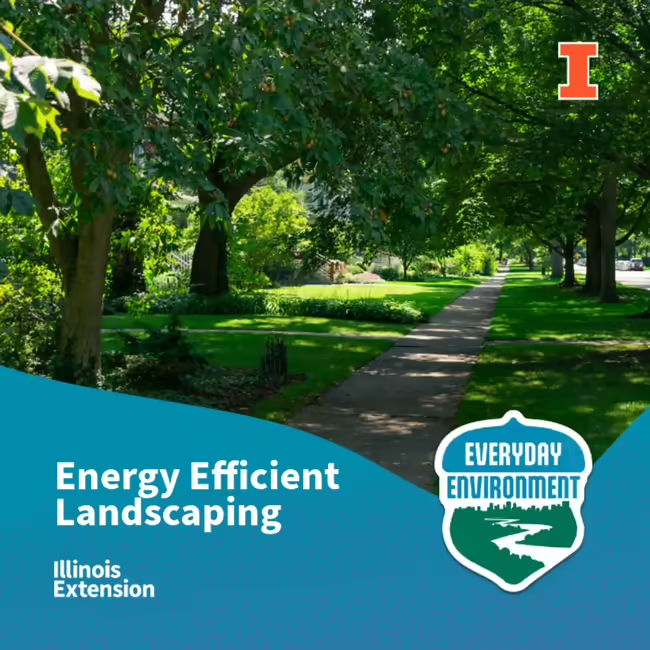
Welcome to another episode of the Everyday Environment Podcast where we explore the environment we see every day. I'm your host, Erin Garrett.
Abigail: 00:14And I'm your cohost, Abigail Garofalo.
Erin: 00:17And today, we are joined by not one, but two special guests from Illinois Extension. So we're gonna welcome Jay Solomon, who is a natural resources environment and energy educator up in Northern Illinois, and Andrea Wagner, who is a relatively new energy specialist, she's further down south. And they're gonna be chatting with us today about energy efficient landscaping. Welcome Jay and Andrea.
Jay: 00:48Good morning.
Andrea: 00:49Thank you.
Erin: 00:49Andrea, you're new to the podcast. Jay was on back when we were spotlight on Natural Resources, so shout out to any of our listeners that have been around for a long time before we were Everyday Environment Podcast, but we decided to bring you both on. We've got a seasoned podcast guest. I'm gonna call you that Jay because he used to do a lot of spotlight on natural resources and a newbie, so excited to have you both. But before we get chatting today, we'd love to hear just a little bit more from both of you about what you do in Illinois Extension.
Erin: 01:23So, Jay, I'm gonna pick on you first.
Jay: 01:25Thank you. Glad to have the chance to be here. As you said, natural resource environment energy educator in the Northwest Corner. While I'm assigned to a small group of counties, I do tend to work across an area and try to work with the rest of the team on things. So do a little bit more in the area of, livestock and also in home energy energy type things, energy efficiency, indoor air quality.
Jay: 01:51My experience as an ag engineer is well over in some other things that I get involved in.
Erin: 01:55Alright, Andrea. How about you?
Andrea: 01:58Yeah. So as you mentioned, I'm relatively new with Extension. I started last March focusing mostly on clean energy sources in Illinois. I do work statewide, but I'm housed down south kinda in the Metro St. Louis area.
Andrea: 02:14So right now, what we're working on is really developing our energy program with Illinois Extension. So our big focus right now is on utility scale solar and wind, but we've also got, like, a residential guide to solar on our revamped energy website. Maybe we can link to that in the show notes and get people to head over there. And we've also got things highlighted on our website through the... Through safe electricity on energy efficiency, energy safety.
Andrea: 02:44So, yeah, kinda run the gamut, and, you know, we're looking to get some more landowner resources up as well and other resources for for local leaders who handle permitting on utility scale. But we have heard through some listening sessions that we did that, of course, affordability of energy bills is a huge concern for everyone. And so we're trying to work work in that, you know, things about affordability and efficiency wherever we can and the resources and the programs that we're building.
Abigail: 03:12And that's really great. That's... I feel like what Extension is meant to do is, like, to help gather that information and data from the public about what they need and what they want and then be able to provide that for them. Also, new energy website and the homeowner's guide, everything is really awesome.
Andrea: 03:28I appreciate that.
Abigail: 03:29We'll feature that for sure in the show notes. Well, we're here today to all talk about landscaping. Our whole season is focused on nature based solutions. When we were thinking and brainstorming about nature based solutions, we were like, what are some ways that, like, we can think about our energy in terms of of nature based solutions? So thinking about how we kinda design our landscapes in that sense.
Abigail: 03:52And so people don't usually immediately connect that. Right? Like, well, what what I plant in the ground doesn't really affect what goes on inside my house. Those are two separate things. But we we know that's probably not true.
Abigail: 04:02So why should homeowners start thinking about their yards as part of their, like, home energy strategy?
Jay: 04:08As you said, we don't think about it or we don't think about it now. But I will point back that it is something historically has been thought about because we think about plants, things in our landscaping can really affect and help us manage the light and heat from the sun coming in and the airflow around the buildings. I mean, that's really getting down to the the nuts and bolts of what it can do is whether we're introducing air in and through the building, encouraging air in the summer to go through the building, or winter trying to keep air off the building. So that's the that's the nuts and bolts of of it.
Andrea: 04:47Yeah. And I think in an earlier conversation with Jay about this topic, I really like the phrase that he used, you know, make your landscaping work for you because it is an investment and also, you know, making that investment work in other ways to reduce bills in other ways. And I think that we're really used to thinking about this concept on the rural landscape. I think, you know, we're almost likely used to seeing, you know, historic farmsteads that have their big windbreaks, you know, all the way around. But if you're, you know, more in town, in a residential neighborhood, you might not think about it as much. Of course, you have windbreaks from the other structures around you, but I don't think that we we think as much about what is going on in that in town residential yard where our our windows are facing and how we can help, yeah, reduce reduce energy bills with landscaping.
Jay: 05:38You're very right in that that we don't think about... And and I can wanna point out that, as you said, historically, there's a lot of historic examples out there. We think about the rural ones are still out there. But if we look at some of the historic buildings, the landscape's an important part of that building and the the architecture of the time. But, also, if we look...
Jay: 05:59Start looking at... There's some of that's got a lot of function, and goes back a long ways. In some ways, it's stuff that we knew prior to, say, 1,900 prior to electricity that was being used and very much in the part of the land... The design of the building and which way they faced and all those kinds of things. And it was really rediscovered in the nineteen seventies and eighties in the in the energy crisis.
Jay: 06:26And I would say that we're now looking back at that again as some of those plantings age out, and we start replacing them. And also with newer construction and then green... As we think about green design, it's a very... Can be a very important piece of it as well. But some of the...
Jay: 06:43I will say some of the thought pattern has changed over time about that as well.
Abigail: 06:48Yep. That's a really interesting point about how, like, prior to air conditioning, right, we we had to... We were like, what can we do? Right? That was the option.
Abigail: 06:59And then we've kind of overcompensated essentially, and there's been ebbs and flows over time of, like, air conditioning can fix my problems. Air conditioning, and now we're in this... And then you... Like you said, when those energy crises and, like, looking at energy consumption that really shifts the the the mindset from people of, man, it's like, one, our infrastructure is aging too. Right?
Abigail: 07:20So it's like, sometimes you buy a house and you're like, man, it's really expensive to replace a whole air conditioner. Or some old houses don't even have central air depending on what house you buy. So it's like all of those different pieces are really connected to what we need to kind of make do in this new era of of our changing climate as well. Right? Like of...
Abigail: 07:44We're having these extreme heat effects that are occurring in the summer in which we're having like 100 plus degree days. Air conditioning is working too hard.
Erin: 07:53Yeah. So when we talk about, I guess, our landscaping to our advantage to help with energy savings, that if we talk about landscaping in general, let's break it down a little bit. So what roles do different plant types play in kind of our cooling shading areas in our yard? So, like, we could look at trees, we could look at shrubs. We could look at ground covers.
Erin: 08:17Kinda break that down a little bit for us and talk about how we can use these different groups of plants in different spots to kinda help us out.
Jay: 08:24I'll kinda start in on that that part of that is thinking about where that plant is at. And if we think about trees, ultimately shade, we're always talking about shade trees. So whether that is, as you said, shading the yard, landscaping, driveways, or the building. Traditionally, we looked at large trees to shade the buildings. And one of the things that has changed over the years is we now have the ability to put a lot of insulation in the ceilings, but the walls are still our vulnerable places.
Jay: 08:55So shading, especially to the south and west on buildings, anything that creates shade onto that, at least part of the day or most of the day, is sufficient. We don't have to have these big, huge trees up and over a home. And I see that coming out of my neighborhood. That's one of the changes going on my... Built in the seventies, a lot of big maples and and oak trees that are starting to age out at this point are getting to the point where they're growing up over things and kind of take them out.
Jay: 09:30And so if we think about that's one of the opportunities to look at at at that piece of anything that creates shade on it. So whether that is a tree, some type of a, you know, a a bush against the building or closer to the building that creates shade, anything that casts that shade onto a building from a summer standpoint is very effective for that.
Andrea: 09:55Yeah. And I was thinking about this, and and I think we might get into this a little bit later on. But, you know, how do you do this affordably? Of course, you know, if if you are lucky enough to have large mature mature shade trees in your neighborhood, in your own yard, that's great. But, you know, if you don't, maybe it's a maybe it's a new construction build or maybe it's a case in my own yard where you've had ash trees die back.
Andrea: 10:21And it's like, okay. I just lost two really big trees. What can I put back affordably and easily for some shade, especially when we think about walls? And trellises, you know, maybe not by themselves the most natural, you know, solution, but... And and have to be careful, you know, putting those directly on the building as opposed to, you know, a little bit away from them.
Andrea: 10:41But having, you know, even trellises with some vines, right, providing some sort of shade back onto walls like Jay was talking about can be helpful in terms of if you are gonna make that leap and and plant new trees and kind of wait for them to, you know, grow and mature over time. Right? Deciduous versus evergreen. Right? Don't plant...
Andrea: 11:03Maybe don't plant an evergreen tree on your on your south or west face... Facing, you know, windows. Right? Because in the wintertime, you do want that sunlight coming in to help heat up the home so you're not running that furnace as much. But in the summertime, of course, you want that shade.
Andrea: 11:17So deciduous is better because you'll have that that shade in summer and and and sunlight in the wintertime.
Jay: 11:24Flip side, if you look at doing the evergreens on northwest, Northeast corners, depending on your airflow, but in... For the most part, in Illinois, looking at the north and Northwest corners, especially, planting evergreens, arborvitae, anything that stays green and leafy year round does a nice job of deflecting those north winds away from the building. And you don't have to be right at the building. We often talk about setting those a little ways away from the building, whether it's a wind block, you know, row of evergreen trees a little ways away, which is a windrow, keeping it out or coming in closer. One of the things we often think about with evergreens is...
Jay: 12:10And and a mistake that I see made is ideal is to keep them a little ways away from the building. What you'd like to do is create... You don't wanna get far enough back that there's a lot of airflow behind it, but if you can create a foot... A one foot air buffer in there that's not moving, there's a lot of benefit to that. That's what you're really going for.
Jay: 12:30And why you see some of the older plantings on the Northwest Corner, you'll see an evergreen planting that goes around the corner. And so it... It's it's the it's the corner piece there. And that's on that northwest corner, basic splitting that air and making it go down the sides of the wall or or down away from the wall is what you're really trying to gain with that.
Abigail: 12:54What's the benefit of, like, breaking up the wind as far as, like, for the building itself?
Jay: 13:00It reduces the the heat loss. That airflow moving across it where you've got cold air moving across it, that air buffer in there, you'll have different air temperatures in there, but they're not changing as much. So you get a little bit warmer air against the building going out to the cold air instead of having constant cold air right against the building.
Abigail: 13:22Like the... Like, blow on the soup kinda scenario and how it pulls down. Right? It displaces that hot air on top and pulls the cold air down versus if we keep that kind of almost like an air insulation a little bit of your house.
Jay: 13:36I mean, it's it's it's truly the absolute reverse of what we wanna do in the summer.
Erin: 13:42That's really interesting. I've never really thought about like the airflow piece of it. Right? You just think of the shading. So that's just really interesting to think about.
Erin: 13:50And I guess for me, and maybe it's just because of the neighborhood that I live in. Right? Like my house is almost 90 years old. So I don't think about new construction as much and, like, designing your landscape in that way, but I think about, okay. I moved into this house and maybe I don't like the evergreens or maybe I wanna change some things.
Erin: 14:10And so how do you... How can you like more assess your site with like looking at your current landscaping and trying to figure out, okay, maybe there's some reasons why these things are cited in this way before removing things. Can you talk a little bit about kind of doing that sort of assessment and what you're looking for?
Andrea: 14:29I think it's really... A lot of it's just about observing, taking what time you can to observe where is the sunlight hitting the yard throughout the day, where is it more shaded, and and taking some time to kind of get to know that space. I think we've probably all heard this phrase, you know, live in live in your house for a year before you change anything on the inside. It's kind of the same for the outside too. Really try and and get to know that space, and it could be that, you know, previous homeowners simply made bad decisions.
Andrea: 15:00But sometimes there's a method to to what might look like madness and trying to just observe where is the sunlight really hitting. What are you noticing inside your house in terms of intense sun or rooms that are maybe a little bit darker because of the shade?
Jay: 15:17You're exactly right on on that one is looking at if you're thinking about taking something out or you need to take something out, and I'll talk a little bit about that later, think about what is that item doing now and why it might have been planned. Was it just something that was planned purely for aesthetic, or is there something being gained from it or being lost by it when you take it out?
Erin: 15:41And I think that's a good point too. You talked about waiting a year, and that's kind of... I mean, we started doing things, but, like, tree wise, we waited a year because looking at how the light changes throughout the seasons too is important. And, like, for me, I was looking at where to site my vegetable garden where I would maximize the sunlight. Right?
Erin: 16:05And so I was like, I think I want it here. And so I kept, like, checking where the light is to see how much shading it would get, right, throughout the seasons and the days and ended up picking this one spot because I didn't just jump in and pick a spot and put it in, right, and figure it out. Yes. That would work. But, yeah, it is the observation. It's important.
Abigail: 16:27When you find the hottest and coolest parts of your house is inside too. Right? Like, we all have a room that we're like, oh, man. Like, I'm not going in there when it's like the polar vortex going on. Right?
Abigail: 16:39It's just way too cold. Or like that happens to be your office, but you have work somewhere else in the winter and This is... Things. Yeah. Or like you bake in a certain spot in the summer.
Abigail: 16:49So, yeah, that observation inside and outside, I think, really, really helpful.
Jay: 16:54You know, one of the things that I think about and pounding back to the the the winter side of that is how many times have you seen that group of three or five evergreens planted in a in a right angle off of a corner?
Jay: 17:09And that's that classic... Part of that is a style, but part of that is creating that windbreak because you plant three of them in the northwest corner, and you plant it off to that corner. The mistake that I saw with the two that... In my my house, they planted two of them, and they didn't put them far enough far enough east. So too far west.
Jay: 17:37So, really, in some ways, was funneling it right towards the front window. Oops. Yeah. Great. Yeah.
Jay: 17:43That that doesn't help a lot. So there are some things like that. We we need to ask about what are you taking out. If you're having to take those out because they've gotten big, mature and whatnot, what can you put back in place of that and maybe not look as big of a of a plant? Mhmm.
Abigail: 17:58That was so shocking to me when I moved up to the suburbs. It was like, there are so many evergreen trees around here, which is super weird to me. And now that makes like so much sense because a lot of our buildings were like... A lot of our neighborhoods were like fifties and sixties, And I wonder if that was, like, one aesthetic, but also, like, aesthetic built out of practical sense. Right?
Abigail: 18:19Like, lot of people are like, oh, everybody has a pine. We love it or a spruce. But... Yeah.
Jay: 18:23Yeah. Because mine mine were actually on the corner... I'm on the corner corner lot, and it's actually at the corner of the street. I know why they didn't go further out because the neighborhood wouldn't let them.
Abigail: 18:34Mhmm. Yeah.
Jay: 18:35But, you know, as I look at what I'm gonna replace, I've gotta take something else out and move it closer... Move something closer in.
Erin: 18:41Interesting.
Abigail: 18:42So So we're talking about trees. We talked about shade. We talked about wind. Are there any other ways that trees can be sited to help with energy efficiency?
Andrea: 18:54Yeah. I mean, I just, I guess, wanna point out, you know, the average two story home is only about 25 feet tall. Right? So you don't necessarily need to plan to have, like, oh, I need the tallest tree possible to get shade. Right?
Andrea: 19:08You don't necessarily need to plan for an oak. You can you can pick out a species that maybe is going to be a little bit shorter, something that's a little bit easier, less costly to maintain over time as opposed to going for just the the tallest suckers out there. It'll be costly to maintain and prune because of of how tall they get. So
Jay: 19:28And I think that maybe a really relevant comment to make right now is we look at all the storm damage that's happened this spring. A lot of, at least in my area, a lot of bigger, older trees have suffered and are coming down not by choice or have come down on top of things. And other neighbors garage? Garages, houses, yes, businesses, yes, all the above. And and so, yeah, I think I think this...
Jay: 20:01Going into the fall, then when you start thinking about, okay. We've got that cleaned up. Now what are we gonna replace it with? Mhmm. So I think there's gonna be a lot of discussion about that.
Jay: 20:09So, hopefully, we can have some influence there. Hang on. Get people to think about it. Again, what was that plant doing? And and not only what was it doing, but what problems were there with it as you think about plant type, plant size.
Abigail: 20:25Plant an ash, essentially.
Andrea: 20:28And also monocultures too because when you do have diseases sweep through, I mean, look at... Again, look at what has happened with ash trees. You had all these communities plant a lot of ash trees at street trees. Well, those street trees are now gone. So I think think about, yeah, your own yard.
Andrea: 20:42Don't create a monoculture for pests or, you know, other things. Right? You wanna have built in build in some resilience in in what you're doing.
Jay: 20:52But also select those that are noninvasive and otherwise Yes. And to take over things. Yes. So when we talk about bushes like honeysuckle and autumn olive and mulberries, Stay away from some of those.
Erin: 21:09Yeah. Don't put in a privet, please. I've cut out so many privets. Oh, gosh. But yeah, so we've talked a little bit about when trees are removed, it can change how things look in our landscape.
Erin: 21:26So something to keep in mind. Right? Like if you do have to take a tree down for some reason, how it's gonna impact the energy needs of your home, but I also kinda wanna talk about moving a little bit away from trees because we focused on them a lot. Can you talk more on, like, lower herbaceous plants or, like, even ground covers when it comes to, like, some of the the other heat effect that we might get from like asphalt or gravel.
Andrea: 21:51Yeah. I think Jay talked a little bit about shrubs, but we certainly... Yeah. I can emphasize that more. I mean, would be, you know, a really affordable and low maintenance way to create, you know, shading against the walls.
Andrea: 22:05And and I think, like Jay mentioned as well, getting some of that kind of natural air insulation against the home where you're planting something closer to the foundation, maybe not right on top of it, of course, but to try and get some some, yeah, some natural insulation, a little bit of shading, you know, especially in older homes like you and I have apparently, Erin. Right? Anything that you can do to try and help insulate those those outer walls that maybe aren't up to the current standards for for insulation would be helpful. And in terms of of ground cover, I mean, we know, you know, things like asphalt concrete right there. They're absorbing all that heat from the sun.
Andrea: 22:47So, you know, having, you know, big patios, more driveway than you might need. Right? They they are going to emit that heat back as they absorb it throughout the day. Whereas when you have vegetated areas, they're not they're not doing the same thing. They're not, you know, emitting that heat back.
Andrea: 23:05They are kind of absorbing it. You might have, right, evaporation of water in the soil, which is going to naturally cool things down. So vegetated areas, you know, even just just low lying ground cover where you can... I mean, if you're adding a patio, think about how big do I really want this to be? Adding more driveway space, think about how might this affect...
Andrea: 23:26You don't wanna start to create a heat island around your own home. Mhmm.
Jay: 23:29You know, some other things to think about is if you do need those areas where... Well, maybe it's a... Maybe it's not necessarily a patio area, but an area where your picnic table is another... Think about are there ways that you can go and use some of the some of the open pavers and others where you put it in there and create the structure you need that will still accommodate lined plants or ground cover, whereas grass, some of the other ground covers, low ground covers to grow up through it that you can still
Andrea: 24:00Mhmm.
Jay: 24:01Walk on or or drive on. You know, places for for somebody to turn around occasionally or park an extra vehicle on occasionally. Don't make it a gravel parking lot. Put in some... Put in the the substructure, which is the, like, the the concrete bricks that are hollow, sunk down, fill back up with grass, or fill back up with with sand and soil, and there you've got something that's not gonna sink, but at the same time going to allow that to grow.
Jay: 24:35There's a lot of those kinds of things, yes, you can think about from an heat island standpoint.
Erin: 24:39Yeah. Another one that I just... One of our other guests this season, Amy Powers was mentioning and it was like a mind blown moment and another justification against using rocks as mulch which again if you've had to remove that from a landscape, oh man. Yeah. It's terrible but like if you have a large landscaped area that's covered in rocks it's gonna absorb the heat right versus your wood mulch which is not gonna do the same so like that's even I like was like woah.
Erin: 25:13I didn't even think about it about absorbing the heat. So it's another justification that I have against using rock as mulch because I just have a little vendetta against it.
Andrea: 25:25A little bit of trauma there from it.
Erin: 25:27Uh-huh.
Jay: 25:29so glad to know that you have experience with that because that's part of the landscaping that I inherited because the previous owner of my house was a landscaper.
Erin: 25:36Mhmm.
Jay: 25:37Which is the great thing, but also the problem with the house.
Abigail: 25:40Yeah. So what kind of landscaper? That's what you gotta know
Jay: 25:44One that loved a variety of plants and create... And didn't didn't create a map of what it was that's in there. Oh my.
Abigail: 25:52Gotta have a map.
Erin: 25:53It can work, but, like, Midwest, I'm like, it it doesn't work. Don't like it here.
Abigail: 26:01Yeah. I have a friend who like loved that look of like white rock with plants in it. Mhmm. And she didn't account for that, and she had actually like a lovely established rhubarb plant and completely fried it. Mhmm.
Abigail: 26:16As well as even the hostas were fried, like, everything fried in that front bed. And it's like... Even, like, maybe it'll survive a little bit a year or two, and then it's like... It just can't take the stress over time because it's just too much.
Jay: 26:32All it takes is one dry season. And as you said, about three or four, those 95 to a 100 and something degree days, and you got white rock after, and that's it.
Abigail: 26:44Mhmm. Mhmm.
Jay: 26:45Yeah. And and cooked whatever else you had.
Abigail: 26:48Yeah. It looked really good, and now it looks like white rock with, like, brown things sticking out. No. Brown, dry, shriveled plants.
Andrea: 27:00It can be beneficial to shade your AC unit if you have a central air conditioning unit, which we hadn't talked about. Of course, again, you don't want it too close because that unit itself needs room to breathe and have airflow around it. But that's something to think about too, you know, with either, you know, a a shrub that's a little distance away from from the AC unit if it's, you know, in the path of direct sunlight. Keeping that cool running more efficiently can help you save money on your energy bills and also increase the lifespan of that unit too. And then, you know, so you're not replacing it prematurely. So I just wanted to add that add that point on.
Jay: 27:41The reason why a lot of conditioner coils, air conditioner units on the outside are placed either on the east side or the north side of a building For that shade effect.
Jay: 27:53One of the other places from the energy standpoint of... That we don't think about is with some of these shrubs and other things and that you have to do a lot of maintenance on, that maintenance is usually either elbow grease or it is some type of energy, whether it's a fuel powered saw or or a hedge trimmer or electric hedge trimmer or, you know, any of those kinds of things can take up with using using a a flowable fuel or electricity. One or the other, you're using to do... Like I said, keep the hedges in in check, keeping some of those evergreens in check, or, you know, those kinds of things can be a part of that maintenance. And that's another energy source that you've got being expended, which can get kinda pricey.
Abigail: 28:54This kinda leads us really nicely into something, you know, if we think about we're having to maintain it. The idea of, like, right plant, right place is something we talk about a lot, something I'm... I've been talking about my entire career with Extension. How does species choice influence long term energy savings and maintenance?
Jay: 29:13The one that I would say is whether it's some of your viburnums or trees or anything like that is to think about is, again, that size piece. Mhmm. That that species may not live as long, but it may stay in your yard longer because it doesn't outgrow the spaces in. And that's, again, not... It it doesn't make any difference with the tree or some of your shrubs.
Abigail: 29:39That's interesting. About the mature size of the of the tree or the shrub. Right? Button bush can grow, like, fairly wide and large.
Erin: 29:49What? You mean the one that I planted not in the right place and now I'm like slowly cutting it back because it's just too big for where it is. I'm not giving up. Not giving up. I'm gonna prune it back under control.
Erin: 30:03There you go. We talk about it and, know, we on Everyday Environment have a lot of different priorities that we look at. Right? I'm over here like, caterpillars are the best. I want to support caterpillars so I need an oak in my yard. But I'm like, okay. Where am I gonna put the oak? Also now looking at I had two oaks that had to come down. Right? So I'm like, where am I gonna site it? I'm not putting it where it's gonna fall on my garage again. Potentially. Right? Like, looking at sighting it, like, okay. I know I wanna have that tree.
Erin: 30:35That tree can get huge so where am I gonna put it where it's gonna support what I want and serve that function but if I want a shade tree maybe I want to have some or I want to shade the house in a way but not have a huge tree looking in that realm. So it can be kind of overwhelming to kind of balance this but like the information is out there and we can help you in extension too right? What trees you know how tall do we want to get a tree? What's the form of the tree? Like trees grow in different ways, right?
Erin: 31:07You can have one that is more
Abigail: 31:09of A a typical circle tree shape.
Erin: 31:11Yeah, more of a round shape, you know, so like if you're looking for shading, like looking at the shape of a tree is important too. How fast does a tree grow? I put a magnolia tree in and I know it only grows like six inches a year. It's gonna be a really long time before my southern magnolia is huge, right? And I know that so I put it in a spot where eventually it's gonna shade my plant room, but probably not in like my lifetime.
Erin: 31:39It's gonna be fine for my living in the house. So I'm okay because I love all my plants in that room and I want all the the sun. Right? But eventually, it'll help shade. And so, like, thinking in that way long term, I always... My favorite thing is I love driving around my neighborhood and looking at people's yards, and I'm like, oh, I like that, or, oh, I like that, or I don't like that. And, like, looking from example and seeing, like, when it comes to, like, form and shape and height, I like doing that. And then kind of pairing it with, like, well, what else are you looking for? Right? We definitely wanna stay away from invasives.
Erin: 32:16We talked about that. But, you know, if you are looking to support birds or support pollinators, like, thinking about, like, what other choices and kind of melding it all together. But maybe not just defaulting to an ochre or maple. There's a lot of trees. There's a lot of trees out there and they can serve different functions.
Jay: 32:35Slow growing slow growing walnut.
Abigail: 32:38Mhmm.
Jay: 32:38You know, and sometimes your... Things like your maples can be a big, you know, when you talk about in a neighborhood, can be a big tree that is not something to shade your yard, but your neighbor's yard as well. Yeah. There are there are some options with some of that, but, you know, one of the things is to look at... We've got that publication that's the right place...
Jay: 32:59Right tree, right place, and it talks a lot about location relative to the building, but also things like electric lines, that kind of stuff. That's the other piece that's changed a lot of times. How many times we've seen that that tree that has this really nice shape except for that piece that's been cut out of it around the electric line? There's there's a... There is over or was over in Lena, I believe it was Lena, a perfect Pac Man tree.
Jay: 33:24They had just cut the the mouth out of it. So, you know, thinking about things that go back in that. So you make a good point that there are some things out there looking what the, again, looking at what that mature size of that tree is, not what the... What it is now or how fast it grows, but what is that mature height and width. Mhmm.
Erin: 33:48Alright. Well, I think we're gonna wrap up soon, but we've talked a lot on the homeowner level and I kinda wanna zoom out a little bit to more of the community level when we're looking at kind of nature based solutions to help with energy efficiency, how can like neighborhoods and municipalities kind of work to use these nature based solutions to kind of reduce heat and improve energy efficiency for everyone?
Jay: 34:18I would like to start that most of the things that we've said apply to businesses and business buildings the same as they do for a home. Mhmm. And then looking at things like windbreaks, looking at your tree, what is your tree inventory in the community? You know, street... A lot of street trees have come out.
Jay: 34:44Again, same thing we're talking... What gets tall enough, but yet will actually shade some of the streets without being too big of a tree and causing the other problems they can cause. And and in general, back to your comment about anything that we keep growing out over parking lots, grass areas, or or any any of those hard surfaces can definitely be a a benefit Of helping that that heat island. One of the things I would point to my community, rural subdivision, essentially, an original setup, it had a windbreak on the northern property line
Andrea: 35:28Mhmm.
Jay: 35:28All the way across. Mhmm. That's starting to mature out and not being replaced by the individual homeowners, and it's impacting all of us now just because it's just not protecting us now.
Andrea: 35:43Yeah. And I think when we start talking about the community level too, it almost switches from talking about, you know, energy efficiency to just quality of life for for that community when you start thinking about ordinances for street trees or a homeowners association kinda like like Jay was talking about with his subdivision, you know, that the actions that they take. Because we know that, you know, the more shaded and green spaces are, you know, if if temperatures are kept cooler, that is easier for folks to be out and about. It keeps any vehicles that might be parked on the street just that much cooler in the summertime. So just increasing that quality of life for for the community even if, you know, the...
Andrea: 36:27Those street trees aren't necessarily casting shade or or helping anybody's individual property out. But at the municipal level, there is, of course, a huge cost to maintaining a program like that. You know, you've gotta think about maintenance. You've gotta think about that planting plan. Kinda mentioned resiliency and and avoiding monocultures and, you know, just, oh, this street's gonna have this one tree species all the way down.
Andrea: 36:51Right? Mhmm. So there's a cost to that. And and if you do have, you know, street trees in front of your house now or would like to later, I think keeping in mind that if the city plants them, they also get to decide when to prune them and when to cut them down. It is theirs, but they can still be extremely, you know, beneficial.
Andrea: 37:13So if your municipality doesn't have a street tree program that you're aware of and you think it would make, you know, a big impact on the community, you know, it might not be in in the budget for them. But I think, you know, one thing folks don't realize is is they can make requests of of their city government, their local government. They can put in public comments. They can look at the ordinances themselves and and make suggestions for what could be changed or improved at that community level. So I really like to think about it once we get, you know, zoom out that much, really think about it more as a a quality of life issue, especially with the extreme heat that we're seeing in these Midwest summers.
Andrea: 37:54Those urban heat islands are becoming a a real a real issue and trying to avoid those wherever possible for people who do have to be out and about and just making it nicer for folks to enjoy their neighborhoods, enjoy their communities, and have that community cohesion. So
Erin: 38:14Yeah. And that's great. And we are gonna have another episode later this season where we talk about kind of municipal codes and HOAs and with more native plantings, like pollinator garden plantings, but that's a good point too that like that feeds into the street trees as well. I mean, and kind of how your city manages those. I know up where my parents are at, so in like the Northwest Suburbs Of Chicago, they...
Erin: 38:37In their neighborhood, my parents tree is on the decline, which I talked about in a previous episode this season, but they were chatting with their neighbors who their tree taken down by the city and they actually got a choice. So the city had, like, maybe eight options of trees that the homeowners got to choose which one went in front of their yard. So my parents were scoping out the options and looking at who put what in and trying to figure out which one they wanted to to choose. So sometimes that is an opportunity that you do get to have that that choice and help make that. I know they were like, we're not doing the catalpa that the neighbors put in because it just...
Erin: 39:16That tree has struggled. That tree has just struggled. I love a mature catalpa. I think they're beautiful. They bloom, but, like, this poor tree.
Andrea: 39:25It's beautiful, but also messy. They got those seedlings.
Erin: 39:27They are messy. This one just... It just is not in its prime. It it has... I don't think it got the maintenance it needed.
Erin: 39:35It it struggled. So they're definitely not choosing that one, but I think having... And, you know, we're seeing a lot of cities have learned, right, from the emerald ash borer we talked about and other, you know, pests or diseases that have come through. We're seeing a lot more diverse trees.
Jay: 39:49Dutch Elm?
Erin: 39:50Yeah. Which is really awesome. I know in my neighborhood it's... We have more of like a boulevard in the middle of the road with a lot of different diverse trees and they keep putting in different species and so that's really fun. And I'm fortunate enough that those are the trees that give my house the shade.
Erin: 40:07So yes, didn't have to do it or maintain it myself but if a tree does come down right then it is up to whatever the city chooses to put in. So if that maple goes, I'm in trouble because that one helps shade my house and provide some cooling. So interesting to kind of think I'm more of that community level.
Jay: 40:26Morton Arboretum has a lot of those resources because they've been very involved in trying to do what you're talking about, the the Chicago area reforestation Piece.
Jay: 40:38So they've got they kind of worked through some of those numbers, some of the things we've been talking about being the challenges of what goes where and those kind of things. Definitely encourage people to look at that as a resource. We are collaborators with them.
Erin: 40:51Alright. Well, think we're gonna wrap up our episode today. So thank you so much Andrea and Jay for being with us, about energy efficient landscaping. We're gonna wrap up our episode today with our everyday observation where we highlight the mundane and normal of our environment that is actually really interesting. Abigail, how about you kick us off with your everyday observation?
Abigail: 41:15Okay. So I have a list. I have a few. I think I'm gonna go off the heel today. So I have been seeing a lot of different fungus in my landscape, like, around my yard lately.
Abigail: 41:29We do have wood mulch. We haven't mulched in a few years, so a lot of it's really breaking down now. And, in our corner bed where I just put in, like, some really nice... Just, like, some random things that are, like, summer bulbs that I'm enjoying, started noticing something orange and finger like popping out of the ground, and I'm like, what is that? And then I've only ever seen it, like, laying down, like, not straight up, but I actually went and go to Joe check, like, right before this recording, and it is back.
Abigail: 42:05So I have a stink horn mushroom in my corner bed, which is really fun to see and also, like, super weird and, like, a little kinda gross. Like, people see that and go, oh, what is that? But it's just a super fun little, like, everyday little nature thing that you can see that that grow in in our landscapes. So, yeah, we've been seeing a lot of mushrooms in grass and in our other beds and stuff too, but this is the one that's, like, really bright colored and really interesting to me. So my stink horn mushroom.
Erin: 42:36I'm here for it. They're so funky. I love it. They just... Go look it up if you've never seen one before. they're so cool. Okay. I'm gonna kick it over to Andrea if you wanna share with us.
Andrea: 42:51Yeah. So I'm not much of a birder. I don't know a whole lot about bird species, but a couple weeks ago in my yard, I had the great pleasure, and I had to look up the name because I did not know it. A pileated, I think I'm saying that right, a pileated woodpecker, which I had never seen one of these. Didn't know anything about them.
Andrea: 43:12The sucker was huge.
Erin: 43:13It's huge.
Andrea: 43:14It was it was absolutely huge. I never seen one like it. It looked like, you know, what is it? Woody the Woodpecker? the old cartoon. When it started pecking on this this tree that wasn't surprised the tree... That tree is also in decline. I'm sure it's got some bugs under the bark. It was so loud. It was just echoing. It was it was magnificent. And it was so loud, I thought that maybe another woodpecker had come and was actually directly, you know, pecking on my house on wood trend. And I stepped outside to maybe shoo one away, but no. Was just that one single pileated woodpecker.
Andrea: 43:49I never seen one before. May never see one again, but it was quite the treat, and I have since read quite a bit about them.
Erin: 43:56That's awesome, Andrea. I love it. I call it the pileated woodpecker, but, you know, however you say it, I'm here for it.
Andrea: 44:05You're the expert. I don't know.
Erin: 44:06I'm not a birder. No. No. But I saw one... Like, I was used to seeing them when we went up to Northern Wisconsin, you know, where my uncle lived out in the woods.
Erin: 44:18Like, that's where we would see them. But a few years ago, I saw one in town. Like, I went into our front yard to pick up... I don't know, my stepson left a skateboard outside or something, and it was, like, at the neighbor's house on their declining redbud. And I was like, what?
Erin: 44:34Like, in town seeing those huge birds. It's, like, so jarring, but so cool. So that's awesome.
Erin: 44:45Jay, what's your everyday observation?
Jay: 44:48I had the fortune to walk out of my garage door after a light shower... Evening shower earlier this... Earlier last week and saw not a single, but a full double rainbow.
Jay: 45:08A fairly dark single one, and the the second one was was pale, but it was complete.
Erin: 45:17That's Awesome
Jay: 45:18I've seen a a a... The single full one and then a partial or most of a second one. First time I'm really been able to just obviously see both of them.
Abigail: 45:31Could you see, like, the whole arch of both of them?
Jay: 45:34Could see could see both of them all the way down... I don't know. What what caught my eyes, I stepped out. It was the the north side of it. I could see the the the inner one fairly dark, and then I saw the the outline haze of the second one.
Jay: 45:52And when I stepped out in... Into the driveway eventually, in the street, you could see all the way up and across. Cool. Growing up, we used to see them coming up, and you'd lose the center section of them into the clouds, this one. So that was kinda cool.
Erin: 46:11That's awesome. I love it.
Jay: 46:15I thought about calling one my neigh... Thought about calling one of my neighbor... One of my one of my colleagues saying, hey. Go out to the lake home or lake area there and see if you can get... Find the find the pot because it's... That's where it's at. It's a pot of gold.
Abigail: 46:28Honestly, when I see cool things, I'm always like, y'all gotta get outside and see this. Like, I'm telling all my neighbors. So... Alright, Erin. What's your everyday observation today?
Erin: 46:40Okay. Mine's kind of a sad everyday observation. We've been talking about trees. We've been talking about trees declining. And so I was out with my family in June, just keeping in mind when this was recorded, and we were hiking out in the Cache River State Natural Area out at Heron Pond.
Erin: 47:01If you've never been to Southern Illinois and gone to Heron Pond, you can see Cypress Tupelo Swamp. It's amazing. So I'll probably have a few everyday observations from that hike, But one of the really cool things that you can see on that hike is the state champion cherry bark oak tree, which is one of the most magnificent trees I've ever seen. So for... If folks don't know, there's an Illinois big tree registry that has the largest tree of most species that you can find in Illinois, and this one tops that or it did because we went out and we had just had some really bad storms and one of the main leaders of this tree had cracked and fallen off to the side and it just missed the sign like the state champion Cherry Park Oak sign but it clear took off another tree like the tree was snapped off from the base next to it like this is a huge tree.
Erin: 48:00I just went and looked it up so picture this in your head. It was 26 feet in circumference That's how big the base of this tree was. So we would always take field trips and have see how many kids it took with their arms to wrap around the tree. It's a huge huge tree so it was really sad and I think I was one of the first people I shared it with the folks that work there, and they were like, oh my gosh. We didn't know that this happened.
Erin: 48:27So we we found it, like, just a couple days after. So it's sad. I don't know quite what they're gonna have to do, but it was cool to see, like, the inside of this tree. It was completely, like, rotted hollow on the inside. So it's just kinda cool to see, like, the decline and the, like, long term, what happens to an oak.
Erin: 48:47But... Sad that it's we've probably lost that state champion tree status on that one, but again just a different not only an everyday observation, but we see trees in decline every day, but just something that was interesting to to see.
Abigail: 49:05I love that that tree was like, if I'm going down, I'm taking you with me. Like, it took another tree down with it. It was... Like, that's how we could
Erin: 49:13tell it was fresh because that tree was, like, literally, like, looked like a pencil snapped in half. I'm not kidding you. It was crazy. So...
Abigail: 49:25I wonder if they're gonna identify a new... So that tree... Is that tree completely dead or is there still like other leaders coming out?
Erin: 49:32Still probably at least a half or two thirds of it is there, but it is right next to the path. So I don't know, like, assessment wise if they're gonna have to take that down. We'll just have to kind of wait and see what happens. But, yeah, that's what my husband and I were like, alright. Who's the runner-up that's just waiting to be nominated as, like, the next state champion cherry bark oak?
Erin: 49:55Because they're really on the range of those. Those are not super common, right, in Illinois. Definitely, like, a Southern Illinois species. So we'll see. We'll see what happens.
Abigail: 50:04Very cool.
Erin: 50:05Okay. Well, this has been another episode on the Everyday Environment Podcast. Check us out next week where we talk with Kim Rohling about birds in your yard.
Abigail: 50:18This podcast is University of Illinois Extension production, hosted and edited by Abigail Garofalo, Erin Garrett, and Amy Lefringhouse. Marketing and communications are by Emily Steele.
Jay: 50:31University of Illinois Extension.