Resources
- Research publication: Invasive golden oyster mushrooms are disrupting native fungal communities as they spread throughout North America
- University of Wisconsin Pringle Lab Golden Oyster Mushroom project
- Golden oyster culinary background and how best to cook it from Chef Alan Bergo
Share your own Everyday Observation
Questions? We'd love to hear from you!
Abigail Garofalo aeg9@illinois.edu, Erin Garrett emedvecz@illinois.edu, Amy Lefringhouse heberlei@illinois.edu
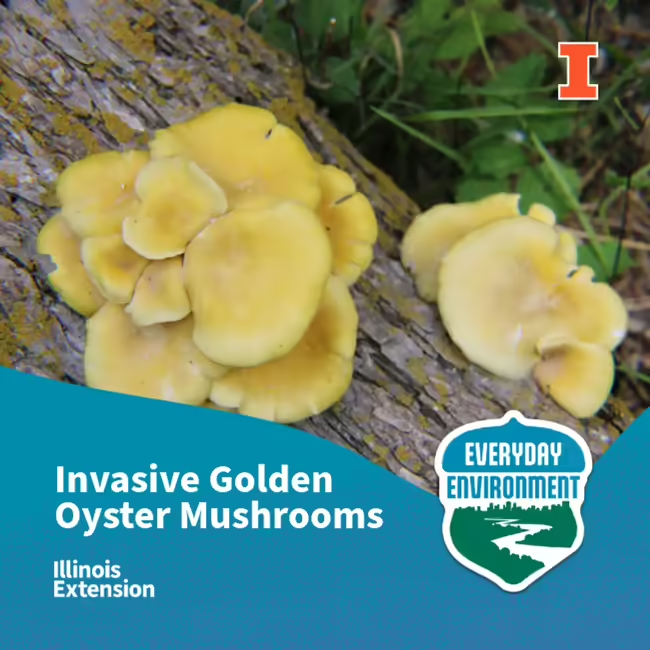
Welcome to another episode of the Everyday Environment Podcast where we explore the environment we see every day. I'm your host Abigail Garofalo.
Amy Lefringhouse: 00:14And I'm your cohost Amy Lefringhouse.
Abigail Garofalo: 00:17And today we are here with Aishwarya Veerabahu, the mycologist and PhD candidate from University of Wisconsin Madison. And she is here to chat about golden oyster mushrooms. Welcome.
Aishwarya Veerabahu: 00:30Thanks so much for having me. It's so nice to talk to you both.
Abigail Garofalo: 00:34Well, really we're really excited. Idea talking about this particular species of mushroom came to us when our team was out on like a continuing education, like in service type of thing. And we were like, I wonder like what other kind of invasives could we talk about? Because we always kind of lean on the plant side of things. Sure.
Abigail Garofalo: 00:56And then we touch on wildlife when we think of it, and then like aquatics sometimes come up. But like the the world of fungus, we don't really explore super often. And then we came across a tree that had like a whole bunch of mushrooms just kinda hanging out on the bottom, and of course, you know, there's a bunch of naturalists around, and we're all like, what is this mushroom? And we found it was golden oyster mushroom, and we were like, So we were like, we gotta find somebody to talk to us about this because, like, an invasive mushroom is, like, really cool, and then, you know, we'll get into it. But, you know, we're just really excited to chat with you.
Abigail Garofalo: 01:29So we wanna hear a little bit about your work at University of Wisconsin and just kinda what led you to study this species.
Aishwarya Veerabahu: 01:37Yeah. Can I ask first, did it smell bad when you guys found that tree and all the mushrooms?
Abigail Garofalo: 01:42I'm trying to remember. And you know what? I really don't remember.
Aishwarya Veerabahu: 01:47You know, you can imagine at this point, I've come upon so many of these trees and logs, and every time it's this distinct, awful, decaying mushroom smell. Yeah. Yeah. So it's always the smell that hits me first. But the way yeah.
Aishwarya Veerabahu: 02:04The way that I got to studying them is I kind of got my start in in the fungal kingdom in the Adirondacks in Upstate New York. I was working there as an environmental educator, and I hadn't really seen or noticed mushrooms much before that. I grew up in Southern California, you know, which is a pretty dry place, not a place you typically associate with mushrooms, though they are there, and you just have to know where to look for them. But so in the Adirondacks, you know, the snow melted, and I started to see mushrooms popping up, and I just fell headfirst into that rabbit hole. And it's Mhmm.
Aishwarya Veerabahu: 02:42You know, turned into an entire career. And so I I knew that I wanted to study really just broadly, like, the biodiversity of fungi. And so I was applying to PhD programs. And when I was talking to Anne Pringle, now my adviser, she brought up this project and said like, okay, so a one way to approach biodiversity is to think of like, what are the things that are threatening it? Right?
Aishwarya Veerabahu: 03:12Like, what are the and invasive species are one of the leading drivers of biodiversity loss. And so the situation here in the Midwest was that a number of amateur mycologists, enthusiasts, and professors in the region here had started to notice this mushroom popping up. And, you know, there's a pretty well established mycological culture here. And so people knew, you know, that have been foraging in the Midwestern States for, like, the past many decades, they were like, Okay, I've seen many morels. I've seen a lot of dry eyed saddle, but this is the first time I'm seeing this yellow oyster popping up.
Aishwarya Veerabahu: 03:52And so it it very quickly became a word-of-mouth thing that then also translated onto biodiversity websites like iNaturalist and Mushroom Observers. And that's when it really started to click, oh, this is an invasive mushroom that is starting to become more abundant and dense in the areas where it's established, and it's also starting to spread in its range, which are kind of right, like the flags that we associate with an invasive species. Mhmm. And then it was kind of like the perfect open ended project for me to ask the kind of different questions I wanted to ask, and so they sticked me onto it and here I am.
Amy Lefringhouse: 04:31And here you are. That's awesome. Side note, I've been to the Adirondacks. I took my kids there couple Christmas breaks ago, and it was just so beautiful. I went in the winter and it felt like I was just in the winter, like a winter snow globe up there.
Amy Lefringhouse: 04:47It was Yeah. Really great. It's magical. I we had zero radio signal and barely cell signal. So we were in the middle of middle of nowhere up there.
Amy Lefringhouse: 05:00So it was great, though. It was great.
Amy Lefringhouse: 05:02So back to mushrooms, back to the golden golden oyster mushrooms. Why don't you tell us what does it look like? Give listeners kind of just a visual description of what is a golden oyster mushroom.
Aishwarya Veerabahu: 05:16Yeah. Well, the first thing you're going to see is that it's growing on dead wood. And so you'll see this kind of Crayola yellow bright bright colored golden or yellow cap, and then they have milky white gills and stems. And, they grow in clusters, so you're you're never going to find like just one of them. And so they grow in these clusters on dead wood like fallen logs or standing dead snags.
Amy Lefringhouse: 05:45Okay. So there's a stem. I don't know the official like
Aishwarya Veerabahu: 05:48It's called a stipe.
Amy Lefringhouse: 05:50A stipe? Okay. And then there's a cap that goes over
Aishwarya Veerabahu: 05:53Yes. The Yeah. There's the stipe, which is in plants, you'd kind of consider it the stem, and then the gills on the underside of the cap, and on the top, the yellow cap.
Amy Lefringhouse: 06:03Okay. Okay.
Aishwarya Veerabahu: 06:04You Guys might actually like this, but I have a I have a group chat with some of my friends here, my my girlfriends that I work in the lab with here, and we're our chat is called women in stipe instead of women in stem.
Amy Lefringhouse: 06:18Love it. Love it.
Abigail Garofalo: 06:22Amazing.
Amy Lefringhouse: 06:24So what so you described what it looks like. So it's this, like, bright color and it's in clumps. It's got the stipe and the cap, the gills in the cap. So what makes it a little bit different than other fungi that we see growing in the woods?
Aishwarya Veerabahu: 06:43I think I think the first thing that you'll notice that's different is just how numerous and abundant you'll you'll find their clusters. Like, that's that's number one the thing that sort of stands out and I think initially gave people this intuition that they were looking at an invasive mushroom. Which is kind of an incredible thing, right, that that we have that instinct as humans. Sometimes when we look at, like, kudzu, right? Like I think someone could look at kudzu in the South and be like, there's something off here, like, why is this absolutely covering everything?
Aishwarya Veerabahu: 07:18And so that that is the thing that really stands out about it, I'd say, compared to other mushrooms, is it's it's really going to be just numerous on the stumps and logs that it's growing on. And and maybe some other things that that are a bit different is, you know, there are other mushrooms that you'll find in the forest, They grow out of the soil. Like I mentioned, this one grows out of wood. Other other mushrooms will grow kind of more, singly, you know. They'll, like, not grow in in prolific clumps like that.
Aishwarya Veerabahu: 07:51And then something else kind of different is even for other wood decay mushrooms that grow on dead wood, like the golden oyster does, they don't always grow high up in the tree, which I've noticed was something kind of like unique about golden oysters is they can really climb their way high up on a tree. There are some like polypores or bracket fungi. You might have seen that they kind of look like a little shelf just like coming off of a tree. Some of those can get high up there too. But that was something we noticed was a little bit different about this guy.
Amy Lefringhouse: 08:23Mhmm. And the smell. You said it has a smell.
Aishwarya Veerabahu: 08:26Yeah. Yeah. It's just I hate the smell. It's just a pungent, awful thing.
Abigail Garofalo: 08:32Well, when we're thinking about these mushrooms, these golden oyster mushrooms, so they're growing high up, they're going in larger clumps, you know, what are what are some other, like, ways that it's interacting with the the its ecosystem, its space that it's it's it's cultivating in or growing?
Aishwarya Veerabahu: 08:51Yeah. Well, the main thing that the study that we recently published, what we found in there was that it is out competing the native fungi that are in those dead wood environments. And and this is a pretty sad and and concerning thing to find because dead wood holds a really diverse beautiful community of fungi that do a lot of different things in those wood. Like they help break down the wood, right, and carry out that process of decomposition, which is a crucial step of the carbon cycle. And there's also a lot of other organisms like birds, squirrels, insects, like a ton of other things in the forest that interact with dead wood.
Aishwarya Veerabahu: 09:41And so, we're concerned that if golden oyster is pushing out the diversity of native fungi, like what does that mean for, like the downstream consequences of these interactions? That would be kind of like a next that's a next step thing to look at. But right now, we found that the wood where we find golden oysters, they're lower in species richness, so they have a lower number of unique different fungi. You know, golden oysters sometimes like one of like just five fungi in there, compared to trees that have not been colonized by golden oysters. They'll have kind of like normal numbers like somewhere between the thirties to a 100 and, you know, 50 or something like that.
Aishwarya Veerabahu: 10:29So so we found it was significantly associated with lower fungal diversity, and also that golden oysters were associated with changed fungal community composition. And what that means is, let's say in a normal healthy dead tree, which I know is kind of an oxymoron, but
Abigail Garofalo: 10:49Hey, dead trees are very important for an ecosystem.
Aishwarya Veerabahu: 10:53They are. Thank you. Thank you. In a normal healthy dead tree, maybe we would have fungi A, B, C, and D, but in a in a dead tree with golden oyster, now it has golden oyster and fungi x, y, z. So the identity of which fungi are in those trees is also
Amy Lefringhouse: 11:13Okay. So the grouping, the associated fungi isn't all it's different. Yeah. It's interacting with different mushrooms that that you would you wouldn't normally see there. That's interesting.
Amy Lefringhouse: 11:29Is the is this research that you're doing fairly new?
Aishwarya Veerabahu: 11:34Yeah. Yeah. Or I mean, we we published it just this past July. So, you know, maybe not the newest thing in the world, but it still feels kind of fresh. And the thing that was very special about this is, so far in in the field of invasive fungi, there we like, the field has shown that there are impacts when a fungus that is associated with a plant or a tree, so a mycorrhizal fungus people might have heard of, that those two together can cause impacts like this.
Aishwarya Veerabahu: 12:12But the field had never really shown that a single mushroom on its own, right, like the golden oyster doesn't mutually associate with any sort of tree partner or plant partner, that this invasive mushroom on its own can can have those kinds of impacts and cause diversity loss.
Abigail Garofalo: 12:33So that's when I'm thinking of like timeline of like this species, right, like where it's coming to kind of head like when were observations from like naturalists, like like foragers, things like that, like when were those starting to pop up versus like so that's why I'm trying to kinda get a timeline of this Yeah.
Aishwarya Veerabahu: 12:54I guess. The the timeline of this is that people started to see it pop up, would say between like 2010 and 2014. So I've I've talked to, a wonderful gentleman named Dave Layton from Iowa, and he said that his club, when they went out on a foray in Iowa, the first time they found it was in 2010. But the first time the like, an observation of a wild growing golden oyster was made in North America was 2014. And so, you know, like, the this is the February is pretty much the the decade that we're looking at.
Aishwarya Veerabahu: 13:33And we suspect that it was probably brought over for cultivation in like the nineteen nineties. I think that was when that movement was kind of starting here. So yeah, it's it is kind of just crazy to to think of the lag time of like how long were maybe these spores or these propagules out there and how quickly did it take. But I think the one thing that we know for sure is from the time that we know it took, you know, like, let's say between 2010 to 2014, and how quickly it spread just like within eight years to where it is now is staggering. It's crazy how quickly it has spread.
Amy Lefringhouse: 14:17Yeah. That doesn't I mean, really, 2010 to 2026 really, I mean, isn't very long for a species.
Aishwarya Veerabahu: 14:26Right. For just a little guy. For for just yeah.
Amy Lefringhouse: 14:29For species, you just that's not a very long time. But we know just from reading some of your work that you do a little bit of like looking at evolution and how things are changing. So in that period of time and just the short time that you've been studying it, are you seeing some changes in these mushrooms? Like are they adapting faster? Are making any changes to establish themselves in all these different places?
Aishwarya Veerabahu: 15:00Well, you guys might have to have me back on the podcast because that is what I'm looking into right now. So I can tell you just like my preliminary thoughts and hypotheses are that in the process of being cultivated, I I do think that some traits have maybe changed in this mushroom. I think that it has possibly evolved to grow faster, to resist a greater range of temperatures, or like maybe you could even say thrive in a greater range of temperatures, and possibly also to have bigger mushroom clusters and maybe more numerous, like, reproductive events, you know. So like like creating a new mushroom cluster, like, multiple times over the course of the growing season. And so the project that I'm doing right now is so cool.
Aishwarya Veerabahu: 15:53And it is also thanks to community scientists out there, which, you know, I really really believe this. My project would not exist without community scientists and citizen scientists at all. Know, their observations on iNaturalist have laid the foundation of us being able to track this invasive species and its spread. And then also with this current project, it's called a population genomics study. So I'm trying to collect samples of golden oyster from all over North America, and I'm also collecting them from the native range in Asia, with some wonderful collaborators that we have there.
Aishwarya Veerabahu: 16:35But here, I'm depending on people, like, just sending me samples from from their state, you know? And so I've had so many incredible people send me these mushrooms in the mail, and I've I've got them from all over, you know, like pretty much as far out as Vermont to Iowa, pretty much, and and all the states in between. So I'm really grateful for that. And with all those samples, I'm going to sequence their DNA and try and see, okay, are there any differences happening here? Have have they been changing on a genetic level?
Aishwarya Veerabahu: 17:11And then that starts to help me answer, are they on different evolutionary trajectories? You know, like, is the native population in Asia kind of its own little thing, you know, and then is this population here in North America, has it kind of been turned into something else through the process of cultivation? Possibly even has it evolved due to the even just the process of invading, you know, like that's an entire new set of selection pressures from the environment. And so so that's that's what I'm going to be looking at. And I'm really excited.
Aishwarya Veerabahu: 17:45I'm in the process of extracting all of the DNA and getting them ready for sequencing now.
Amy Lefringhouse: 17:50Oh my gosh.
Abigail Garofalo: 17:51Really really cool. We were talking with Teresa. She's in Cincinnati, University of Cincinnati. She was talking about the genetics of invasive species. Yeah, it kinda makes me think these like you were saying, those selection pressures, it's not just, you know, the natural environment of that species then.
Abigail Garofalo: 18:09It's also like the cultivated environment is so different. It's not just that there's no other species that eat that animal or anything like that. It's also that maybe we're planting them in more dense populations, which blew my mind at the time. And so, yeah, just like the genetics tell so much about it. So I'm excited.
Abigail Garofalo: 18:28Maybe we'll have to have you back. Maybe we'll do an invasives part two season. Yeah. So Yeah.
Aishwarya Veerabahu: 18:34That would be neat.
Abigail Garofalo: 18:35So we were talking about cultivation of the species. And so when it comes to it, this is a species that, you know, people grow. Right? In their in their can you buy the kit online even? Yeah.
Abigail Garofalo: 18:48Right? Can you yeah. Buy So how much of the success of the golden oyster mushroom comes from human activity, like cultivation or even just like movement of fungi, right, like physically moving and bringing it a place versus how much of it is due to like just natural spread?
Aishwarya Veerabahu: 19:04You know, I think we can never really know the breakdown of, right, of how much of its success was human mediated or or on its own merits, but it's I think the answer is very much both. So, like, the fact that, like you just mentioned, it can be bought and shipped anywhere in the country, and then that, you know, if you're you're kind of giving it a little bit extra propagule pressure, it's propagule pressure meaning like, giving it a the spore load that might exit into the environment or the mycelium, like the raw volume of mycelium or spores that might help it establish in the environment, that itself is increased because of human cultivation. For example, in commercial mushroom farms, the way that they do things, right, is that so they're growing all of their mushrooms, right, in in whatever, indoor setting, but because of all of the spores that the mushrooms drop, they have to vent their facilities pretty much daily. And so imagine the spore load that's that's coming out of there, right? And like that also has to be done so that people that are working in those mushroom spaces can like breathe properly and and, you know, not have their respiratory systems affected by it.
Aishwarya Veerabahu: 20:26But it is an added component to how humans are creating more let me let me think about how best
Abigail Garofalo: 20:36More opportunities for it to reproduce and succeed.
Aishwarya Veerabahu: 20:40Right. Exactly. Yeah. You know, like, activities cultivating it are giving it a higher chance and a higher likelihood of success by, you know, that that many more chances for the spores to establish, that many more chances for these grow kits to get, you know, maybe from a compost pile into the soil or into into the nearby woods. So there's that human side of it, and then on on just the golden oyster biology side, it's got really small spores, which means that it can carry very easily on the wind.
Aishwarya Veerabahu: 21:15Like, I wouldn't doubt that its spores could carry, I don't know, let's let's just say, like, any even around, like, 500 miles, like like, you know, it can really carry on the Woah. Distances. And that, like, spore dispersal does follow kind of a diminishing curve, right, where most of the spores are going to fall within inches, feet, you know, a short distance from the parent mushroom. But there is always the chance that some really small percentage of, like, of the spores can carry and get and get pretty far. And that was something too that, my friend David Harof from New Zealand, he recently graduated with his PhD, and he was looking at oyster mushrooms, in in New Zealand, which it seems like maybe the pink oysters are invasive there and in Australia.
Aishwarya Veerabahu: 22:14And so he was telling me, you know, like, like, we should not discount what this mushroom can accomplish on its own. You know? Like Yeah. So both sides of it. Sure.
Aishwarya Veerabahu: 22:25Yeah. And kind of like I mentioned, also the fact, right, that it can get high up into trees. Oh. That means it can pick up onto wind currents that are up at that level, you know, not there are obviously the ton a ton of golden oysters that you'll see close to the ground, but just the fact that it can also get higher up there.
Abigail Garofalo: 22:44So fungus one zero one, real quick for our because we we typically cover plants and wildlife in this podcast. So let's let's go to a different part of the kingdoms. And so when we're talking about a couple of terms, right, the spores are like the reproductive, like the seeds Yeah. Of the mushroom. Right?
Abigail Garofalo: 23:03Mhmm. Mycelium, can you explain that Yeah. One zero one for us really quick? Yeah.
Aishwarya Veerabahu: 23:07Sure. The mycelium is the main body of the fungus. You can kind of consider this like the tree, you know, like the plant's body itself. And the mushroom, can kind of think of like the flower or the or the fruit. You know, we can't make perfect parallels, but you know, yeah, kind of like the flower or the fruit, the reproductive structure of the plant, and yeah, and then the spores can can go from there.
Amy Lefringhouse: 23:31Cool.
Abigail Garofalo: 23:32Okay. Yeah. I wasn't sure if like mycelium was like a common term people were familiar with, so I wanted That's make sure that we got
Aishwarya Veerabahu: 23:38totally fair. Yes.
Amy Lefringhouse: 23:40And the gold the golden oyster mushrooms themselves, okay, back to kind of like we brought they were brought over. You can buy them as a kit. Like are people buying those as a kit to use for food? Guess I don't know what folks are using them for. That's like question one.
Amy Lefringhouse: 23:59And then like also question two, are folks going out in the woods finding these, grabbing them and bringing them back home and could that be part of it too?
Aishwarya Veerabahu: 24:10Yeah. So the golden oyster mushroom grow kits, you can you can pretty much buy them for the sheer joy of watching a mushroom, you know, and bloom in front of your own eyes. Okay. Which is such a special experience. Like, would never knock anyone for that, you know, like, I've I've used one of these grow kids before too, like before even starting this project, and it is so fun to watch.
Aishwarya Veerabahu: 24:36And then, yes, because this is an edible species, that I think is probably the primary reason most people are going to grow it.
Amy Lefringhouse: 24:45Okay. Yeah.
Aishwarya Veerabahu: 24:46I've kind of grown old of the taste, but I would say I really like to dry the golden oysters out and then kind of like draw the water out of them in the pan, saute them with some oil and garlic, and then put them in tacos. I think that's that's the best way to do it.
Amy Lefringhouse: 25:02Okay. Okay. Okay.
Aishwarya Veerabahu: 25:05Yeah. And then folks are also foraging them from the forest. I would say most you definitely can inadvertently spread a little bit of the spores or maybe parts of the mushroom in the process of foraging it and, you know, like transporting it back. But most people I've seen who are foraging mushrooms are usually doing it in some type of closed container or like, you know, a a basket or something like that.
Abigail Garofalo: 25:34Okay. Yeah. I'm just yeah. I'm just taking a minute because I need a mushroom minute .
Aishwarya Veerabahu: 25:43It's it's a lot. It's a crazy project.
Abigail Garofalo: 25:46Yeah.
Amy Lefringhouse: 25:47There's a lot to learn. It's really neat. I very like, I guess I would call this emerging, you know, kind of an emerging invasive that you're really studying and learning a lot about.
Abigail Garofalo: 25:59Species of great concern.
Amy Lefringhouse: 26:01No. Species of great concern.
Abigail Garofalo: 26:03Yeah. Yes. Yeah. So when it comes to management of this particular species, what are what are options or are there no options for dealing with an invasive mushroom compared to like a plant or an animal?
Aishwarya Veerabahu: 26:17Yeah. In one way, there are no solutions. So once a fungus is in the environment, it is virtually impossible to get it out. So we touched on the biology, the mycelium earlier. And so that mycelium, they're fine thin little threads.
Aishwarya Veerabahu: 26:40You can kind of think of them as like a root system, but they're even thinner than roots that you might find in the soil. And so this mycelial network is spread out through the wood, in the case of the golden oyster. Sometimes even wood decay fungi, they can kind of persist in the soil as well, so it might also be in the soil. And so it is essentially just like integrated into the substrates and the environment that it's growing in. So there's no way to to get it out.
Aishwarya Veerabahu: 27:10You know, with something like, let's say, the the carp, right, invasive carp Mhmm. Like, at least with a fish, its body starts and ends at at the fish's body. But that's not the case for for fungi and mushrooms. Like, it could they they are so those little of the mycelial network are also so fine that they break off and insects eat them and move them around. It would really just be impossible.
Aishwarya Veerabahu: 27:35There there is a pretty like cutting edge field of fungal biocontrols called mycoviruses. They're and they have actually successfully been used in the case of Dutch elm disease, I believe. It's a virus that attacks a fungus, hence the term mycovirus. And and it it potentially, in the future, you know, if it's, like, if it's really worked out, that could be one way that we address invasive fungi in the future. But in the case of something like the oyster mushroom, we would start to ask questions like, well, how specific can it get at targeting only the oyster mushroom and not other native oyster mushroom species that are growing in North America?
Aishwarya Veerabahu: 28:24And not only that, oyster mushrooms are known very much to hybridize in the environment. So, you know, like, our our nice species concept also kind of kind of breaks down because they can reproduce and, and mate across species, and so it would be a very difficult thing. I do tell folks that if they're seeing golden oyster on their property or on some location for the first time, and they're only seeing it on like one log Mhmm. If they're able to, try and try and cut up that log and burn it, or ask the, you know, like a forest official or a park official, like, let them know. So that might be a chance at preventing its further spread, but, you know, you we wouldn't know for sure.
Aishwarya Veerabahu: 29:11And and it would just it would be an attempt. Sure. But that said, the things that I think we can do, like in a really tangible way to prevent its spread, is maybe consider not buying these grow kits. Right? Like, that's that's one huge thing is if we just kind of don't have that introductory material in in a new environment.
Aishwarya Veerabahu: 29:37Like, for me right now, the West Coast is is the big thing that's on my mind. Like, I really, really hope it doesn't establish in, like, the entire Western Half Of North America. And so consider kind of like talking to maybe like local mushroom companies if if you have one that you normally like, you know, buy products from. Be like, hey, I heard that golden oysters are invasive, like, are your guys' like thoughts on that? I think one of the most important things in this invasive management process as a community is to have open conversations and not be approaching anything with blame.
Aishwarya Veerabahu: 30:14You know, because like like there aren't huge profit margins for any farmer anywhere, and that also applies to mushroom farmers, you know. And so for a lot of people, I totally understand this is like a source of income. And for a lot of people, it's like a source of joy. And so, let you know, there's just ways to, like, approach this mindfully. If you're still thinking about growing it, you could try growing it inside in a pretty, like, contained space and discarding the, like, the grow kit or the substrate in the trash, because we don't right?
Aishwarya Veerabahu: 30:47We don't want to compost it and get it back out into the environment. And I think, like, the last thing that's super helpful that started this whole thing is write, like, if you see it, post it to iNaturalist. It is so vital in helping us track how far this thing has gotten.
Amy Lefringhouse: 31:04Speaking of that, how far has it gotten? I was thinking range.
Abigail Garofalo: 31:08I was also going to ask about Yeah.
Amy Lefringhouse: 31:12Are we looking at just the Midwest? Are we looking at Eastern United States right now?
Aishwarya Veerabahu: 31:16We're we're kind of looking at, I'd I'd say Eastern North America. Wow. Like the the edges of it are Colorado, Texas, Alabama, North Carolina, Vermont, and and then the Ontario province of Canada.
Amy Lefringhouse: 31:36Yeah. Okay.
Abigail Garofalo: 31:36Is there an environment that this mushroom does not thrive? Like that we like, would like possibly be the end of its range? Like it's too cold or too hot or whatever?
Aishwarya Veerabahu: 31:47You know, I I would definitely say like, unforested, really dry and arid environments are the are places that I would say for sure it's not going to cross into there because it needs that dead wood to grow on, you know. And so like, two of the main trees that we see it growing on in North America are ash and elm. And what do you know, they've been hit by the emerald ash borer and dutch elm disease. And so like, they're two of the most prominent like dead wood substrates on our landscape. And so I think it it it I will also say though, it has jumped to a lot of other tree hosts.
Aishwarya Veerabahu: 32:25We've also seen it growing on black cherry, maple, red oak, cottonwood, just kind of crazy things. And then probably the craziest one, processed pine planks. You might have noticed that all the rest of all the rest of these that I'd named before were hardwoods, and when it jumped onto the softwood, I was like, oh, god. Yeah. That's why
Abigail Garofalo: 32:50I was like, the two most common is that just because of opportunity. Right? Like, are the most common deadwoods in The United States right now.
Aishwarya Veerabahu: 32:58Yeah. I I don't think that that's a coincidence, but also the fact that it grows on elms in its native range. Like I think in Russia and China, it does grow on elms and chestnuts. So yeah, suffice it to say, it does not seem to be really contained to just a few tree species. It seems to be able to handle quite a few, but it does need a solid deadwood landscape.
Aishwarya Veerabahu: 33:25And so I'm thinking like anywhere anywhere that can kind of support a forest is a place that I would be looking out for. Mhmm.
Abigail Garofalo: 33:33Well, Aishwarya, thank you so much for taking the time to just chat with us about this really, really cool species and just like where it's emerging and all of that. I just like yeah. I I every time I get to explore a new piece of the natural world, I get really like, it's really exciting. So, yeah, we just really appreciate it.
Aishwarya Veerabahu: 33:53I'm so glad. If there is one last thing I could say, if any of your listeners are wondering like, why should I care? For me, the the first way that I really cared and felt like I was losing something to to invasive golden oysters was when I walk through a forest, my favorite thing is to see a bunch of different weird shapes and colors that are the diversity of mushrooms that you'll find in a forest. They're doing so many different beautiful, crazy things in the ecosystem. And even aside from maybe like the ecosystem services they provide, biodiversity anywhere on this beautiful planet deserves to exist just because.
Aishwarya Veerabahu: 34:40And so, you know, that's really why we care. Like, we want the fungal kingdom to to grow and evolve and and have that standing genetic diversity to be able to do that so that we can keep learning about them and loving them.
Abigail Garofalo: 34:53Yeah. I always say we can make the business case for a lot of the things in our natural world. Right? But when I talk to our Master Naturalists across the state, I'm always like, that's not what made you want to be a Master Naturalist was like the business case. Right?
Abigail Garofalo: 35:07Was because you grew up enjoying this particular forest with your family or you like something helped you in, like, a time of need or you just felt like this special connection to it. And it's that's noteworthy and important to think about. So
Aishwarya Veerabahu: 35:22Yeah. Yeah. Absolutely. Yeah. Thank you both so much for having me on. This was super fun.
Amy Lefringhouse: 35:28Yeah. It was fun. Thank you.
Abigail Garofalo: 35:30We're gonna finish today's episode with some appreciation of the natural world that we've all been talking about. So some everyday observation where we highlight the mundane and normal of our environment that is actually really interesting and deserves appreciation. So Amy, we're gonna kick it off with you.
Amy Lefringhouse: 35:46Yes. Okay. So underneath the snow layer I've been learning about the Subnivian, is that right? Wait, hang...
Aishwarya Veerabahu: 35:55It is. I know the Subnivian Zone.
Amy Lefringhouse: 35:57The Subnivian Zone, okay. I didn't even know that there was like words. Sometimes that is how I roll a lot of times is I just see things. I don't really know the terms for everything.
Amy Lefringhouse: 36:09But Subnivian Zone, Okay. So I saw when the snow melted this year for the first time and maybe again I wasn't paying attention, but I was seeing we were walking down to the woods with my students and we were walking through a pasture area, so grass, like grassland area, little tunnels in the grass. So the snow had melted away and then the result was these little trails through the grass where all the little rodents and the little mice and voles and things like that were just like They had made this like network of tunnels under the snow. And I had never seen that before in all my years and I thought that was just really really cool and showed my students and they were like, Oh yeah. And then now I know that it's called the Subnivean zone and it's like that zone between the grass, the soil, the grass, and then the snow that's kind of like insulating that area keeping it warmer than the air temperature.
Amy Lefringhouse: 37:12So like you know it can be very very cold, single digits out there, but underneath that insulating snow layer in the ground it's kind of still like 32 degrees. So anyway to see the result after the snow had melted off was kind of a neat thing. I just kinda walked upon it and I was like, look. There it is. So it's a Nivian zone.
Amy Lefringhouse: 37:31Look it up.
Abigail Garofalo: 37:31That's so cool. I normally see those trails on like Facebook pages of like neighbors being like, how do I get rid of this? Because you know, the people in the the voles and mice in their yards and stuff. And I'm like, I love that you brought it up in like a a a way that's like, it's important and this matters.
Amy Lefringhouse: 37:50I know. I thought it was awesome.
Abigail Garofalo: 37:51Good to hear that.
Amy Lefringhouse: 37:52I know. I thought it was great. Of course, I was I was in a pasture, so, you know, not someone's yard, but still.
Abigail Garofalo: 38:00Next time I'm gonna comment, though, and I'm gonna be like, oh, it's the Subnivian Zone.
Amy Lefringhouse: 38:04There you go. Yeah. Cool. Alright. Aishwarya, it's your turn.
Aishwarya Veerabahu: 38:12Well, recently, here in Madison, we have our winter solstice celebration over by the Olber Gardens. And so we went there, and my friend Megan and I went out on the frozen Lake Monona. And I looked down, and I saw frozen air bubbles Oh. Like trapped underneath the ice. And they they almost look like stacked pebbles on top of each other, you know, of different sizes.
Aishwarya Veerabahu: 38:40And it was so beautiful. I tried it was like the kind of amazement where you pull out your phone and you try and take a picture and you're like, this is failing to capture how cool this is right now.
Aishwarya Veerabahu: 38:51I know. Yeah.
Aishwarya Veerabahu: 38:53So that's what I saw, and I just loved it.
Abigail Garofalo: 38:55Yeah. That's right. That's cool. Mhmm. I feel like I need to, like, look into why, like, the bubbles get trapped, like, in that way.
Abigail Garofalo: 39:03You know? I feel like there's different Yeah. Biology or or, like, you know Yeah. Like, different interactions going on there.
Aishwarya Veerabahu: 39:08Yeah. Right. Happening? Like, what you know, was it a little critter breathing down there? And, like, air like, gas bubbles, you think of them as moving so fast.
Aishwarya Veerabahu: 39:17And so for it to get like trapped in the ice, you know, and and see it and preserve like that little moment in time was so cool.
Amy Lefringhouse: 39:24Yeah. Yeah. Yeah. The phenomenon thinking about the phenomenon behind that, you're like, what? How does that happen? I need somebody to
Abigail Garofalo: 39:32Something that was happening.
Amy Lefringhouse: 39:33Yeah. Yes.
Abigail Garofalo: 39:37Very cool.
Amy Lefringhouse: 39:38Abigail, what about you?
Abigail Garofalo: 39:39So surprisingly, a lot of my observations this season I feel like are about birds. It is, like, late January when we're recording, and I just feel like I'm seeing a lot of fat birds, like really rotund, round birds to the point where I'm like, and I know they're not like the like resources are low, and it's because they're keeping warm. Right? Like, they kind of fluff up their feathers and they look a lot more round than you think they should be. So it also makes identification a little funny because you're like, that's a really round bird.
Abigail Garofalo: 40:09And I saw like a giant like some giant birds in my backyard, and I was like, what are those? And they were mourning doves. They were just like and mourning doves aren't small birds. Right? And you can tell by their behaviors how they hang out and walk because they're in the pigeon family.
Abigail Garofalo: 40:24But I was just like, that's a like, it's really fat pigeon. Like, I was just Yeah.
Amy Lefringhouse: 40:30Is it a pigeon or is it a dove? Because it looked really yeah. Probably.
Abigail Garofalo: 40:34Yeah. Well, and doves and pigeons are the same. Right? Like, they're, like like, they're two different species within like, a rock dove is a pigeon, and then there's the mourning doves. I feel like I shouldn't be talking about this because I'm not a bird person, and none of us in this room are bird people.
Abigail Garofalo: 40:54So we'll check this out later. But, yeah, I'm pretty sure it's like they're both, like, doves. Rock rock doves are pigeons.
Aishwarya Veerabahu: 41:03That's my understanding too. Yeah.
Abigail Garofalo: 41:05Yeah. So Amy's looking it up for us.
Amy Lefringhouse: 41:09I was just looking up if they were larger because we in my when I've seen pigeons flying around my oh, you know, you see them on the overpasses. I see them on the overpasses on the interstate a lot, and they're like large compared to, you know, like a mourning dove. So I guess when I'm looking at them, you're looking of size. Right? Like when you're trying to identify a bird, size is part of it.
Amy Lefringhouse: 41:32Right? So then you're like, wait. Which one is that?
Abigail Garofalo: 41:35Well, and like a mourning dove is a fairly larger bird for a backyard bird. Right? Like, it's like not like a chickadee or like a sparrow or anything like that. But, yeah, it was like almost giving like city pigeon vibes was the size of this mourning dove. I get what you're saying now.
Abigail Garofalo: 41:52I gotcha. But it was it was clearly like a mourning dove, like the way it was, and I heard it. And so but I was just like, what? Big bird. So so that's my every observation.
Abigail Garofalo: 42:02That's cool. This has been another episode of the Everyday Environment Podcast. Check us out next week where we talk with Dr. Maria Lemke about invasive management at the restoration scale. This podcast is University of Illinois Extension production, hosted and edited by Abigail Garofalo, Erin Garrett, and Amy Lefringhouse. Marketing and communications are by Emily Steele. University of Illinois Extension.