Learn more
For more tips on tree care, use resources like Illinois Extension’s Tree Maintenance Schedule, or USDA Forest Service’s Tree Owner’s Manual.
Share your own Everyday Observation
Questions? We'd love to hear from you!
Abigail Garofalo aeg9@illinois.edu, Erin Garrett emedvecz@illinois.edu, Amy Lefringhouse heberlei@illinois.edu
Welcome to another episode of the Everyday Environment Podcast, where we explore the environment we see every day. I'm your host, Amy Lefringhouse.
Erin Garrett: 00:15And I'm your cohost, Erin Garrett.
Amy Lefringhouse: 00:17And today, we are happy to be here with Sarah Vogel. She's one of ours. She's from University of Illinois Extension. She's one of our horticulture educators, and she's here to talk to us about trees. And, you know, this season's all about nature based solutions, and trees can be, you know, part of that conversation, and they do a lot for us in our everyday environments.
Amy Lefringhouse: 00:42So we just wanna say welcome to you, Sarah. Thanks for being here.
Sarah Vogel: 00:46Thank you so much for having me.
Amy Lefringhouse: 00:48Well, first off, this is your first time on our podcast. Let's go ahead and tell the audience just about your Extension work that you do, and especially with trees and tree health. I know you have some big projects that focus on trees.
Sarah Vogel: 01:04Yeah. So as you mentioned, I'm a horticulture educator for Extension. A big part of what I do focuses on tree health, especially trees in urban and community environments. I spend a lot of time helping homeowners and local leaders and our volunteers understand how trees grow and what stresses them out, how to care for them properly over time. Often that looks like digital diagnosis, I guess you could say, trying to diagnose issues that somebody might be seeing in their yard that's affecting their trees, or teaching workshops on tree ID, like how to do proper maintenance or timely maintenance.
Sarah Vogel: 01:46I can write articles, and oftentimes providing that programming, the backside of it is like finding opportunities for myself to learn more so I can stay current on all the relevant stuff. But, yeah, a a big part of that is, like, again, the digital diagnosis, which we always suggest the Plant Clinic, helping people connect what they're seeing on a tree to what is actually happening below the surface or over the past several years.
Erin Garrett: 02:12Sarah, where are you located at in the state? I can't remember where you're where
Sarah Vogel: 02:17I'm in Decatur, so I'm about an hour from campus, hour from Springfield, hour from Bloomington.
Amy Lefringhouse: 02:23Well, I have never heard the term digital diagnosis. Tell me, is that like what we do? Is that what we do as Extension educators, is this digital diagnosis nowadays?
Sarah Vogel: 02:34I mean, to a certain extent. It's kinda hard to diagnose anything without being able to put your eyes on it. Right? And so the whole list of pictures that I'll ask for, I wanna see the tree from far away, you know, so I can see the rest of the landscape maybe or where in the tree that symptom is showing up. I ask for the picture of the base of the tree so I can see if there's any stem girdling roots or, you know, really obvious problems like volcano mulching method, where the branches meet the trunk.
Sarah Vogel: 03:06So I ask for a whole bunch of pictures that are gonna kinda start giving me clues. And what I tell anybody is these symptoms would indicate, but to follow-up with Plant Clinic if it's something that we really think could be detrimental or fatal to the tree. Yeah. I guess that's what it is to me in my mind, but again, it takes backup with science.
Amy Lefringhouse: 03:29Sure. Yeah. Yeah. I just have never heard that term before, and I was like, yeah. That's kind of what it is.
Erin Garrett: 03:35And you're gonna adopt it now.
Amy Lefringhouse: 03:36Yeah. I know. Telehealth. I'm adopting that.
Sarah Vogel: 03:39I like it. Telehealth. Telehealth. Trees. Right.
Amy Lefringhouse: 03:44That's the best.
Sarah Vogel: 03:45Yeah. Copyright patent pending.
Amy Lefringhouse: 03:47Exactly. Exactly.
Erin Garrett: 03:50Well, we have a lot of different things we're gonna talk about with you, Sarah, today, but let's kinda start with the basics. When we talk about healthy trees in our landscapes, can you kind of tell us a little bit about some of the kinda everyday benefits that these trees provide? We know some of the kinda obvious ones. Right? But I feel like there's some hidden ones too.
Erin Garrett: 04:11So can you chat a little bit about the benefits that our trees give us in our landscapes?
Sarah Vogel: 04:16Yeah, absolutely. So there are a lot of benefits that trees provide, things that we experience but don't always connect back to trees, right? Like how shade from a tree can significantly reduce energy costs when we're trying to cool our homes. They can, you know, help manage storm water by slowing down and absorbing rainfall. They help improve air quality.
Sarah Vogel: 04:41They also help buffer noise, you know, if you're between you and the highway, if that's the case. And they really just make outdoor spaces more comfortable. And then there's also a human side to that. Research has shown the effects of trees on people, you know, social, emotional wellness, not only physical wellness, because we're getting out there and recreating and whatever. Some people run.
Sarah Vogel: 05:06I try not to do that unless something's chasing me. But even in that mental space that we feel calmer, we recover from stress more quickly in green environments. In fact, it's been shown that people actually recover in hospitals more quickly if they have a view of green space. I think it's called the biophilia hypothesis, and I don't remember from whom it came.
Amy Lefringhouse: 05:31Is it E. O. Wilson?
Sarah Vogel: 05:32Yeah, E. O. Wilson.
Sarah Vogel: 05:33Yeah, yeah. Yes. That we're connected to nature on a very instinctual level, so even when we're not consciously thinking about, Oh, trees are making my life better. Healthy trees are definitely improving our day to day lives in subtle but very meaningful ways.
Amy Lefringhouse: 05:51I think it's some things that you don't really think about. You don't really connect when you're in those environments. You don't think, Oh, I feel good right now because there's trees around me. But then if you think back, you're like, Wait, the places where I feel really good typically have, you know, trees surrounding me. I also find that with students and young kids.
Amy Lefringhouse: 06:15No offense, Erin, with your prairie grassland ecosystem, which I also love, but when they're in a forest, I guess, if you will, they're in the, you know, in nature or in the woods. They're in nature. So that's that feeling of, like, kind of envelope envelope, you know, kind of like a cocoon of trees. They feel good they feel like they're in nature so
Erin Garrett: 06:39I feel like I notice the absence of trees more like my yard right now doesn't have any mature trees in it because we lost two of our oak trees And I'm thinking now, we used to, like, bike on a bike path in the town where we used to live, and it was, like, through the woods and had tree cover. And now the only, like, bike path is, like, full sun, and it's just, like, so unpleasant because there's no shade. And so for me, I think I I realize it more when the trees aren't there. Right? That, like, what I'm missing. So it's interesting.
Amy Lefringhouse: 07:12Yeah. Good point.
Sarah Vogel: 07:14It might be from that same the biophilia hypothesis, but I remember one of the classes in grad school where the savannah type environment was the most we were evolved to like that the most because it provided a little bit of place to hide from predators and so on, but we could always also or they could hide from us.
Erin Garrett: 07:36Yeah. This sounds familiar. I'm I'm I'm on the same page as you, Sarah. Yeah. Great.
Sarah Vogel: 07:41I'm having flashbacks. Now that I mentioned that thing, like, grad school's coming back.
Amy Lefringhouse: 07:46So we know that trees that are in our cities or our communities usually grow in kind of different types of environments than our trees in a natural forest. We've done a lot of tree inventorying the last couple years. My Master Naturalist volunteers and I, we see a lot of really rough spots, tough spots where trees are growing and sometimes being resilient through very tough conditions, but sometimes not. What are some of the biggest challenges trees face in our neighborhoods and in our communities?
Sarah Vogel: 08:22Like you said, trees in urban environments are growing in conditions that are way different from where they would naturally occur or what conditions they evolved to grow in. In a neighborhood setting, they might have limited space for roots, there might be compacted soil, more exposure to heat and drought because we have that heat island effect from some of our cities. Street trees, city street trees probably take the biggest beating in terms of that. It's hot and dry. They're in little tree wells maybe, so there's restricted root space.
Sarah Vogel: 08:59But on top of that, we don't always choose the right species or the site. Like, sometimes we're a little sentimental about it. You know? Someone that you loved had a cherry tree, but you have a yard that's a swamp, and cherry trees don't like wet feet, and you're probably not gonna be able to grow a cherry tree there. But, you know, we try because we want to.
Sarah Vogel: 09:22That's fantastic. We, you know, sometimes give them a a tough start, but also in urban environments, we're gonna see damage from construction or vehicles, or the routine lawn care, the mower deck disease as we like to call it, where the deck of the mower is cutting right into the cambium layer of that tree, which interrupts the vascular flow of moisture and nutrients. Right? So it's really damaging. So again, if it's not suited to the site, if it's maybe planted a little too deeply, which is a really common problem, that stress follows the tree for the rest of its life.
Sarah Vogel: 10:02And trees can take years to show symptoms of all these kind of small compounding stressors. And when I say urban urban environment, like, that doesn't always necessarily mean, again, like the city streets of Chicago. I mean, our parks and our yards and those green spaces that connect together to kind of form our, what we call the urban forest.
Erin Garrett: 10:25You know, you kind of hinted at it already, Sarah, that we plant a lot of trees in our landscapes or we move into homes and we inherit trees that were already there, and we might really be into nature and like to figure out what's going on with our tree. We might be like, oh my gosh, there's all these trees in our yard. What do I do with it? I know Amy can attest to this too. We get a lot of questions.
Erin Garrett: 10:51You said already, what's wrong with my tree? We get those all the time. I love to forward them over to mister Chris Evans because he's right next to me, and he gets to answer a lot of those tree questions. But it's often it's really complicated, right? So can you talk a little bit about why someone just saying, I noticed this thing, can you tell me what's wrong with my tree? Is not really an easy question to answer.
Sarah Vogel: 11:13Yeah, so you're exactly right. We get that question a lot, but the answer is not always simple because trees are these great big elements that make a huge impact just visually. You even mentioned you noticed the lack of trees. Well, if there was one that looked really haggard, you know, hanging out, you'd probably notice that too and be like, oh. You know?
Sarah Vogel: 11:35But they they're woody perennials, so they, you know, don't reset their foliage each year like herbaceous perennial plants. They have they remain above ground, and they remain there for many, many years, so these stressors kind of build up over time. By the time somebody notices a problem like leaf discoloration or branch dieback, that's often just the visible symptom of a much longer story. Right? So it's the combination of factors like site conditions, like maybe we've had five years of drought in a row, hypothetically, not here, and then what past care and management practices have been done because honestly, a lot of the times we're one of the biggest culprits in the decline of tree health.
Sarah Vogel: 12:21But it's all these things that kind of come together that are make it a more complicated issue. So when somebody sends me the pictures, all those pictures that I ask for, because I'm sure that you all can attest, I don't I'm not able to make it to every site for a tree inquiry, but I will ask things like, has there been nearby construction? Do you put a lot of fertilizer on your lawn? Because trees have roots that are in the top foot of soil, so they're absorbing anything else you do to your lawn. What are some other things?
Sarah Vogel: 12:54Are there utilities or structures nearby? Things like that. So you kind of want to get the not only the visual, but the historic, the past on the tree. As I mentioned before, I like to tell people, think of these symptoms as clues, not conclusions. Right?
Sarah Vogel: 13:10So it's easy to focus on what is most visible, like an insect or the spots on a leaf, but those things are often secondary. I think I had included a picture of a maple leaf with maple bladder gall on the leaf, and that was the symptom that a client sent in. But once I had him send all those pictures and kind of asked what had happened when they were planted and so on, we saw a much different story. They had been planted so deeply that they looked like telephone poles going into the ground, which is going to really stress a tree because the bark around the trunk is not the same tissue as what's on the roots. That's not where it's meant to be, so that can really damage a tree.
Sarah Vogel: 13:59This whole line of maple trees this person had planted had planted by a company, unfortunately, were all just telephone poles, and they were all showing early fall color. But that's the symptom that he notices, these little red dots, which are not too damaging. They're mostly cosmetic from what I understand. So, yeah, so when their trees go through what we call the decline spiral, and so they're first maybe weakened by that environmental stress, and then pests and disease and things move in later. So instead of stopping at the symptom you first see, it's really helpful to ask what might have stressed this tree up until right now.
Sarah Vogel: 14:44Mhmm. Think about that history on it.
Erin Garrett: 14:48Yeah. That's interesting. It makes me think about once I started getting into the Extension realm of things and, you know, helping with, like, Master Gardener training, and then I'm going through it while everyone else is going through it and going through the tree lesson, you know, year after year after year. I've been here a while now. You notice things.
Erin Garrett: 15:06So I went home one year to my parents' house, and I was like, wow. Our front tree, our front maple tree, that's always been the best on the block, the most beautiful, the best form. I'm like, it has some gnarly girdling roots. And I was like, it's only a matter of time before that probably contributes to its eventual decline. And that coupled with some pretty intensive pruning by the power company, it's now on its decline.
Erin Garrett: 15:34And I was like, it was only a it was a matter of time, unfortunately. But when I saw that, I was like, oh, that's bad news. Now I know what that is, right, with those with those girdling roots. And yeah. But if you only see one piece of it, it is hard. Yeah. It's hard too if you don't know the history of a site. Right? They've lived there forty years, so they've been there, like, for most of the portion of that tree's life. Right? If you don't have that background information, it is hard to like figure out what's going on.
Amy Lefringhouse: 16:02Kind of goes back to your, Sarah, your digital diagnosis, you know, like doctors diagnosing us as people, and all of us people are different. We all respond to different things that's going on in our bodies. I feel like trees are the same way because trees respond differently. You might be able to plant this tree too deep and it might find a way, right? It might find a way to figure it out and survive and be successful, and then this other one over here is like, you know, maybe there could have been some historical part of its life where maybe transplanting and things like that might have happened, so it just doesn't quite make it.
Amy Lefringhouse: 16:45So I think that's what's sometimes difficult for me and homeowners probably to diagnose some of those things. It's like, gosh, you just don't, you know, this tree is not going to respond the same as this tree, and they might be like receiving the same salt from the road, receiving the same, you know, like neighboring, like spray from a neighboring agricultural field or something, but one responds one way, this one responds another way. So sometimes I think, you know, looking for all of those clues, you just have to kind of put all of that together before you're like, Oh, this is how I want to approach the treatment, I guess, or how I'm going go forward with this tree.
Sarah Vogel: 17:24Yeah. And even when it is just one thing that's killing the tree, I like to use emerald ash borer as an example. Like, if you you see that eighth inch d shaped hole or maybe bark is peeling off or it's, you know, dying back, epicormic sprouting, all that stuff. Yep. Found the bug, everything.
Sarah Vogel: 17:44Even those go after the stressed trees first.
Amy Lefringhouse: 17:47Right. Right.
Sarah Vogel: 17:49And what they showed is like, yes, they might take them all out. Not quite all in my area anyways. I understand it's still EAB's still getting to the south in some places. But even they went after the trees that were already unhealthy from those years of history. Exactly.
Amy Lefringhouse: 18:05Right. Good point. And that's kind of especially in your blog, you're talking about how do we keep our trees healthy, right, so that they can put up the best fight for all of the things going on in its environment, you know, the abiotic things, the biotic things, the living and non living things that are happening. So if homeowners want to go outside and evaluate the health of their trees in their yard, this could be like those that are showing signs, but even also those that are not quite showing anything right now. Maybe they look like a healthy tree.
Amy Lefringhouse: 18:36What are some simple things that they should do when they're out there evaluating their trees?
Sarah Vogel: 18:42Yeah. So one of the first things is certainly take into account that history, that we were just talking about. Like consider what those kind of extraneous factors are. Look at where the symptoms appear in the canopy. Are there patterns across the landscape?
Sarah Vogel: 18:58If it was something like herbicide injury, it would probably show up all on one side, possibly. It was a drift issue. How quickly did systems develop? You would be amazed at how many people have a picture of the past tree, maybe so and so's ninth birthday party, and they're like, oh, well, this was just three years ago, and it kinda starts to establish this timeline. Think about when putting in your deck or your patio, building a a garage or other structure nearby.
Sarah Vogel: 19:26I often hear, well, I didn't hit any main roots, and that's all well and good. But, again, sometimes there's this preconception or misconception that trees look like underground exactly what they look like, above ground. Maybe it's our colleague Ryan, somebody had pointed out in someone's work where they compared a tree more like to a wine glass. We've got this canopy, but most of the roots, again, are concentrated in that top six to 18 inches of soil. Not only that, I think something like 96% of a tree's roots are less than a half inch in diameter.
Sarah Vogel: 20:07These small fibrous absorbing roots are really the ones we wanna keep, and they're the ones that dry out first. They're the ones that are gonna get damaged by, you know, construction or whatever else. So think about that. Think about what maintenance has been performed. So that's the history. That's one thing. One, several things to take into account.
Amy Lefringhouse: 20:29One group.
Sarah Vogel: 20:30But then that kind of yeah. The visual inspection, that's the last thing I want to see is the most obvious thing. Right? It's like, here's what somebody sent me a picture of. I'm like, okay.
Sarah Vogel: 20:40Well, tell me all this background first. First, you want to be able to identify the tree because that's going to clue you in to narrow down what it could be if it was a pest or disease. And if you know what characteristics are normal for that species, you won't necessarily be surprised by some things. So identify it, look at the roots. Is it buried too deeply or do you see that root flare?
Sarah Vogel: 21:03Are there any stem girdling roots? Has there been damage? Then look at the trunk and branches. Has there been any damage to the trunk? Have the you know, is it missing, you know, half of the tree?
Sarah Vogel: 21:14Has it been shaded out on one side? Things things like that. Sometimes you'll find, like, infestations of bugs in certain places, like where larger branches meet the tree, kind of in that branch union, and then look at the foliage. That's often what most people notice first. That's often what most people how most people identify a tree, right off the bat, I guess with some exceptions.
Sarah Vogel: 21:38When you're looking at the foliage, is it wilted? Is it discolored? Is it smaller than normal? Are there spots and holes and bumps? I have to clarify now when I ask for more information.
Sarah Vogel: 21:50Insect infestations infestations because someone will just send a pic of, like, one ant. Okay? So I got those too, but I don't know that they're killing my tree. Mhmm. So insect infestation.
Sarah Vogel: 22:05But yeah. So identify the tree, look at the roots, trunk and branches, look at the foliage, you know, the leaves, and then kind of consider those other factors. That helps give if you kind of keep it in a system like that, you kind of checklist things off there.
Erin Garrett: 22:21In your experience getting all of these tree inquiries, what is the outcome the majority of the time? Is it like, what do what is the recommendation for people? Is it like, oh, yeah. It's this pest, and it's not really a problem. Like, the tree can handle it. It's okay.
Erin Garrett: 22:37Or, like, this is bad. Your tree needs to get cut down. Like, I'm just curious because I think a lot of the times, we get really concerned. We see something like webworms or something in a tree, and we're like, oh, no.
Erin Garrett: 22:47It's terrible. It's gonna defoliate. Or we see, like, anthracnose in a sycamore, and it's like, that's just what sycamores do. Yeah. So I'm just kinda curious, like, what the balance of, yeah, this is just what trees do, and it's part of the balance of nature versus, like, we need to intervene.
Sarah Vogel: 23:02Yeah. Well, the anthracnose thing. Exactly right. Every year, I'm gonna have calls in for us here in June or even late May. Why does my tree look like all the leaves are torched?
Sarah Vogel: 23:13You know? And it's like, well, I reserve some canned answers that are like, here's why volcano mulching is bad. Here is some a little blurb about anthracnose because those are really common questions. Right? And we see that pattern of questions coming in.
Sarah Vogel: 23:27But otherwise, it really just depends. I usually start out by saying there could be lots of other things at play here, but the things I see from these photos are then point out some things. If I point out things that may be homeowner error or tree caretaker error, Mhmm. It's a fifty fifty on whether they're gonna say thank you or the opposite of that. I'm like, well, you're you know, if you're cutting your, you know, deciduous trees, if you're pruning in July, not a great time or, you know, in late fall or something.
Sarah Vogel: 24:07Here's an info sheet to back it up. But yeah. I mean, it really just depends. I suggested, oh gosh. These people built a beautiful house, and then a few years later, a wonderful like a great big machine shed maintenance garage thing, and they built it specifically around this tree because they wanted to have the tree.
Sarah Vogel: 24:26But then it had restricted root space. It had gravel that was probably changing the pH of the soil slightly. It was getting compacted, and so there are lots of things going on. I'm like, it might continue to decline because of these factors, but here are some things you can do, like aerate, fertilize, and so on. And here's, you know, some other resources.
Sarah Vogel: 24:47However it went down, I don't think that they were super happy about it, but I'm just here to present the information. You can decide what to do with it.
Erin Garrett: 24:55Yeah. And sometimes it's you know, we don't realize how embedded, I guess, in the full environment our trees are. Like, we've talked about today and that, like, how the choices that we make will impact it, and then we do things, and then we're like, uh-oh. That was bad. But, like, but I wanna save my tree.
Erin Garrett: 25:12So, yeah, it is definitely difficult to kinda balance balance all of that. But
Sarah Vogel: 25:17Yeah. Yeah. I mean, ultimately, just like anything else, I can show you or tell you or demonstrate it, but it's your decision on how you're going to use that information. That's something I have to make my peace with when I want to go, no, don't do that. That's the wrong way.
Sarah Vogel: 25:34But that's okay. We just all do things differently. We're just out here providing information.
Amy Lefringhouse: 25:40Right. Well, sometimes you realize, oh no, I made a mistake. What's the easy fix? Can I fix it? Can I fix my mistake?
Amy Lefringhouse: 25:47Sometimes, unfortunately, there's not an easy fix for some of the damage that we might do or even like, you know, wildlife damage, deer damage. I've seen that a lot, you know, in out in rural areas, and sometimes there's just like not an easy fix and that's such a bummer, but goes back to some of those maybe proactive things that homeowners can do to work with our trees and try not to work against our trees. So do you want to talk about some of those proactive things that homeowners could do? Know we talked about diagnosing our tree and taking a look at our tree, how we can approach that, but what can we do proactively to work with that tree in our yard?
Sarah Vogel: 26:32The biggest impact in free health comes from doing the basics really well. Okay? It's not any like, it's not a big science. I mean, it can be a science experiment if you're into that sort of thing, but, I mean, there's established standards for a reason. So you wanna start with the right tree in the right place.
Sarah Vogel: 26:49So if you're planting a tree, make sure that you're planting one that is suited to those conditions. Make sure it's planted correctly, not too deeply, that you're giving it adequate aftercare, whether that's water or pruning after a couple years or whatever. Know when to do things. Timing matters, and we have a really good resource, the tree maintenance schedule, that people can use too. Beyond that, you want to protect your trees from physical damage, avoid compacting the soil around it.
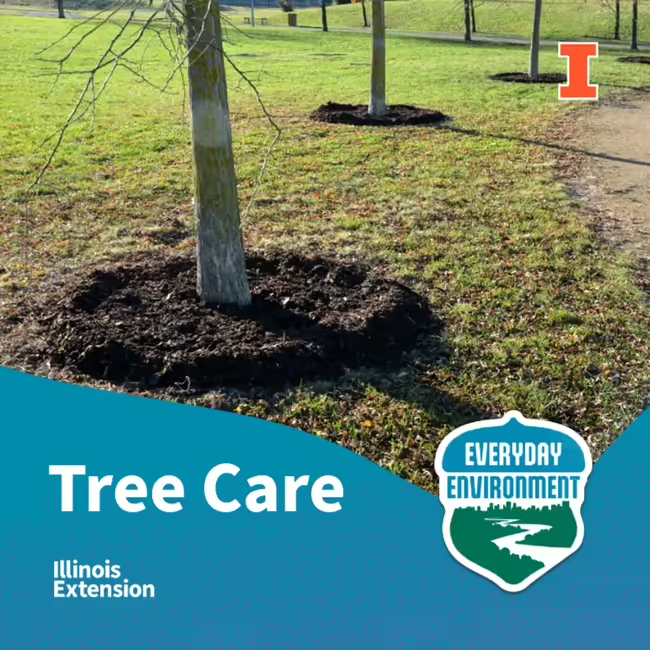
Sarah Vogel: 27:19We suggest a mulch ring that looks like a bagel or doughnut, not a muffin. Healthy roots are the foundation, so really reducing stress early on the roots helps trees to stay more resilient long term. But, yeah, just giving it basic care and knowing when to provide those maintenance practices and how to provide those maintenance, whatever method you employ.
Amy Lefringhouse: 27:44I have a volunteer that he he kind of comes from a family of landscaping business, and he always says, Dig a $1,000 hole for your $100 tree. That's with the whole tree plant proper tree planting part of things. He always says, Dig that $1,000 hole for that $100 tree. Do a lot of work right there in the beginning when you're planting, and then your life will be better later. The tree's life will be better later.
Sarah Vogel: 28:12Yeah. That's like the measure twice, cut once. Yeah. It right the first time, and you won't be coming back here.
Amy Lefringhouse: 28:21Well, we really appreciate you being here today, Sarah, and teaching us a little bit about how to take a look at our trees, how to work with our trees in our yards. And like every episode, today we're going to finish our episode with our everyday observation, where we highlight the mundane and normal of our environment that is actually really interesting. So Sarah, do you want to share your everyday observation with us?
Sarah Vogel: 28:48Absolutely. Yeah. I had a couple to share. First of all, this is the first year that I've seen my shooting star bloom in my yard. It's been about three years, I think, I planted it, and so this year I was so excited to see it pop up in bloom.
Sarah Vogel: 29:05Something else I saw when I was out kayaking on Lake Decatur, there are some floating wetlands that have been installed by some U of I students and or the Natural History Survey. So that was really cool. I was just really excited about my shooting star on a personal level, then on a community minded, we're making a difference on that side. The wetlands are just really cool, something really cool to have in our community.
Erin Garrett: 29:33Definitely. I'm in year three of my native gardens. It's all really exciting now, so I understand year three is magical, when you add those plants in. And then we are gonna be lucky enough to have the floating wetland people on the pod later this season, so we'll get to learn more about that project. So Sarah's setting us up early in the season, and we'll get more information about it in a few weeks.
Erin Garrett: 29:56So that's awesome.
Amy Lefringhouse: 29:57Erin, would you like to share your everyday observation this week? Sure.
Erin Garrett: 30:02I had quite a few different tree related ones, and so I was like, which one am I gonna share on this episode?
Amy Lefringhouse: 30:08Yeah.
Erin Garrett: 30:08But I'm gonna talk about my Cherokee plum because I got this I was looking back. It had to have been spring of twenty twenty four. We had some extra trees that Soil and Water was giving away to kiddos. They had some extra ones, and I got it was a pretty big, like, bare root tree. Like, usually, they're kinda small. Right?
Amy Lefringhouse: 30:32Yeah.
Erin Garrett: 30:32This one was, like, huge. So maybe, like, the diameter of my thumb Okay. I'm gonna say. Okay? So I planted it in my yard and it started growing and it grew and it grew and it grew and I kind of couldn't believe how big and how fast it was growing.
Erin Garrett: 30:51So fast forward this spring, we're two years into it. Yeah. It is I'm gonna say nine feet tall at this point, feet wide, it flowered for the first time and it was absolutely covered like imagine callery pear flowers, but on a native plant and beautiful. It was stunning. It was covered in pollinators this spring.
Erin Garrett: 31:16And I yesterday, I went out there, and I was looking at it. I'm like, this thing is huge. And I tried to fit my hand around the base of the trunk, and I my fingers didn't touch. Really? So in two years, it is it is, like, exploding.
Amy Lefringhouse: 31:31Holy moly.
Erin Garrett: 31:32I cannot handle it. Did I plant it in the right place? No.
Amy Lefringhouse: 31:38I was wondering that.
Erin Garrett: 31:40It's too close to the fence. I need to do some pruning when it's time to prune, which is not when we're recording in the middle of the summer. But I'm paying attention to it, and I'm like, wow. I was not expecting you to do that. But it's been really fun just to see because sometimes I mean, I don't know how many little twigs I've planted, and they don't.
Erin Garrett: 32:00Yeah. Nothing happens. Nothing happens, or it's so slow. And to so to see this growth, I was like, wow. That's, like, amazing. So we'll see we'll see how this ends up playing out.
Erin Garrett: 32:14But it's been it's just been really fun to enjoy it. You know? Over the years, if something happens and it really becomes a problem, it was free, and it provided these services for however many years it can stay.
Amy Lefringhouse: 32:26That's true.
Erin Garrett: 32:26I'm gonna try and make it work and keep it, so we'll we'll see how it goes. But I yeah. I can't believe it. It's it's crazy.
Amy Lefringhouse: 32:35That's awesome. I think that's funny because I'm thinking of that's why demonstration gardens are so great because I planted a couple black chokeberries. I guess they're last year, I guess. This is year well, one full year now. Mhmm.
Amy Lefringhouse: 32:50But I went to a garden the other day in another town, and I was like, oh, this is a black chokeberry? Oh my goodness. Look how humongous it is. So one day I might have to adjust fire my pollinator plants and my, you know, forbs around it, might have to change it up a little bit, but I think that's, you know, what's kind of cool about native gardening for me is just like, okay, I'm planting this stuff now. It's gonna grow and spread and change over time because everything's going to light is gonna change, you know, root competition's gonna change.
Amy Lefringhouse: 33:27So anyway, yeah. But demonstration gardens, that's good. They're good to To see what they're gonna be.
Erin Garrett: 33:35It's important to know your soil conditions. We've talked about this on the podcast before. Everything grows huge in my garden, and I know that now. So, like, things that I plant, I can expect it to get at least, like, herbaceous wise, at least two feet taller.
Erin Garrett: 33:51Now I know woody species, like, huge. So I have to kinda keep that in mind when I'm placing certain things that, like, expect it to get huge and out of control. So, like, yeah, you can see it in a demonstration garden, but then, like, knowing your soil conditions too, like, it might be smaller. It might be bigger. It might just be a surprise.
Erin Garrett: 34:11I mean, I think it's fun, but, yeah, good point for sure.
Amy Lefringhouse: 34:15Yeah. For sure. For sure. I'm gonna share a tree related one as well. Last fall, I can't remember when I saw this, but last fall I saw the underneath an oak leaf, it was an oak tree, I'm looking under the leaf, and I see these like red, what look like berries, you know, on the mid rib of this oak leaf.
Amy Lefringhouse: 34:42I turn it over and I'm like, oh gosh, these aren't berries, I know they're not berries, but they must be some kind of gall. And if you got if, you know, our audience has ever listened to anything about oak galls, there's a million different types of oak galls, and but these look like little tiny red berries on the on the underside of an oak leaf. And I looked them up, of course, because I wanna know what they are, but they were called clustered oak midrib gall, which again, very good namers of the galls. Right? It was definitely right midrib, right in the middle.
Amy Lefringhouse: 35:16These are one of these, you know, observations where go look it up. Look at what look up what I'm I'm talking about. But those are always the galls are always fun to point out to kids, well, to anybody, really, because they're just so weird, and they're just so different, and all of them look funky. So that was my cool everyday observation. It was a clustered oak mid rib gall.
Amy Lefringhouse: 35:39Fun times.
Erin Garrett: 35:40Sweet. I'm here for it. I love galls. They're so funky.
Amy Lefringhouse: 35:45They are funky. All different colors. You never know what kind of color, size, the shape. They're all weird, but cool. Awesome.
Abigail Garofalo: 35:56Well, thank you everyone for sharing your everyday observation. This has been another wonderful episode on the Everyday Environment Podcast. Check us out next week where we talk with Chris Enroth. He's gonna talk to us about solving lawn problems using an ecological mindset. This podcast is University of Illinois Extension hosted and edited by Abigail Garofalo, Erin Garrett, and Amy Lefringhouse.
Matt Wiley: 36:21Marketing and communications are by Emily Steele. University of Illinois Extension.